IceProbe Thermoelectric Aquarium Chiller - Nova Tec DIY

  • Thread starter Thread starter jonny
  • Start date Start date
  • Tagged users Tagged users None

jonny

Active Member
View Badges
Joined
Mar 29, 2013
Messages
378
Reaction score
13
Location
Chanute,KS
Rating - 0%
0   0   0
IceProbe Thermoelectric Aquarium Chiller - Nova Tec - Bulk Reef Supply

Anyone else see this thing and think "Holy crap, I could make that..why didn't I think of this?"

But honestly..most tinkerers and or computer people will have AT LEAST one spare old heat sink sitting around, and the termo-electric modules can be had for pretty cheap..the hardest part I can think of is getting the water routed to/by the heat sink without leaks. Anybody ever made something similar to this DIY, or have any ideas on how to make a reliable version at home?

Thoughts? Concerns? Build logs?
 
Actually looking at it closer (and maybe paying more attention to the name lol) this is actually a probe...it just sits in the water...I think I may just have to try and make one of these up..I wonder what their probe material is made of that it doesn't rust or corrode..
 
Ahhh..that would explain why the price is where it is...titanium is expensive...I wonder if you could do a steel/aluminum/copper pipe in several coats of plasti dip. I don't think it would be as effective since it would act as an insulator...but when you could make 5 of these for the price of one of those (considering you had the heat sinks on hand), it seems like you could afford to have slightly less efficiency.
 
Oh nice! I would never have considered checking ebay for titanium haha...looking at that, you could make 2 of these around the price of 1 store bought if you needed to buy absolutely everything...Very roughly $80 each if you buy the titanium rod and cut it in half..

NOW...I have ZERO disposable income right now..and I'm not sure when I will...so someone pick up this idea, and post back here with results haha


I claim no responsibility if someone tries this, and fails, gets hurt, dies, kills fish, or can't convince their significant other into doing this. lol

So lets see..
Here is the module: Peltier Thermo-Electric Cooling Module 6 Amp | 320-253
Here is the titanium rod/probe: 6AL 4V Eli Titanium Round Rod 1 1 4" Diameter x 12" Long | eBay
Here is the heatsink/fan assuming you don't have one laying around Foxconn CPU Cooler for Socket 370 and AMD Socket A Up to XP 1800 | eBay
Here is a power adapter that I "think" will work New DC 12V 1A 2A 3A 5A 6A Power Supply Adapter Switch Switching 5 5 2 1mm | eBay
Here is thermal adhesive: Arctic Silver Aata 5g Arctic Alumina 5g Thermal Adhesive Epoxy Set | eBay
 
Good question haha..I guess I assumed you could cut it very slowly with a band saw or something like that. I wonder if you could get cut to order pieces for similar pricing..surely we have some metal workers here...where are they? Lol
 
A chop saw would probably be best. You can trash a miter saw with just 2" square steel tube.
 
A couple notes.

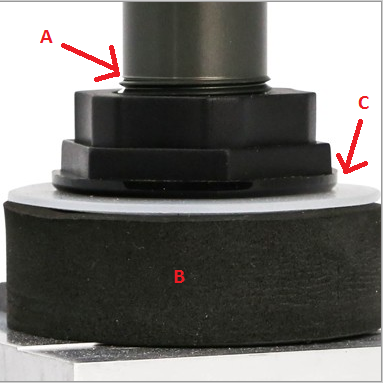
A) - The titanium is somehow mounted to an upside down bulk head. If you look closely the grey plastic color seems to be a shrink wrap around the titanium. Notice how the thread on the bulkhead is slightly covered in it as well. The cooling module will need to be in direct contact with the titanium. Which means that the titanium will need to go through the bulkhead to reach the module, while somehow being sealed from water.
B) - What is this? Some sort of riser?
C) - Hard surface for bulkhead's gasket to seal against.


chillerprobe_zps4208e01d.png
 
the only purpose of the bulkhead is to mount it through the glass waterproof and easily. its most likely just a titanium rod connected to a heatsync.. both being highly conductive the air from the fan chills the heatsync, the titanium touching the chilled heatsync gets cold too and then chills the water touching the rod...

the only really tricky part here is getting it to go into a tank.. honestly if you get a fan pointed directly on the rod and had the other half of the rod in your tank it would be a slightly less efficient method of re-creating this
 
Upon closer inspection, it seams they have used a threaded piece of titanium.


Yeah, I was actually thinking about this..for MY application, I just have a HOB fuge, and I could make a bracket that allows the rod to be mostly in the water without the need of cutting and using a bulkhead.


the only purpose of the bulkhead is to mount it through the glass waterproof and easily. its most likely just a titanium rod connected to a heatsync.. both being highly conductive the air from the fan chills the heatsync, the titanium touching the chilled heatsync gets cold too and then chills the water touching the rod...

the only really tricky part here is getting it to go into a tank.. honestly if you get a fan pointed directly on the rod and had the other half of the rod in your tank it would be a slightly less efficient method of re-creating this

These actually have a thermo electric module in between the heat sink and titanium rod. One side gets really cold -- the side with the titanium, and one side gets really hot -- the side with the heat sink. It's a little wafer that's maybe a cm thick, so it fits in something like this pretty easily.
 
Upon closer inspection, it seams they have used a threaded piece of titanium.


I was actually wondering if you could silicon the bulkhead without leaks? Alternatively I know you can get titanium rod that is all threaded..that might not look as good, but considering these units normally go in the sump, it probably wouldn't matter too much.
 

TOP 10 Trending Threads

WHICH KIND OF INVERT HAS CAUSED THE MOST MISCHIEF IN YOUR TANK?

  • Sea urchins

    Votes: 18 25.0%
  • Hermit crabs

    Votes: 12 16.7%
  • Other crabs

    Votes: 5 6.9%
  • Shrimp

    Votes: 6 8.3%
  • Snails or conchs

    Votes: 3 4.2%
  • Sea stars

    Votes: 0 0.0%
  • Anemones

    Votes: 12 16.7%
  • None! My inverts are model citizens. :-)

    Votes: 12 16.7%
  • Something else (tell us in the comments)

    Votes: 4 5.6%
Back
Top
Home
Post thread…
Market
What's new