Apex Salinity Probe Heater Interaction / Curiosity

  • Thread starter Thread starter Morpheosz
  • Start date Start date
  • Tagged users Tagged users None

Morpheosz

Active Member
View Badges
Joined
Apr 8, 2021
Messages
342
Reaction score
212
Location
Minneapolis
Rating - 0%
0   0   0
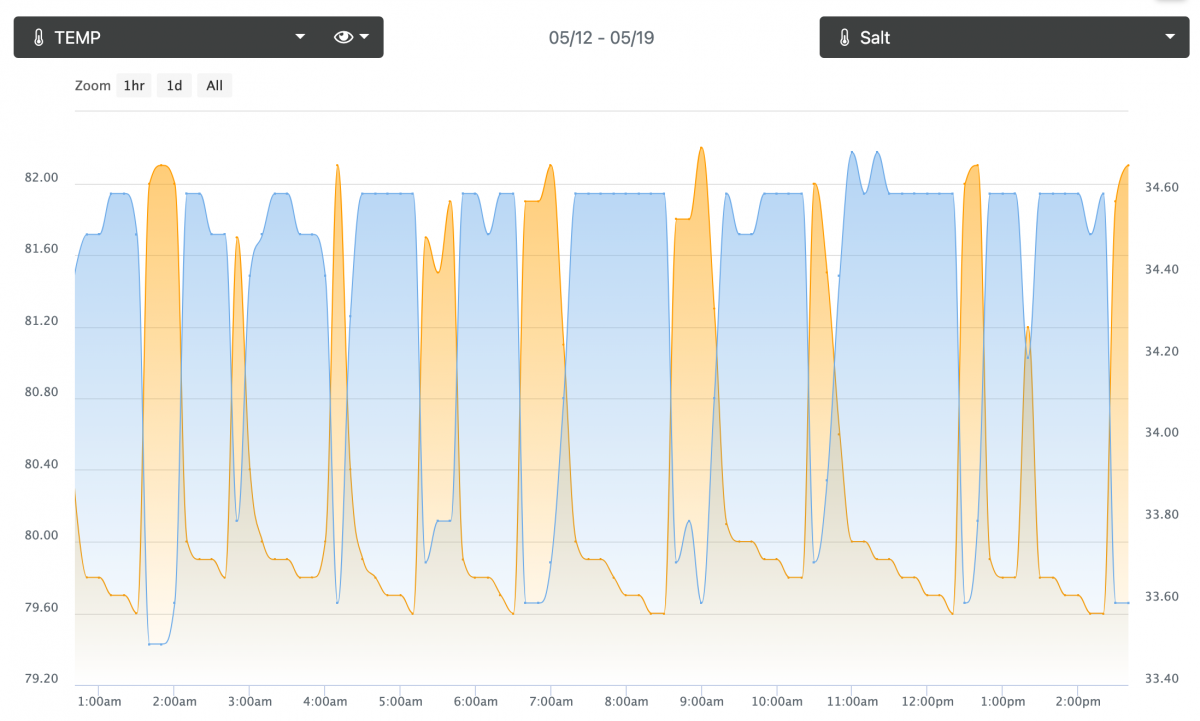
I've noticed that my salt reading jumps up and down by approx 1ppt regularly on my Apex. It dawned on me that my temperature does that as well, from the heater going on and off so I used the overlay feature for the first time in the Apex graphing interface and found this very tight connection between my heater and salinity reading. It seems that when my heater is on, the salinity reading drops, and vice versa. I am using a Finnex Titanium heater if that matters, since it is metal.

Curious if others experience this as well and if it's a concern - e.g. is there stray voltage in the tank that could be a problem?
1652989540446.png
 
Have you enabled the TC feature on your salinity probe? (under the advanced tab) That helps stabilize the salinity reading. When enabled you have to recalibrate. I use a value of 2.1.
Hey thanks for pointing that out, I don't recall setting it, but it is set to 2.2%. Maybe this is simply temp shift, but I suspect maybe not because my heater is a compartment downstream in my sump from this probe and I imagine the change in temp would be more gradual and this seems very pronounced?
 
I was directed here -

 
I was directed here -

I do wonder if I'm experiencing a different phenomenon. Both because my TC is already set to 2.2% and because that post shows a positive correlation between temp and salinity and my readings are showing an immediate inverse relationship between temp and salinity. That's why I hypothesize that it has more to do with interference with respect to the conductivity vs temp change. It doesn't seem feasible that when my heater goes on, down stream from the salinity probe, mixes slightly warmer water into the 75 gallons of the DT, and then comes back down into the sump and meets the salinity probe, that it would have that pronounced and immediate of a reaction. The temp probe is right above the heaters so it reacts quickly to the heat coming on but the salinity is as far downstream as it gets.
 
The temp probe is right above the heaters so it reacts quickly to the heat coming on but the salinity is as far downstream as it gets.
This is your problem. Try moving your temp probe either next to your cond probe, in your tank, or in your overflow (if you do overflow put it in a chamber with direct contact to your main tank.

The quick response of the temp probe to the localized heat of your heaters is why you are getting the inverse relationship. The temp compensation is compensating differently than the temperature reaching the salinity probe. You will also see more stable temp control in your tank.
 
This is your problem. Try moving your temp probe either next to your cond probe, in your tank, or in your overflow (if you do overflow put it in a chamber with direct contact to your main tank.

The quick response of the temp probe to the localized heat of your heaters is why you are getting the inverse relationship. The temp compensation is compensating differently than the temperature reaching the salinity probe. You will also see more stable temp control in your tank.
Good theory, I’ll give it a try, thanks!
 
This is your problem. Try moving your temp probe either next to your cond probe, in your tank, or in your overflow (if you do overflow put it in a chamber with direct contact to your main tank.

The quick response of the temp probe to the localized heat of your heaters is why you are getting the inverse relationship. The temp compensation is compensating differently than the temperature reaching the salinity probe. You will also see more stable temp control in your tank.
You win the prize! Holy cow, that just smoothed it right out. Bonus - my heater is going on and off a lot less too since I also moved the Inkbird sensors upstream of the heaters as well as the Apex probe. Now they are all reading the well mixed DT water. I had always assumed the flow was enough through that chamber to smooth out the temperature changes when the heater is on and off but I guess it is clearly not!

Thank you!
 

TOP 10 Trending Threads

Back
Top
Home
Post thread…
Market
What's new