



Explain some DSLR stuff to someone who doesn't understand (please!)

drainbamage

Extreme Whippersnapper
View Badges
Joined
Apr 30, 2010
Messages
2,379
Reaction score
55
Location
San Diego, California
Rating - 0%
0   0   0
So yea, I'm fortunate enough to have a girlfriend who's left me her olympus DSLR (and that's the extent I know about) and I've been having a lot of fun playing around with it, but I'd like to get a few more detailed things understood about it, catch being is I understand nothing about cameras (I've recently learned to keep my finger off the lens....j/k but yea, close to that level it seems like.)
So here's my Q's..

Macro mode Vs. Aperture mode (flower vs an A on the dial...)
Most of what I've read says aperture is best, but photo's tend to turn out best in macro mode- I'm mostly shooting from top down, so tripod's not an option, is this the difference?

ISO (what the heck does it mean?)
Camera has an auto, and then 100, 200, 400, etc. Not sure where to leave it, but more importantly I'm curious what the number reflects and what changing it causes (yea, I'm one of those folks- I'm not happy in math class till I've seen the proof and understand why it works)

depth/f-stop
I don't know if I titled that right, but reading another thread F-stop is important...so sort of same questions-what does it mean and what changes will get me what results?

Random Total Laymen Question:
How does one achieve the affect where just a single coral, or desired area, is captured against a black backdrop (and no, I don't mean when it's placed against the black painted wall, unless that's how y'all are always doing it and it just looks really good)

Thanks for any translations of the technical stuff! (and if any of this is covered in a sticky at the top, sorry, I tried my best to read through but skimmed past anything too technical in description that didn't really translate the terms, so I may have missed something)

and random pictures either my girlfriend or myself has taken-the better they look the more likely they're hers...
% (<- gratuitous percent sign)

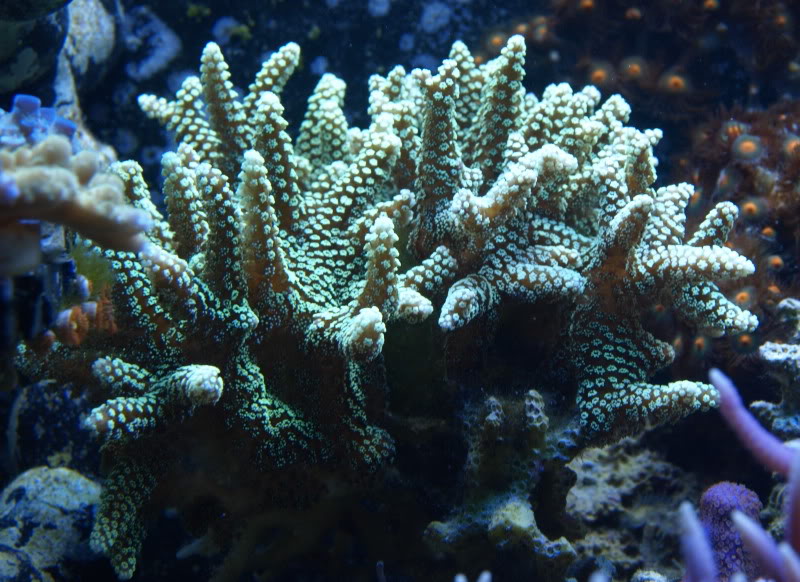
_1110445.jpg


_1110451.jpg


_1110452.jpg


_1110467.jpg


_1110490.jpg


_1110500.jpg


_1110516.jpg


_1110525.jpg


_1110575.jpg


...and a FTS and I'll stop now
_1110556.jpg
 
Last edited:
Those are some beautiful shots!!! WOW! Cant say I know much about the camera stuff, but the tank pics are great! Did she by chance leave the operating manual?I would check into that to find out how to use that camera.
 
So yea, I'm fortunate enough to have a girlfriend who's left me her olympus DSLR (and that's the extent I know about) and I've been having a lot of fun playing around with it, but I'd like to get a few more detailed things understood about it, catch being is I understand nothing about cameras (I've recently learned to keep my finger off the lens....j/k but yea, close to that level it seems like.)
So here's my Q's..

Macro mode Vs. Aperture mode (flower vs an A on the dial...)
Most of what I've read says aperture is best, but photo's tend to turn out best in macro mode- I'm mostly shooting from top down, so tripod's not an option, is this the difference?
Macro is taking pictures as close as it can. Everything around it is blurry, since the depth of field is focused on your subject. Aperture mode is setting it to different F stops, changing your depth of field.

ISO (what the heck does it mean?)
Camera has an auto, and then 100, 200, 400, etc. Not sure where to leave it, but more importantly I'm curious what the number reflects and what changing it causes (yea, I'm one of those folks- I'm not happy in math class till I've seen the proof and understand why it works)
ISO is how sensitive the image sensor is on the digital camera. In film cameras, it was how sensitive the film was that you were using. Higher the number, the more light sensitive the camera is. If it is dark, set your ISO to 400 or 1000 and you allow a lot more light to the sensor. For speed shots, fish swimming etc, set it to 400. For a nice coral shot, set it to 100 and a high aperture (low number).

depth/f-stop
I don't know if I titled that right, but reading another thread F-stop is important...so sort of same questions-what does it mean and what changes will get me what results?
F stop is the amount of light the lens is allowing to hit the back plane of the camera. The smaller the number the more light is being allowed in. Conversely, you will have a much faster shutter speed for a larger aperture (smaller number) allowing you to freeze your subject.

Random Total Laymen Question:
How does one achieve the affect where just a single coral, or desired area, is captured against a black backdrop (and no, I don't mean when it's placed against the black painted wall, unless that's how y'all are always doing it and it just looks really good)
I want to know too. Gary Parr is a master at this.

Thanks for any translations of the technical stuff! (and if any of this is covered in a sticky at the top, sorry, I tried my best to read through but skimmed past anything too technical in description that didn't really translate the terms, so I may have missed something)

and random pictures either my girlfriend or myself has taken-the better they look the more likely they're hers...
% (<- gratuitous percent sign)


ISO Settings in Digital Photography
 
priority modes - these are "modes" on your camera where you control aperture or shutter speed and the camera handles the other one for you. this is easier than manual where you control both.

aperture (f-stops) - this controls how much light the lens lets in - smaller number is more light and a shallow depth of field (not much in focus), higher number is less light and more in focus
---note that is you increase the f-stop you are going to gain focus, however let in less light which means your shutter (exposes sensor) needs to stay open longer.

shutter speed - controls how long the sensor which records the image is exposed to the light your lens lets through. faster shutter speeds capture moving things with little to no blur - slower will blurr (sensor sees all the movement)

so as you increase your f-stop to gain depth of field your shutter time will also increase making you more prone t blurring. this is the reason you should use a tri-pod and a timed setting (2/5/10 second delay to take picture), or a remote trigger. the camera is so sensitive that your hand pressing on the shutter button can blur the image.

ISO controls the sensitivity of the sensor - you can reduce your shutter speed by increasing the sensitivity (ISO) - however it comes at the price of loosing color brightness and grainy images.

try the following settings:

tripod
set timer to take picture to 10 seconds
aperture priority mode
F11
ISO 100

the camera will control the shutter speed for you (again - aperture priority puts you in charge of aperture and lets the camera control the shutter speed).

good example of f-stop impact on depth of field: https://www.reef2reef.com/forums/photography-forum/53956-depth-field-pictures.html

 

TOP 10 Trending Threads

WHEN PLANNING CORAL PLACEMENT, WHAT USUALLY WINS? THE FUTURE COLONY, OR THE NEXT FRAG?

  • I leave plenty of open space for large future colonies

    Votes: 3 21.4%
  • I plan for growth...but occasionally squeeze coral into tight spaces

    Votes: 5 35.7%
  • I try to balance future growth with variety now

    Votes: 4 28.6%
  • I fit in as many frags as I reasonably can

    Votes: 3 21.4%
  • One more frag always wins! Future me can solve the problem...

    Votes: 0 0.0%
  • It depends on the coral and how quickly it grows

    Votes: 1 7.1%
  • I squeeze 'em in! Survival of the fittest, baby!!

    Votes: 0 0.0%
  • I’m already out of room, so apparently we know my answer...

    Votes: 1 7.1%
Back
Top
Home
Post thread…
Market
What's new





