That hydrometer is not going to allow very precise readings due to the very wide scale.
If I wanted to use that hydrometer, I'd make a 35 ppt standard (directions below), see where the 35 ppt comes to in water at your tank temperature, make note of exactly where it is, and target your tank to that level.
https://www.reef2reef.com/ams/reef-aquarium-salinity-diy-calibration-standards.956/
from it:
Specific Gravity Standard
Most aquarists recognize that inexpensive hydrometers are often prone to error. In some cases, inaccuracy is due to poor manufacturing, and in other cases, it is due to poor usage by aquarists. In a
previous article, I tested several hydrometers and found variable results, from good to marginal. Beyond the inherent accuracy of the measurement is the confusing problem of how specific gravity relates to the temperature of the measurement, an issue which I detailed in that same
article.
The best way to be sure that a given hydrometer is giving accurate information is to check its accuracy in a solution with a density (specific gravity) similar to the aquarium water. In order to provide a standard for hydrometers, a solution of a similar specific gravity to normal seawater is required. Seawater with S= 35 has a specific gravity of about 1.0264 (Tables 1 and 3).
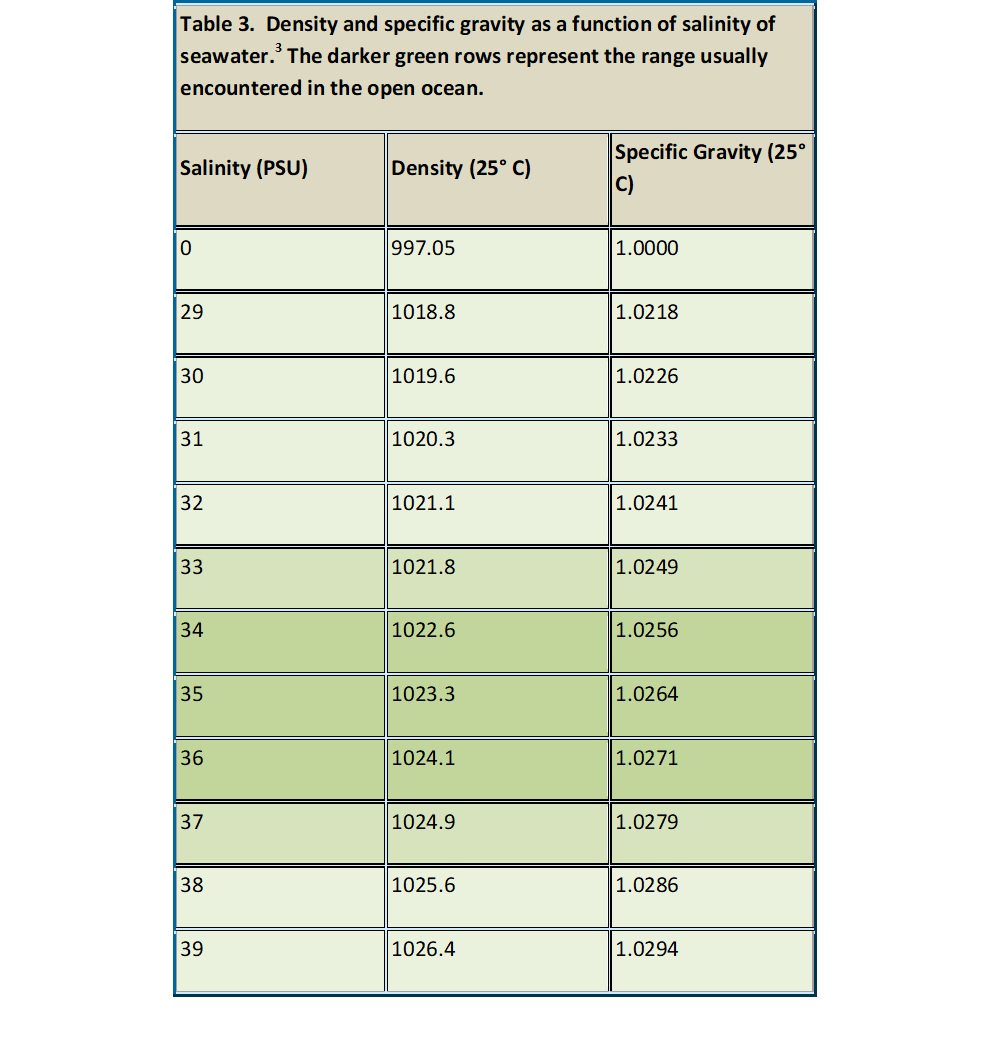
In order to match this specific gravity to a standard solution made from sodium chloride, one can look up the density of different sodium chloride solutions in the scientific literature. My CRC Handbook of Chemistry and Physics (57th Edition, Page D-252)4 has such a table (partially reproduced in Table 3), but it has data only for 20°C (68°F). Specific gravity at 20°C is easily calculated by dividing the density of the solutions by the density of water at the same temperature. This table (4) can then be compared to seawater at 20°C (Table 5). The primary purpose of showing specific gravity at 25°C (77°F; Tables 1 and 3) and 20°C (Table 4) is to show that specific gravity does not change much with temperature (1.0264 vs. 1.0266). Nevertheless, it is only the 20°C data that will be used to devise a standard.
The table in the CRC Handbook has entries for 3.7 and 3.8 weight percent solutions of sodium chloride that span the specific gravity value for normal seawater. Interpolating between these data points suggests that
a solution of 3.714 weight percent sodium chloride has the same specific gravity (and density) as S=35 seawater, and can be used as an appropriate specific gravity standard (Table 5). For most purposes, 3.7 weight percent is accurate enough.
To produce a 3.714 weight percent sodium chloride solution, dissolve 1 teaspoon (6.20 grams) of Morton's Iodized Salt in 161 mL (161 g) of fresh water (making a total volume of about 163 mL after dissolution of the salt). This solution can be scaled up as desired.
For a rougher measurement in the absence of an accurate water volume measurement:
1. Measure ¼ cup of Morton's Iodized Salt (about 73.1 g)
2. Add 1½ teaspoon of salt (making about 82.4 g total salt)
3. Measure the full volume of a plastic 2-L Coke or Diet Coke bottle filled with purified fresh water (about 2104.4 g)
4. Add an additional 2 tablespoons of purified fresh water (about 30 g)
5. Dissolve the total salt (82.4 g) in the total water volume (2134.4 g) to make an approximately 3.7 weight percent solution of NaCl. The volume of this solution is larger than the Coke bottle, so dissolve it in another container.
How to Use a Specific Gravity Standard
Depending on the type of hydrometer, one would use this solution differently.
For standard floating hydrometers (Figure 6), which are
not self-correcting for temperature variations, it is important to use the standard at the same temperature at which the aquarium water will be tested (within say, ± 0.5 ºC or ± 1 ºF). Preferably, that will also be the temperature at which the hydrometer is intended to be used (often marked on it), but that is not an absolute requirement. The aquarist can then mark on the hydrometer the level to which it rises (that is, the water line), and use that as an indication of the specific gravity of S=35 seawater, which has all of the properties listed in Table 1(specific gravity = 1.0264, etc.). If the hydrometer reads higher or lower than 1.0264, then the aquarist can just imagine the scale on the hydrometer to be shifted up or down, and shift all other readings taken with it (at the same temperature) by the same amount.
Figure 6. A Tropic Marin floating hydrometer.
For example, if the standard comes out at 1.0230 (and it is really 1.0264), then just add 1.0264 - 1.0230 = 0.0034 to each measured value).
For swing arm hydrometers (Figure 7), which are largely
self-correcting for temperature variations, add the standard to the swing arm hydrometer at roughly the same temperature at which the aquarium water will be tested (say, ± 5ºC or ± 10ºF). Once the reading stabilizes, the aquarist can mark the reading (or just remember it) and use that as an indication of the specific gravity of S=35 seawater, which has all of the properties listed in Table 1 (specific gravity = 1.0264, etc.). If the hydrometer reads higher or lower than 1.0264, then the aquarist can just imagine the scale on the hydrometer to be shifted up or down, and shift all other readings taken with it by the same amount, just as for a standard floating hydrometer.
Figure 7. The SeaTest swing arm hydrometer.
Just to be especially clear: this solution need not be used at exactly 20°C (68°F). It will be just about as accurate at 25°C (77°F) since specific gravity does not change much with temperature, and these salt solutions would be expected to change density with temperature in about the same fashion as seawater. The most important factor is that the temperature of the standard, when measured, be the same as the aquarium water when it is measured.
How to Use a Standard Hydrometer
Here are a few additional tips for using a hydrometer:
1. Make sure that the hydrometer is completely clean (no salt deposits) and that the part of the hydrometer above the water line is dry. Tossing it in so it sinks deeply and then bobs to the surface will leave water on the exposed part that will weigh down the hydrometer and give a falsely low specific gravity reading. Salt deposits above the water line will have the same effect. If any deposits won't easily dissolve, try washing it in dilute acid (such as vinegar or diluted muriatic acid).
2. Make sure that there are no air bubbles attached to the hydrometer. These will help buoy the hydrometer and yield a falsely high specific gravity reading.
3. Make sure that the hydrometer is the same temperature as the water (and preferably the air).
4. Read the hydrometer at the plane of the water's surface, not along the meniscus (Figure 2; the meniscus is the lip of water that either rises up along the shaft of the hydrometer, or curves down into the water, depending on the hydrophobicity of the hydrometer).
5. Rinse with purified freshwater after use to reduce deposits.
6. Do not leave the hydrometer floating around in the tank between uses. If left in the aquarium, deposits may form that will be difficult to remove.