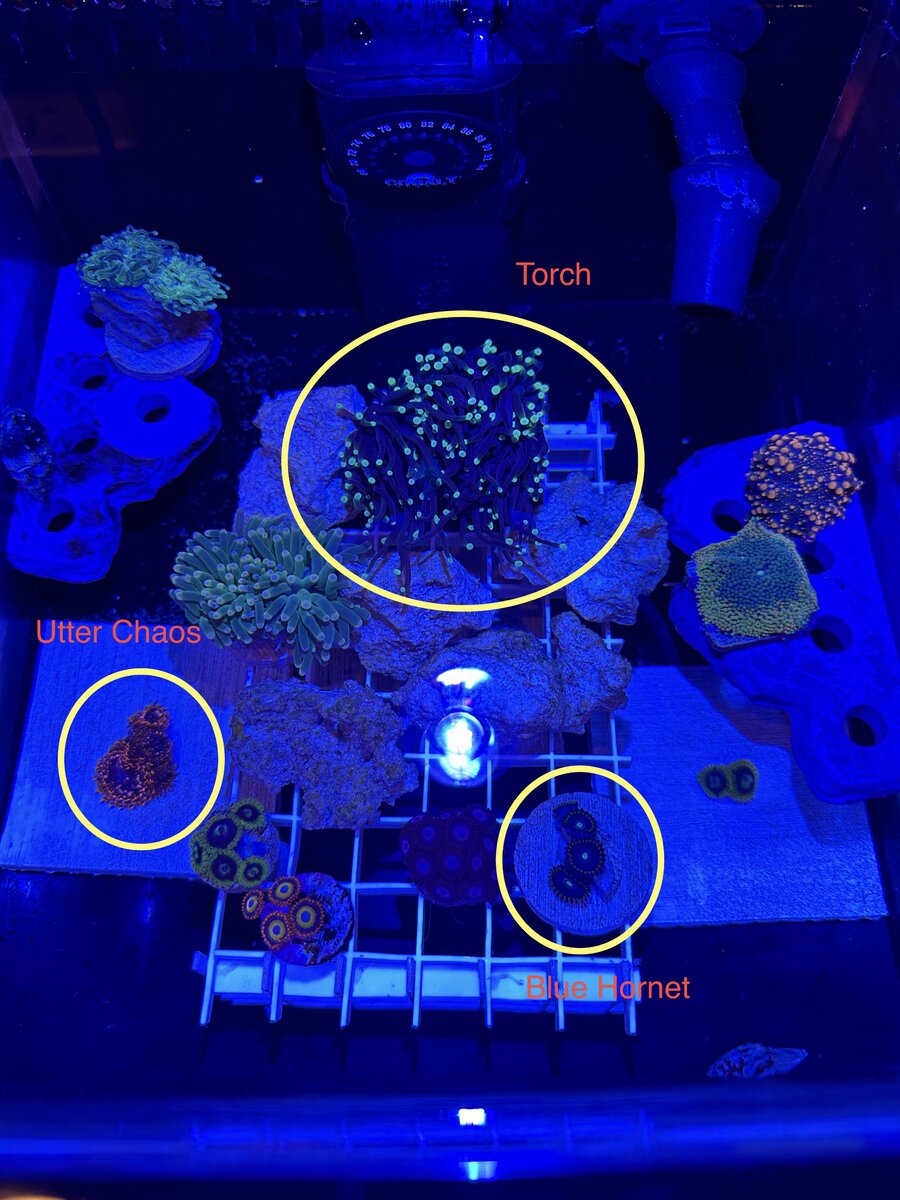
Reef Tank Retrospective for 2 Year Old AIO

vicorhe

Community Member
View Badges
Joined
Feb 23, 2012
Messages
69
Reaction score
64
Location
Rosemead, CA
Rating - 0%
0   0   0
Hello Reef2reef!
This is my first post. I actually made my account 13 years ago when I first started the reef hobby back in high school.
Most of this hobby has been a solitary for me, hoping to change that going forward.

I'd like to get everyones' opinion on why my latest tank is the way it is.
There are aspects I dislike and would like to prevent in my next tank (which I will start cycling DEC 2025).

Tank Video:

Latest Tank: Custom 15G AIO from Advanced Acrylics 24L x 16W x 10H
10G display volume.
Controller and ATO: Hydros X4
Lighting: AI Blade Grow - 21 in
Wave Maker: MP-10
Return Pump: AI Axis 20
Heater: Eheim 100w
Fan: No Name Amazon Fan
Refugium Light: No Name Amazon Grow Light
Skimmer: Aquamax Bullet 1
Bio filtration: ~4 pounds of live rock, various porous media, ceramic tile frag plugs, egg crate.....

Salt: Red Sea Coral Pro Salt Mix

Fish (5):
ocellaris clownfish pair (2)
black clown goby (2, one thick, one thin and being bullied), the thin one is a rescue from my friends tank, introduced in May 2025 (newest addition)
tailspot blenny (1)

Corals:
5 torch corals
3 zoas
2 shrooms

Inverts:
~ 3 hermit crabs
~ 3 snails (hermit crabs have been murdering their population)

Maintenance:
1. Weekly 3.5 gallon water change, (lately roughly 1.5 water changes a week)
2. Wet Skimming, needs to be cleared out every water change

What I dislike:
1. Extremely slow growth, no coral deaths though (not counting the ones that didn't survive my transplanting/quarantine process).
2. Smaller zoa polyps. When I first got my utter chaos frag, it was 5 giant polyps, fast forward 2 years, I have 24 micro polyps that take up roughtly the same area. Likewise for the blue hornets, I have 4 fatty polyps at the beginning, and now I have 17 teeny polyps.
3. Shrinking torch heads, and lots of skeletal growth.
4. The nuisance algae is never ending. I end up spending hours every month tweezering off chunks. I used to use stainless steel brush to brush off the filter on the frag tiles.

Here are some photos from 2 years ago to showcase how the torch and the zoas looked when I got them:
EBFA6394-43D7-46C3-B913-6EB3AA794DFF 2.JPG


IMG_4772.JPG


This is what the utter chaos and blue hornets look like right now after 2 years:
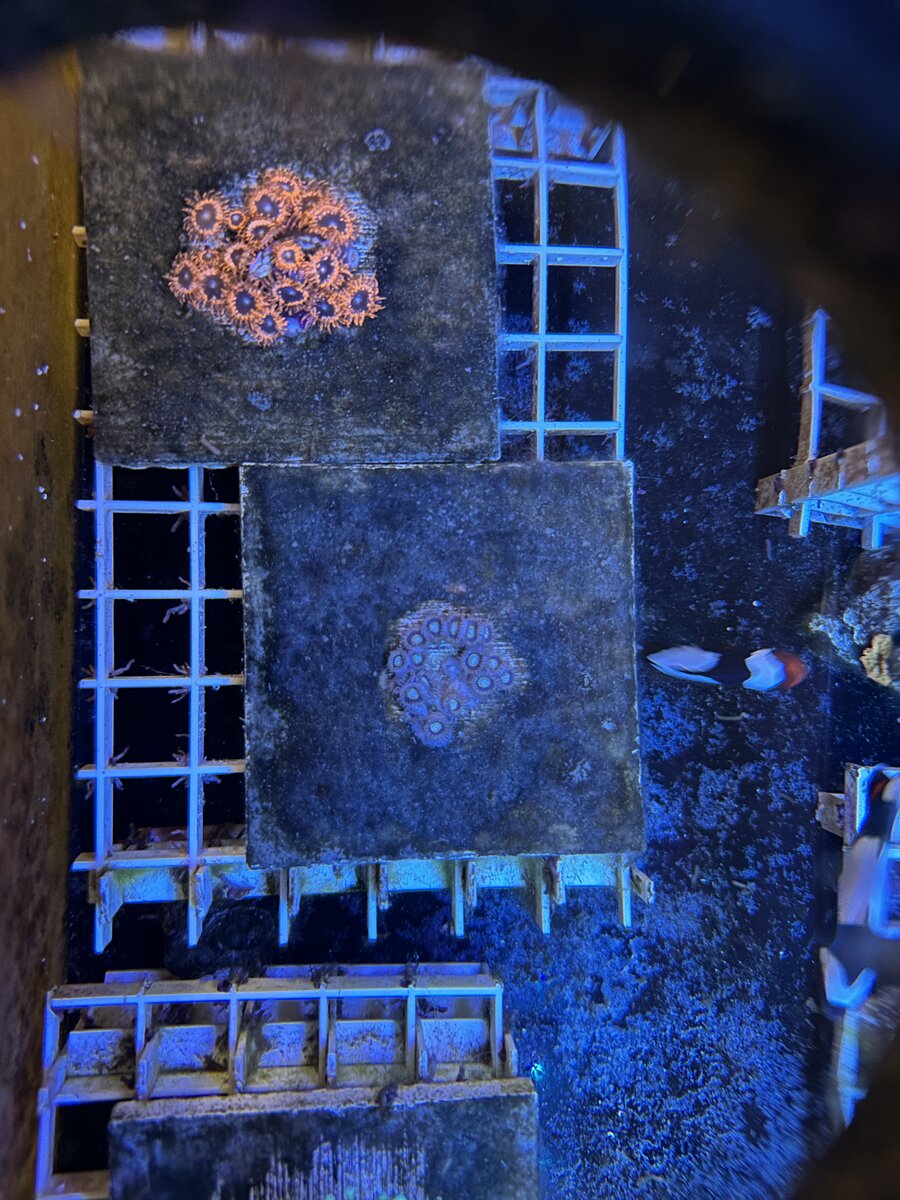
IMG_2683.JPG


This is what the torch looks like after two years, it's completely unrecognizable from when I initially got it:
I started out with 2.5 heads, and technically I have a lot more heads now, but not in the way I would like.
The bleaching on some of the heads might be due to me accidentally dropping a ton of fish food on some of the heads couple weeks back.
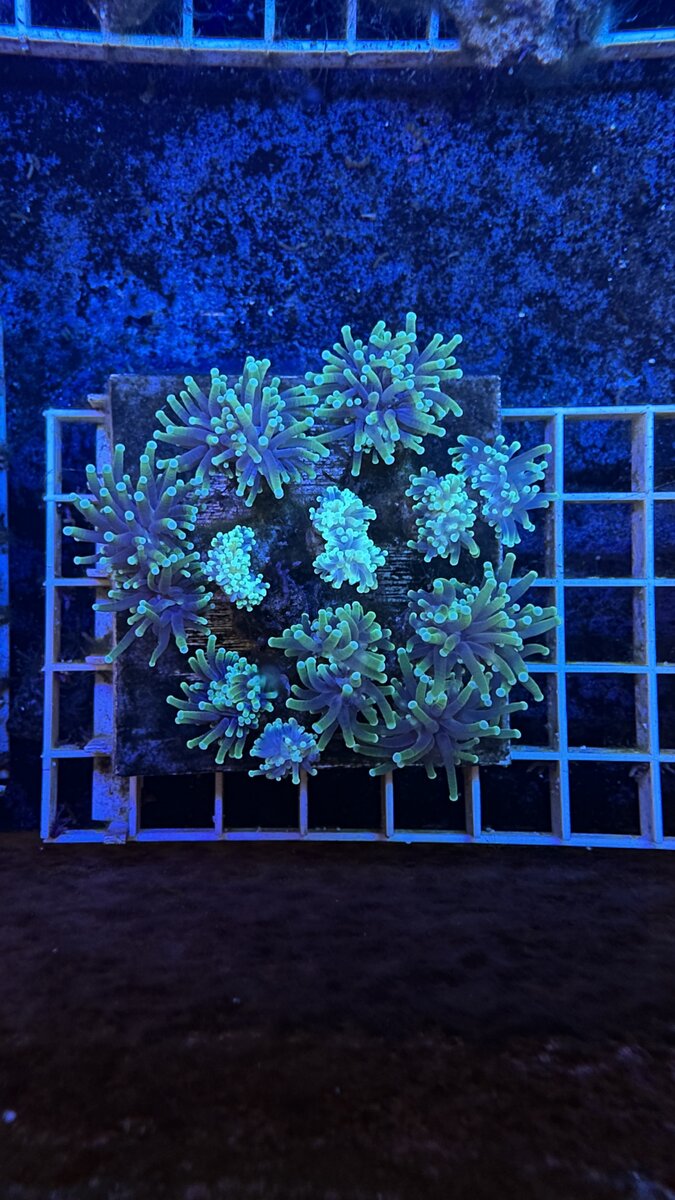
IMG_2681.jpg


Please let me know the data points I should gather and provide.

 
You have a lot of stuff in a small tank. Consider getting ICP test to identify any obvious parameter issues. Also consider starting a tank journal, to consolidate information and to document details.
Thanks for the suggestions
I don't have prior experience with ICP tests, is there a specific brand/configuration you recommend?
Screenshot 2025-11-08 at 8.47.28 AM.png
Screenshot 2025-11-08 at 8.47.17 AM.png


l plan to start a tank journal for the new build, this current tank will be phased out in 4 months. I intend to use this thread to track the remainder of this current tank.
I don’t have a vendor recommendation for ICP test. Know this, dissolved organic carbon as a byproduct of photosynthesis tends to accumulate in closed systems. and ICP test results will not indicate DOC.

With such a small aquarium, consider several 50% water changes to equalize everything out.
 
Nutrients could be your problem, in my opinion. Within two years, your zoas should have developed into sizable colonies.
 
I just took some PAR readings around the height and location where the respective corals are at:
IMG_2694.jpg


In addition to this, directly below the light, 8 inches away from the center of the light, the par is 100 - 120.
IMG_2695.jpg

trying to make sure this is the right setting on the par meter, such that I am measuring this right. This is an apogee MQ-510.

Based on this brs video , seems like I should aim for 75 - 150 the entire tank, since I only have LPS and soft corals.
 
water params before water change:
Hanna Phosphate ULR: 0.01ppm
Hanna Nitrate HR: 0.0ppm

IMG_2699.jpg

I just got the hanna checkers for phosphate and nitrate, after mixing in the powder for the high range nitrate checker, I get these solids in the tube. Not sure if this messes with the test results. I don't have anything to cross reference at the moment, my red sea nitrate and phosphate test kit is 2 years expired, and when I tried to test earlier, the colors were way out of wack.
 
Last edited:
No expert here, but In my opinion your nitrates are too low and you're starving your corals.. Par in some of those places are also a bit low compared to how some of my tanks with softies are. Hell I have zoas getting 250+ par and thriving over taking other zoa colonies.
 
Have you ever tested your par? IME corals slowly declining over a long period of time often comes down to low light.
Seems like that's part of the issue.
I just did a water change to rearrange the corals directly below the AI Blade. This should give them 100-140 PAR.

And I can work on ramping up the light further. I'm at 40% right now for the generic softy/lps configuration on the mobius app.

At 10 inches from blade to bottom of the tank, the spread is pretty bad.

IMG_58D627992702-1.jpeg
 
Have you ever tested your par? IME corals slowly declining over a long period of time often comes down to low light.

With all the filter contraptions you have going in such a small tank I would think you are depriving your corals of nutrients. That's just me

Nutrients could be your problem, in my opinion. Within two years, your zoas should have developed into sizable colonies.

No expert here, but In my opinion your nitrates are too low and you're starving your corals.. Par in some of those places are also a bit low compared to how some of my tanks with softies are. Hell I have zoas getting 250+ par and thriving over taking other zoa colonies.

Forgot to quote some on these in the previous response about the PAR and adjustments.

And yes, I have really low nutrients, which comes as a surprise to me since I'm constantly manually removing hair algae and other nuisance algae.

I run a refugium light 11 hours but it mainly grows hair algae, the little chaeto i have is covered in hair algae.
I currently wet skim.
I do 25-30% ish water change weekly.
I have an auto feeder that more or less feeds a pinch of pellets once a day.

I'm planning on lowering my refugium light to 6 hours.
Maybe I should feed more?
 
I don’t have a vendor recommendation for ICP test. Know this, dissolved organic carbon as a byproduct of photosynthesis tends to accumulate in closed systems. and ICP test results will not indicate DOC.

With such a small aquarium, consider several 50% water changes to equalize everything out.
I think you are right on the dot with DOC. I never put a name to it, and just believed that running carbon to polish the water was a nice to have.

Just watched this video on the topic:
seems like there are several ways to manage it:
1. Water changes (removal of detritus)
2. Wet skimming
3. CAC - cathalyic carbon

I waited until i next did a water change to share pictures of the color tint, but I forgot to take a photo before I already pumped the clean water in the tank... here is the changed water vs an empty bucket:
IMG_2701.JPG


The hue isn't as bad as before I did wet skimming.
 
Yes, activated carbon removes some DOC. Skimming removes some DOC.

Not all doc discolors water.
 
Forgot to quote some on these in the previous response about the PAR and adjustments.

And yes, I have really low nutrients, which comes as a surprise to me since I'm constantly manually removing hair algae and other nuisance algae.

I run a refugium light 11 hours but it mainly grows hair algae, the little chaeto i have is covered in hair algae.
I currently wet skim.
I do 25-30% ish water change weekly.
I have an auto feeder that more or less feeds a pinch of pellets once a day.

I'm planning on lowering my refugium light to 6 hours.
Maybe I should feed more?
Zero nitrate and zero phosphate is not low, it’s zero. However, you are measuring inorganic nutrients. There are other nutrients in the water.

Know this, nuisance algae like Dinoflagelletts & Cyanobacteria thrive when nuitriants are limited to desirable competition. With respect to GHA, I find that CUC is a long term solution.
 
Yes, activated carbon removes some DOC. Skimming removes some DOC.

Not all doc discolors water.
how would I go about testing it and measuring it?

I have a larger tank in the works, large water changes are something I would like to avoid.
 
Zero nitrate and zero phosphate is not low, it’s zero. However, you are measuring inorganic nutrients. There are other nutrients in the water.

Know this, nuisance algae like Dinoflagelletts & Cyanobacteria thrive when nuitriants are limited to desirable competition. With respect to GHA, I find that CUC is a long term solution.
I see.

I definitely can replenish the snail population. At this tank size (10G display), I tried my best with a tailspot blenny as a utilitarian algae eating fish.

for my 60G breeder (48x18x18), I'm looking into a yellow tang, a kole tang, or a tomini tang as an algae eater, and maybe also a lawnmower blenny.
 
how would I go about testing it and measuring it?

I have a larger tank in the works, large water changes are something I would like to avoid.
After 55 years in the hobby, I do not measure or test except for salinity & temperature. No scheduled water changes. Once a year, within a 10 day period, I perform three 50% water changes.

With respect to DOC testing, I found it incomplete & expensive. Instead, I focus on nutrient recycling using multiple food webs that recycle carbon (inorganic & organic nutrients) up yards food chain and feed diverse inverts and filter feeders. For that purpose, diver collected live rock brings in competitors & consumers of nuisance algae like GHA. It by far is the best proactive method to limit the uglies in new tank startup.
 
Last edited:
After 55 years in the hobby, I do not measure or test except for salinity & temperature. No scheduled water changes. Once a year, within a 10 day period, I perform three 50% water changes.

With respect to DOC testing, I found it incomplete & expensive. Instead, I focus on nutrient recycling using multiple food webs that recycle carbon (inorganic & organic nutrients) up yards food chain and feed diverse inverts and filter feeders. For that purpose, diver collected live rock brings in competitors & consumers of nuisance algae like GHA. It by far is the best proactive method to limit the uglies in new tank startup.
I aspire towards those large water change percentages infrequently. I just bought two 20G brute trash cans, which I intend to do 33% water changes for my upcoming 60G breeder, probably monthly or biweekly.

I've only ever bought live rock once from a fish store when I started in the hobby. Since then I've always bought mined dry rock. Even though I've never had to dealt with pests that directly attack corals, it's always been on the back of my mind. It makes me hesitant to go with rock from the ocean.

For the 60G, so far I have 60lbs of this https://arcreef.com/product/dry-live-rock/
I've been in communication with Tom from ARC, and he's been very helpful.
I see that they also offer mari-cultured live rock https://arcreef.com/product/premium-live-rock/, it's something I can consider seeding the next build eventually. But I'm in California, across the nation from Florida where they mari-culture their live rock, by the time it ships here, most of the live stuff may be dead.
 

TOP 10 Trending Threads

HOW LONG HAVE YOU HAD YOUR LONGEST-SERVING CURRENT TANK RESIDENT?

  • Less than 1 year

    Votes: 3 6.7%
  • 1 - 3 years

    Votes: 12 26.7%
  • 3 - 5 years

    Votes: 2 4.4%
  • 5 - 10 years

    Votes: 16 35.6%
  • 10 - 20 years

    Votes: 5 11.1%
  • 20 years or more

    Votes: 5 11.1%
  • I don’t have livestock yet

    Votes: 1 2.2%
  • Other (Post in the comments)

    Votes: 1 2.2%
Back
Top
Home
Post thread…
Market
What's new