Ammonia - TAN / UIA online calculator

First - In my playbook TAN means total ammonia nitrogen and its by definition only the N part of total NH4/NH3. Hanna gives answer in total NH3/NH4. - The calculator say TAN but are indeed TNH (NH3+NH4)

The calculator at Hamas Reef give you the possibility to chose between NH- N (NH4-N+NH3-N) and NH (NH4+NH3)

The salinity part of the calculator present by the OP give wrong result - the NH3 part decrease with increased salinity.

The calculator at Hamas Reef give the right trend according to salinity

I would not trust OP:s calculator at least not for saltwater
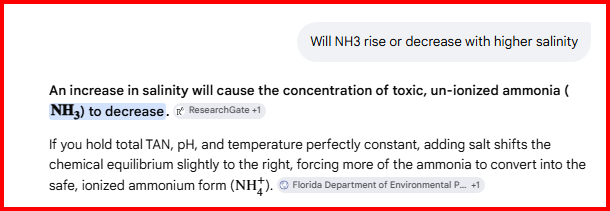
Weirdly, the google search AI gets this exactly backwards and cites a reference showing it got it backwards. lol
In my browser - the Google AI says this

1780430517617.png


Sincerely Lasse
 
Just now, I entered this on my phone:

what is the effect of salinity on the pKa of ammonium in seawater

It says:

Salinity increases the ionic strength of seawater, which lowers the \(pK_{a}\) of the ammonium ion (\(NH_{4}^{+}\)) compared to its value in pure freshwater. This shift generally reduces the percentage of total ammonia that exists in the highly toxic, un-ionized form (\(NH_{3}\)) at a given pH and


At any pH, if you decrease the pKa of ammonium, you increase NH3.

Easy way to understand it. Say we are at the pKa in freshwater, with equal parts NH3 and NH4+. Increase salinity and the pKa lowers by this assertion. Since pH did not change, we are now above the pKa and would have more NH3 and less NH4+.

Never trust an ai. lol
 
Just now, I entered this on my phone:

what is the effect of salinity on the pKa of ammonium in seawater

It says:

Salinity increases the ionic strength of seawater, which lowers the \(pK_{a}\) of the ammonium ion (\(NH_{4}^{+}\)) compared to its value in pure freshwater. This shift generally reduces the percentage of total ammonia that exists in the highly toxic, un-ionized form (\(NH_{3}\)) at a given pH and


At any pH, if you decrease the pKa of ammonium, you increase NH3.

Easy way to understand it. Say we are at the pKa in freshwater, with equal parts NH3 and NH4+. Increase salinity and the pKa lowers by this assertion. Since pH did not change, we are now above the pKa and would have more NH3 and less NH4+.

Never trust an ai. lol
Here let me fix the LaTeX formatting for you

Salinity increases the ionic strength of seawater, which lowers the pKa of the ammonium ion (NH4+) compared to its value in pure freshwater. This shift generally reduces the percentage of total ammonia that exists in the highly toxic, un-ionized form (NH3) at a given pH.
 
I received an email regarding a NEW FANTASTIC WAY OF MAINTAING YOUR TANK . Check out BioSpace Reactors . Pure Plagiarism

That's one funny looking MBBR! Definitely gimmick-y. Usually you just use continuous aeration to make it a "thin-film reactor".

4x the media costs $58: https://pentairaes.com/sweetwater-swx-bio-media

For $310....they're just trying to sell a plastic housing that isn't necessary.
 
I found what looks like a very easy to use, comprehensive online calculator for assessing ammonia toxicity in aquariums. It takes into account the salinity, water temperature and pH to determine the level of un-ionized ammonia (UAI) for a given amount of Total Ammonia - Nitrogen.

The risk assessment it provides is based on zebrafish data. Empirically, I've found that many species of marine fish have similar sensitivity to UAI. I ran a number of scenarios and the calculator seems very robust to me. The only caveat is that you need to be sure you enter the salinity (in ppt) below the "Include salinity correction" radio button when it is selected.

https://conductscience.com/tools/unionized-ammonia-calculator#tool-calculator


Jay I have been using this for a while…..

https://www.hamzasreef.com/Contents/Calculators/FreeAmmonia.php

On this site there are other types of calculators that I have to say add up to actually real time readings I do on a regular.

But no harm in having other sources to get info from! 😎👍🏽
 
How to do to use zebrafish systems for biomedical research around the world?

What's that link you slid into my original post?

They're used for a variety of studies, but basically they share about 70% of our DNA. However, when it comes to disease-related genes, they share about 85%. Because they're so small, aren't aggressive, and they're pretty hardy they make great candidates for initial research. You can pack a lot of individuals into a small space, which makes them great for statistical power.

So it's like a lab mouse, but even smaller and easier to care for (arguably). You start your initial work with zebrafish, then later you move onto mammals. They're kept in systems like these:

1792096262615.png
 

TOP 10 Trending Threads

WHAT KIND OF REEFING DEAL ARE YOU HOPING TO PICK UP THIS BLACK FRIDAY?

  • A whole new aquarium or complete system

    Votes: 5 15.2%
  • Lighting, pumps, or other major equipment

    Votes: 4 12.1%
  • Controllers, testing, dosing, or automation gear

    Votes: 4 12.1%
  • Dry goods and restocks, like salt, media, or food

    Votes: 4 12.1%
  • Corals! Must...Have...CORALS!!!

    Votes: 8 24.2%
  • Fish or other livestock

    Votes: 1 3.0%
  • Rock, sand, or other aquascaping supplies

    Votes: 1 3.0%
  • I’m browsing, but don’t have a specific target

    Votes: 4 12.1%
  • I’m not shopping for reef deals this year

    Votes: 2 6.1%
  • Other (Post in the comments)

    Votes: 1 3.0%
Back
Top
Home
Post thread…
Market
What's new