


Attinella's Tank design version 2

jattinella

New Member
View Badges
Joined
Oct 19, 2025
Messages
22
Reaction score
44
Location
Rochester
Rating - 0%
0   0   0
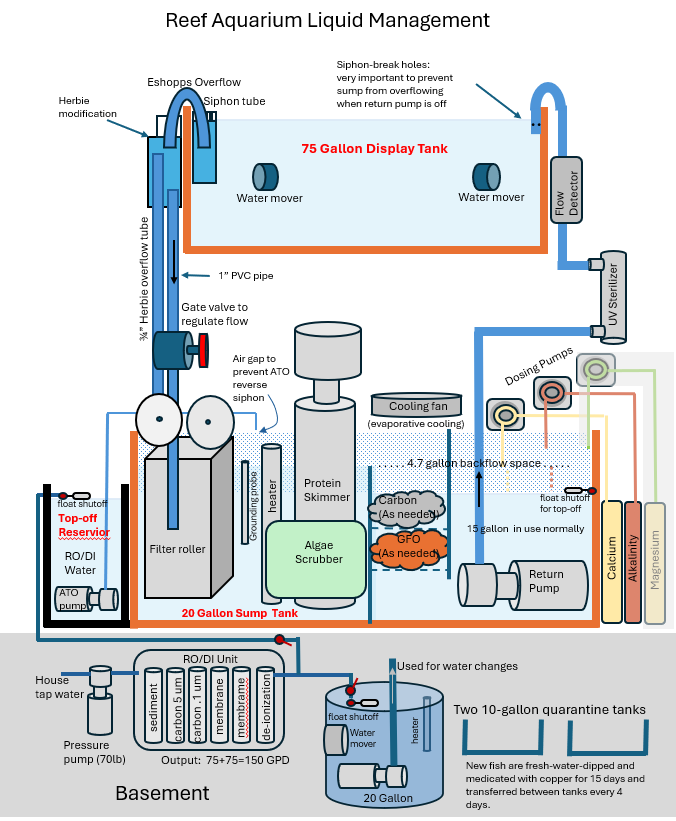
This is my second go-around with a reef tank. I took an extended break while working and now that I have retired, I decided to jump back in. The design outlined here has evolved over many years of having aquariums. I tried to come up with a relatively fail-safe system that allowed being away from the tank for vacations and not worry or wonder about the status of the aquarium. With the availability of the controllers/monitors on the market, much of what is described here could be simplified; however, there is a satisfaction of developing and designing from the ground up. Also, I like having multiple controlling subsystems and not a single control point of failure that could affect all the subsystems. I do have a monitoring system that I developed over the years that has served me well. I recently put this design out on github for anyone interested. The link is Aquarium-Monitor. Instead trying to explain my design with pictures of the aquarium, I would like to start with some diagrams that I created that explain the electrical and the fluid systems. I can follow-up with some actual pictures depending on the interest.
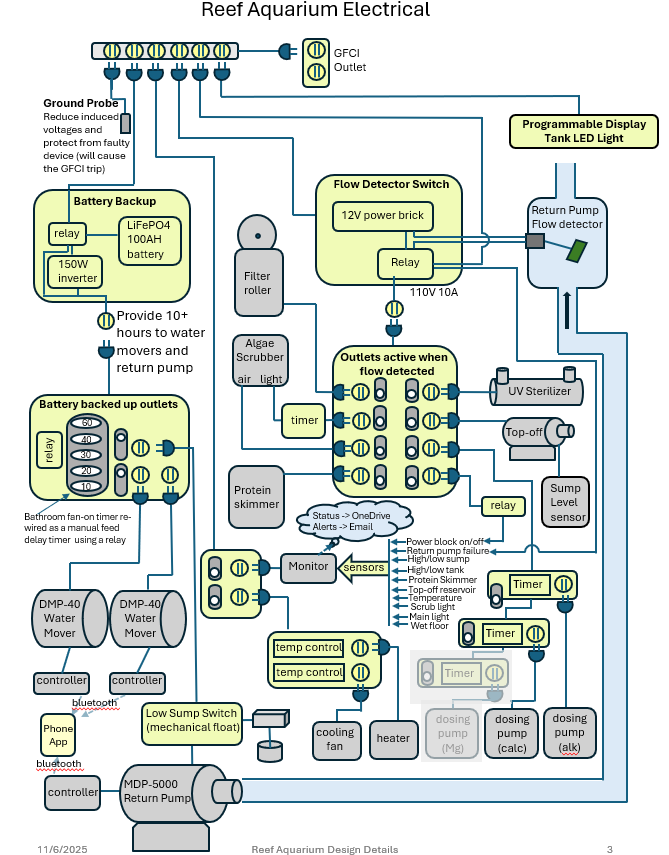
Electrical.png


Fluid.png
 
Following along!
 
Here is some more detail on the homemade algae scrubber. It has been working well. the Only complaint is that algae also grows on the class were the light is located. However, most of the algae does grow on the plastic mesh, so it appears to be effective.
Scrubber.png
 
This is the interior of my cabinet. The upper left drawer was removed for the picture.

CabinetInterior.png
 
I really do not want to be dealing with buckets of water during water changes. This is what I have done to eliminate that:

WaterChange.png
 
Several of my SPS and LPS frags seemed to be growing slower than expected. Ca, Alk, Mg, and Phosphate are where I want them. A variable I did not have a handle on was the lighting PAR. I was running my 300W Maxspect 16000k LED light maxing out at 50%. Without access to a dedicated PAR meter, I decided to try the Photone app on my Samsung phone to see if I was in the ballpark of where I should be for SPS and LPS. I used the instructions for a paper diffuser and put the phone in a ziplock bag. When out of the water I compared the PAR readings with and without the bag to understand what effect the plastic had on the readings. The plastic covering reduced the readings by 7%. Assuming the reduction due to the plastic covering would be similar under the water, I submerged my bag-protected phone and took readings in the upper, middle, and lower portion of my tank. After bumping up the readings by 7% to account for the plastic bag, I realized that I needed to bump up my blue lighting to 70% to get my upper level at 270 PAR and my lower level at 150 PAR. I realized that the phone app is maybe not all that accurate, but I suspect it is getting me in the ballpark. I adjusted my light percentage and now it is a wait and see if I notice any changes over the course of the next several weeks. This is what I am running with now:
Lighting.png
 
Back
Top
Home
Post thread…
Market
What's new




