Follow along with the video below to see how to install our site as a web app on your home screen.
Note: This feature may not be available in some browsers.
Ha ha love itYou challenged the wrong guy. Jda knows his stuff for sure.![]()
Honestly even I make so many mistakes. It took me years to learn and there is still more I need to learn. All what am saying is that there are many ways to run successful system. What matter is fundamentals which many many reefers overlook.
Spot on. The idea here to help this user.Most of that is rust and brown coralline algae. It is of no consequence since a conch or cucumber will be along soon to clean it up. The urchins on the rocks eat it first since it is softer than purple. Are you saying that coralline will not grow in a bare bottom tank?
Actually, never mind, I don't want to change the narrative. The idea to help the OP with his nitrate issue is my emphasis, and showing how sand beds do not release more nitrate appears over.
Can you show us your system so we judge how experienced you are..
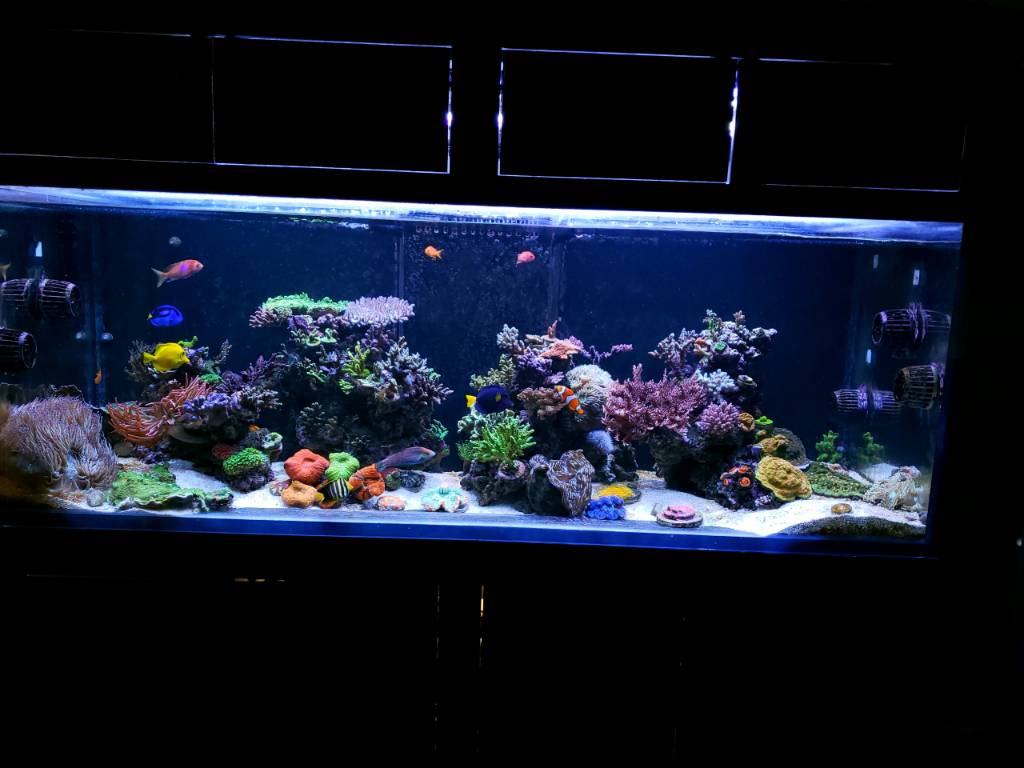
Here is mine![]()
Can you post your system details and feeding habits. so we see if we can help you.After 7 months of bare bottom I had to add sand back in. Even with weekly 25% h2o changes my nit rate stays between 25 and 50. My beautiful monti caps are slowly dieing. I do not have a sump at this time and if I was running chaeto it probably would be fine. I may try again when I am running a sump.
Yo yo, you are getting defensive, for some reason making it personal and seem to just debate for the sake of it.For somebody who is an engineer and a data driven reefer, you sure do like some blanket statements without any science to back them up. Not even a DSB is a nitrate factory - again, it is impossible since they cannot produce any ammonia. None. They cannot produce any phosphate either (if this is what you meant by no4). The sand can get full of phosphate, quit binding more and the phosphate levels can rise after many years, but this is not because the sand is a "factory" it is because it is incapable of masking the reefer's incompetence any longer. There are a lot of good reasons not to use any sand, but "time bombs" and "factories for anything" are not some of them. It amazes me how people screw this up when there is decades of actual science, studies and real PHDs who have written about this literally since the 1970s.
I have no idea where all sand comes from, but the stuff from the Caribbean was tested and has about .000018 ppb of phosphate when used 1 pound per gallon. This is hardly an issue. The ocean is very low in phosphate and the sand comes in clean. It is possible that sand from a beach, crushed up terrestrial rock or sand from a terrestrial area can be full of phosphate, but anything taken from the ocean for a reef tank has traditionally been very much phosphate free.

One of the principal benefits to deep sand bed methodologies is the potential for natural nitrate reduction (NNR). The speed and extent to which a DSB can reduce nitrate in an aquarium amazes many aquarists… especially those that have struggled with nitrate control for any length of time through other means. The benefits to an established tank with the upgrade to a DSB are apparent in just a few weeks with potential for complete nitrate reduction (to "zero")!
It isn't a nitrate factory per se,....but if you stir it up by cleaning your sandbed every time it looks less than pristine, you will cause the detritus to enter the water stream and cause a nitrate spike. Let it breath! :)