


Chiller Ratings

DylanE

Active Member
View Badges
Joined
Apr 8, 2018
Messages
446
Reaction score
701
Location
West coast
Rating - 100%
1   0   0
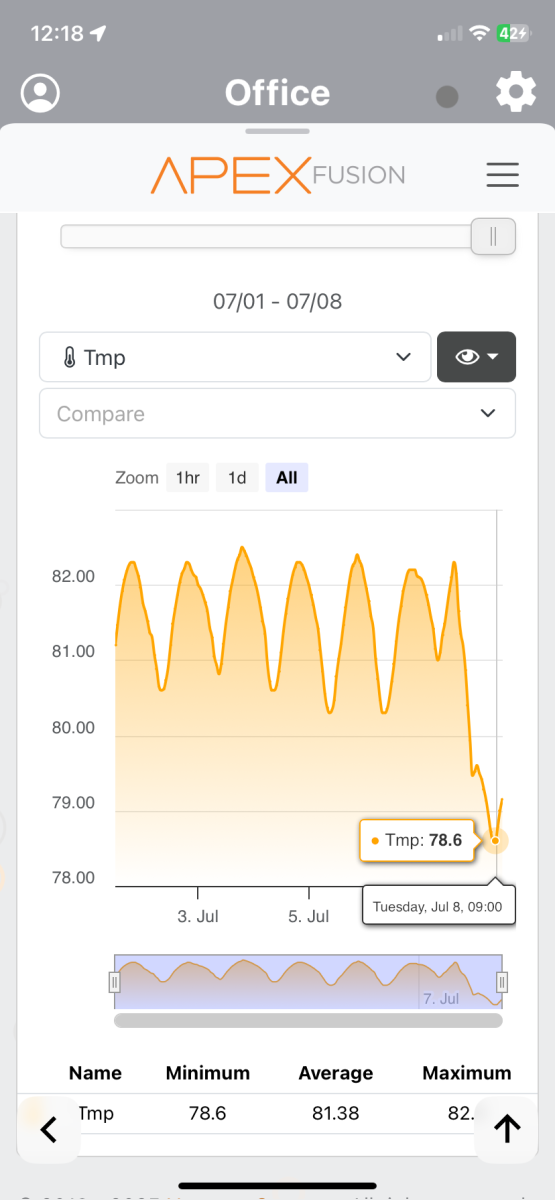
What are chiller size ratings based on? I recently purchased what I thought was a grossly undersized chiller just to see if it would prevent rapid temp swings. Im tired of freezing water bottles and being worried about cracking the window every night. Plus I couldn’t bring myself to spend the money on one rated for 300g. It’s rated for 79g, and I fired it up just to see what it could do. I was shocked to see it drop the tank 3 degrees in about 6 hours. It’ll only have to run a few hours a day to keep the tank 78-80.

I guess I’m not sure why someone would need anything else, unless you’re trying to drop much faster than that?
IMG_8263.png
 

KrisReef

Last to get paid.
View Badges
Joined
May 15, 2018
Messages
22,082
Reaction score
39,131
Location
Vatican & Las Vegas Penthouse Quarters
Rating - 100%
1   0   0
They are rated according to the amount of heat they can export from the aquarium, to lower the water temperature 1degree below the ambient room temperature.

Larger units can remove more heat and lower temperatures in a tank lower then smaller chillers can.

If you put your chiller on the Great Lakes the amount of water is so great that you can’t measure the temperature drop in the middle of the lake.

A tank inside of a house is easier to see a temperature drop. If the house temperature gets really elevated then a small chiller may struggle to lower the tank temperature to the desired temperature.
 
OP
OP
DylanE

DylanE

Active Member
View Badges
Joined
Apr 8, 2018
Messages
446
Reaction score
701
Location
West coast
Rating - 100%
1   0   0
They are rated according to the amount of heat they can export from the aquarium, to lower the water temperature 1degree below the ambient room temperature.

Larger units can remove more heat and lower temperatures in a tank lower then smaller chillers can.

If you put your chiller on the Great Lakes the amount of water is so great that you can’t measure the temperature drop in the middle of the lake.

A tank inside of a house is easier to see a temperature drop. If the house temperature gets really elevated then a small chiller may struggle to lower the tank temperature to the desired temperature.


That I get, I guess my question is what are the actual numbers they use for energy/gallon. My house is 74, so not too cool, and this little chiller is keeping my tank 77-80 no problem so far. Just surprising that it would be able to do that despite being rated for about 1/5 of the volume. Either way, very happy with the pickup.
 

DCR

Valuable Member
View Badges
Joined
Jan 3, 2018
Messages
1,031
Reaction score
863
Rating - 0%
0   0   0
It is not as simple as a matter of tank size. Chillers are rated on how much energy they can remove from the water (usually in Btu/hr). The rate the temperature drops, and the final temperature is also a function of how much heat is being added to the tank and how much other cooling methods like evaporation are contributing to the heat removal. As a matter of refence, 1 watt is equivalent 3.4 Btu's. You can add up all the power of the devices that are adding heat (pumps, powerheads, UV's, lights) multiply that by the 3.4 and it would give you a value of the total heat removal that is required. Some will come from evaporation, but if you wanted to be conservative you could assume it all has to be done by the chiller.
 

KrisReef

Last to get paid.
View Badges
Joined
May 15, 2018
Messages
22,082
Reaction score
39,131
Location
Vatican & Las Vegas Penthouse Quarters
Rating - 100%
1   0   0
That I get, I guess my question is what are the actual numbers they use for energy/gallon. My house is 74, so not too cool, and this little chiller is keeping my tank 77-80 no problem so far. Just surprising that it would be able to do that despite being rated for about 1/5 of the volume. Either way, very happy with the pickup.
Thats a physics problem. My books are long gone. @DCR mentioned some of the stuff.

Heat energy is a quantity and theoritcal temperature reductions can be calculated, but not without a lot of research. The mfgr's generally provide a table that given a tank size and ambient room temperature, their chiller will drop the tank a maximum number of degrees below ambient.

Looking on line (Amazon)
I found a 1/3 horse power chiller that is advertised to lower the tank 5-15F below ambient for an 79 gallon system. Only $349.00 30 day warrantee -Made in China. No mention of what coolant is inside?
 

Johnny C

Active Member
View Badges
Joined
Jun 22, 2020
Messages
108
Reaction score
82
Location
Western Colorado
Rating - 0%
0   0   0
What are chiller size ratings based on? I recently purchased what I thought was a grossly undersized chiller just to see if it would prevent rapid temp swings. Im tired of freezing water bottles and being worried about cracking the window every night. Plus I couldn’t bring myself to spend the money on one rated for 300g. It’s rated for 79g, and I fired it up just to see what it could do. I was shocked to see it drop the tank 3 degrees in about 6 hours. It’ll only have to run a few hours a day to keep the tank 78-80.

I guess I’m not sure why someone would need anything else, unless you’re trying to drop much faster than that?

IMG_8263.png
Now that you’ve had this up and running for a while would you suggest this to cool my 300 total gallon tank? What chiller are you using? In my picture the biggest spike was due to someone turning my ceiling fan off.
 

Attachments

  • IMG_1778.jpeg
    IMG_1778.jpeg
    60.3 KB · Views: 0

TOP 10 Trending Threads

WHAT AMOUNT OF LIVE ROCK AND SAND SHOULD BE PRIORITIZED FOR OPTIMAL BIODIVERSITY/FILTRATION?

  • 100% live rock + bagged sand

    Votes: 34 26.8%
  • 100% dry rock + 100% live sand

    Votes: 45 35.4%
  • 50/50 live/dry rock, 50/50 live/bagged sand

    Votes: 27 21.3%
  • 75% live rock, 25% live sand

    Votes: 11 8.7%
  • 25% live rock, 75% live sand

    Votes: 10 7.9%
Back
Top






