



- Joined
- Apr 3, 2025
- Messages
- 10
- Reaction score
- 23
- Location
- France
- What state or country do you live in
- Other International
Hi everyone,
I'd like to share a project I've been working on for my reef tank: DIY my Dose, an open source 4-pump peristaltic dosing controller built on ESP32 + ESPHome + Home Assistant. The entire system runs on Home Assistant — locally, with no cloud dependency of any kind.

Background
I've been reefkeeping for a while and always struggled to justify the cost of commercial dosing pumps — not just the price, but the dependency on manufacturer clouds and proprietary apps. When a company pivots or discontinues support, your hardware becomes a paperweight. I wanted something I fully own and control, forever.
The hardware wiring is based on an excellent build published on Joy-Reef.com — full credit to them for the electronics design. DIY my Dose is a complete software rewrite on top of that foundation, replacing the original Arduino + cloud setup with a fully local ESP32 + ESPHome + Home Assistant stack.
What it does
Currently running on my tank: KH, Ca, Mg and phyto — stable for months.
Hardware
Software architecture5 modular YAML package files + ESPHome firmware + 4 dashboard files (desktop + mobile, French + English). Everything is configured from the dashboard — no YAML editing required after installation.
The project is open source and free:
What's coming next
DIY my Dose is the first piece of a larger DIY reef automation ecosystem I'm building — more to come.
 https://github.com/diymoica/DmDose
Currently on v0.9.9. A physical manual dose button and improved timing precision are coming in the next version.
I'd love to get feedback from fellow reefers — especially if you're already running Home Assistant. Happy to answer any questions about the build or the software.
I'd like to share a project I've been working on for my reef tank: DIY my Dose, an open source 4-pump peristaltic dosing controller built on ESP32 + ESPHome + Home Assistant. The entire system runs on Home Assistant — locally, with no cloud dependency of any kind.
Background
I've been reefkeeping for a while and always struggled to justify the cost of commercial dosing pumps — not just the price, but the dependency on manufacturer clouds and proprietary apps. When a company pivots or discontinues support, your hardware becomes a paperweight. I wanted something I fully own and control, forever.
The hardware wiring is based on an excellent build published on Joy-Reef.com — full credit to them for the electronics design. DIY my Dose is a complete software rewrite on top of that foundation, replacing the original Arduino + cloud setup with a fully local ESP32 + ESPHome + Home Assistant stack.
What it does
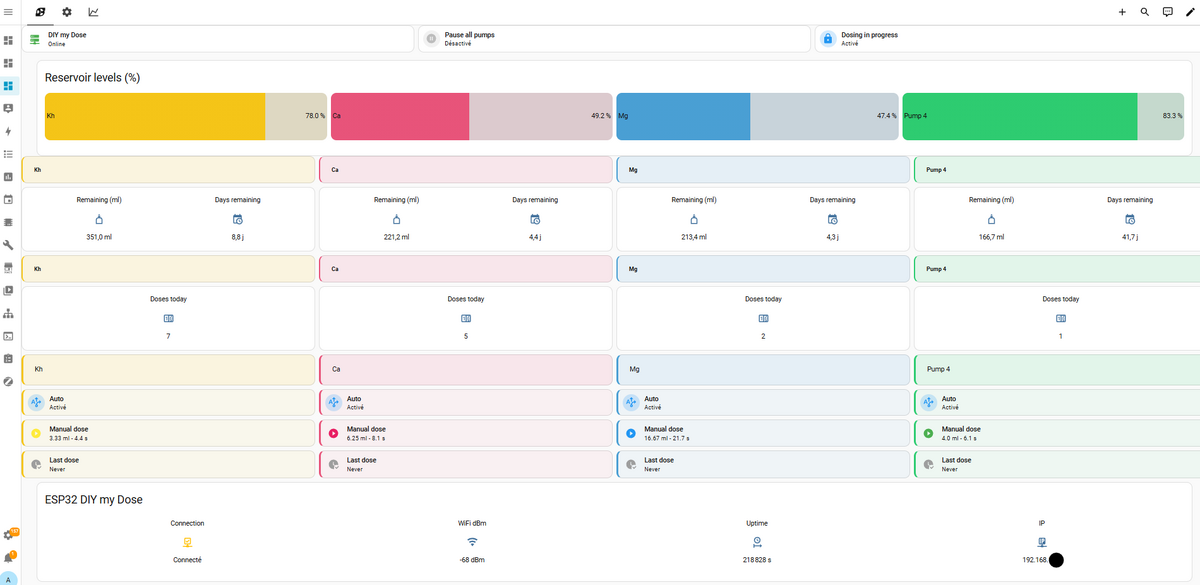
- 4 independent peristaltic pumps — each with its own name, color, schedule and calibration
- Automatic dosing with configurable time windows (start/end) or full 24h clock-aligned mode
- Real flow rate calibration per pump (ml/s) — duration calculated automatically
- Chemical compatibility matrix — set minimum delays between any pump pair (e.g. Ca and Kh never dose simultaneously)
- Tank level tracking per pump — remaining volume, %, days remaining, low level alerts
- Statistics — daily / weekly / monthly / yearly volumes + missed dose tracking
- Push notifications via Home Assistant mobile app (pump offline, low tank, missed dose)
- Simulation mode — test your full dosing schedule without running the pumps
- Hardware safety — ESP32-side auto-cutoff timeout per pump, HA watchdog (soft + hard level), dose lock watchdog
- 100% local — works without internet, no cloud, no subscription
Currently running on my tank: KH, Ca, Mg and phyto — stable for months.
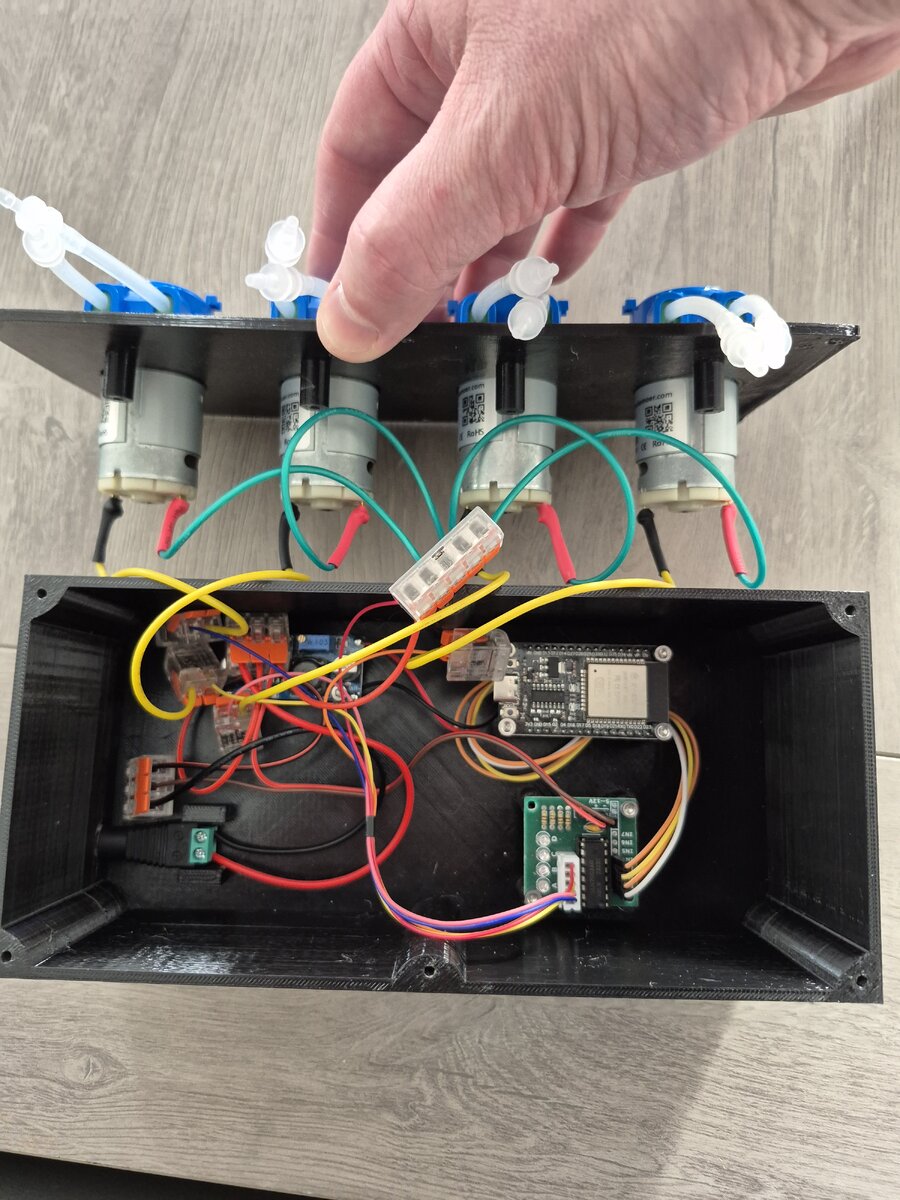
Hardware
- ESP32 + ULN2003 driver
- 4x 12V peristaltic pumps
- 12V PSU + LM2596 buck converter
- 3D printed enclosure
Software architecture5 modular YAML package files + ESPHome firmware + 4 dashboard files (desktop + mobile, French + English). Everything is configured from the dashboard — no YAML editing required after installation.
The project is open source and free:
What's coming next
- Physical manual dose button on the enclosure
- Local ESP32 dosing — keeps running even if Home Assistant is offline
- Flow drift detection — the system alerts you when a pump starts aging
- Gravimetric dosing verification — weigh each reservoir to confirm actual dose delivered
- Master/slave support — chain multiple units for more than 4 pumps
DIY my Dose is the first piece of a larger DIY reef automation ecosystem I'm building — more to come.
https://github.com/diymoica/DmDoseCurrently on v0.9.9. A physical manual dose button and improved timing precision are coming in the next version.
I'd love to get feedback from fellow reefers — especially if you're already running Home Assistant. Happy to answer any questions about the build or the software.





















