DLI Confusion

rob safron

Well-Known Member
View Badges
Joined
Feb 28, 2017
Messages
607
Reaction score
379
Rating - 0%
0   0   0
starting to hear a lot of buzz about DLI lately. I do have the Neptune PAR meter and can figure out what my DLI is. Problem is there’s not much info out there how to use DLI. Currently I have a DLI of 14. So what’s that mean? Too much light, too little light, would I change hours or Par to adjust?

 

Ron Reefman

Lets Go Snorkeling!
View Badges
Joined
Aug 12, 2012
Messages
9,628
Reaction score
12,364
Location
SW Florida
Rating - 0%
0   0   0
Until I saw your post, I had never even heard of DLI. I read a little about it and wonder what it's good for? Isn't it just the total photons over a given area over a day? How is that helpful as a tool? I'm asking because I don't know.

It seems to me if you are counting photons hitting at a low rate, it isn't helpful as the coral's zooxanthellae as they need a certain minimum PAR before they can even start the photosynthesis cycle.
 

oreo54

5000 Club Member
View Badges
Joined
Sep 18, 2017
Messages
6,874
Reaction score
4,081
Rating - 0%
0   0   0
Until I saw your post, I had never even heard of DLI. I read a little about it and wonder what it's good for? Isn't it just the total photons over a given area over a day? How is that helpful as a tool? I'm asking because I don't know.

It seems to me if you are counting photons hitting at a low rate, it isn't helpful as the coral's zooxanthellae as they need a certain minimum PAR before they can even start the photosynthesis cycle.

Look at it this way..knowing your DLI you could adjust your photoperiod to compensate for a perceived lack of light power.
Instead of buying more watts one just adds a few hours..sort of how DLI is already used by some.

Granted the catch is knowing what DLI is good for what corals..

Or helping one judge viewing time.. Like understanding 200"PAR" over 8 hours is the same as 100"PAR" over 16 hours..
Which is just another "expression" of DLI

As to a minimum "start" PAR.. probably generally low for most corals.. though, yes, needs to be considered overall.
Technically photosynthesis starts at a few captured photons.
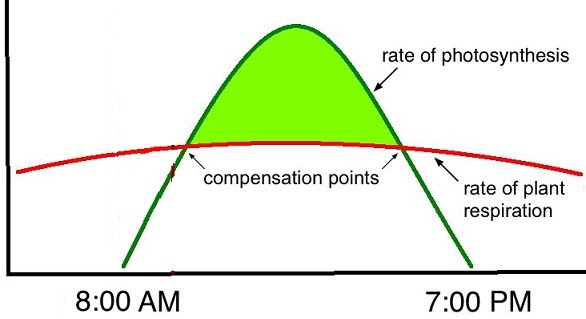
Issue is when respiration exceeds photosynthesis. Sort of grows itself to death..
That point varies by species of course.

ppss.jpg
 

jda

10K Club member
View Badges
Joined
Jun 25, 2013
Messages
14,342
Reaction score
21,756
Location
Boulder, CO
Rating - 0%
0   0   0
Too much light will also include a shutdown of zoox. Too short or too long of a photoperiod can be bad too. There has to be a reasonable scale and parameters for this to matter. 1 hour at 2400 PAR is not good and neither is 24 hours at 100, but both add up to 2400 - 8 at 300 is probably fine. I would keep light cycle between 5 and 12 hours and the min around 200-700 in the "high" parts of the tank and 75-300 in the "low" parts (depending on a lot of factors). If you are in a reasonable range for hours and output, then this might do something to help you - otherwise, I wonder if it is just inventing another problem that did not need solving to sell some units (grouchy old man alert).

You probably would need a $1500 LiCor to get accurate enough of measurements to be precise with this - I would not use the Neptune for anything more than a swag.
 

hatfielj

2500 Club Member
View Badges
Joined
Apr 8, 2007
Messages
2,632
Reaction score
2,326
Location
Ohio
Rating - 100%
1   0   0
The corallab tanks are on a 9 hour photoperiod I believe...1 hour ramp up, 7 hours full intensity, 1 hour ramp down. They claim that in their tests, the shorter photoperiod, higher intensity tanks, have less nuisance algae. I just switched my tanks to this schedule yesterday because I'm interested in seeing if it works. Not sure I'll like having less viewing time though.
 

Dana Riddle

2500 Club Member
View Badges
Joined
Sep 10, 2011
Messages
3,162
Reaction score
7,455
Location
Dallas, Georgia
Rating - 0%
0   0   0

TOP 10 Trending Threads

WHAT AMOUNT OF LIVE ROCK AND SAND SHOULD BE PRIORITIZED FOR OPTIMAL BIODIVERSITY/FILTRATION?

  • 100% live rock + bagged sand

    Votes: 34 27.6%
  • 100% dry rock + 100% live sand

    Votes: 43 35.0%
  • 50/50 live/dry rock, 50/50 live/bagged sand

    Votes: 27 22.0%
  • 75% live rock, 25% live sand

    Votes: 11 8.9%
  • 25% live rock, 75% live sand

    Votes: 8 6.5%
Back
Top