- Joined
- Feb 2, 2025
- Messages
- 62
- Reaction score
- 21
- Location
- Bonifay
- What state or country do you live in
- Florida
Hello, I have been in the aquarium hobby for 9 years. During that time I have mostly invested in high-tech planted freshwater systems and freshwater shrimp. I have about 2 years of SW experience from my time doing aquarium maintenance with an LFS, but this is my first time starting my own pico reef. I know small tanks are generally not recommended for beginners, but my experience keeping Caridina shrimp has trained me to monitor water chemistry like a hawk.
I am doing a 7 gallon Landen cube, with 10lbs of CaribSea dry rock and 10lbs of CaribSea Hawaiian Black Arag-Alive. I am using a small canister filter, filled with ceramic media, with glass inflow and outflow, but plan to get a Hygger Mini wavemaker soon. I am also running a Boxtech heater set at 28 degrees Celsius. I also plan to get a partial glass lid to offset some of the evaporation. I am using distilled water since I do not have space for an RO unit, and my salinity is sitting at 1.026 according to my refractometer.
My lighting is a Fluval Sea Nano currently on factory settings, with an 8 hour photoperiod. I am going to keep it off for the majority of the cycling period.
Now that all of that info is out of the way, I have questions about actually getting this ready for livestock:
1) Cycling a reef tank is different in many regards from cycling a high-tech planted tank. In a high-tech plant system, you add as many plants as possible from the start to offset the ammonia released by an active substrate, do tons of water changes, and allow the plants to establish before adding livestock. For a reef it seems more like allowing bacteria to colonize live rock is more important, while avoiding water changes at the start. I have heard good things about Fritz TurboStart, what is the consensus on cycling a new reef?
2) I know my tank is probably pushing the limits of what I can stock in it. Would it be possible to keep some of the smaller goby species in such a setup, such as prawn gobies, clown gobies, or pistol shrimp/watchman goby combo? I plan on keeping mostly inverts and soft corals.
3) I love the look of macroalgae. Would incorporating macroalgae in such a small system be beneficial, or deprive corals of necessary phosphates and nitrates?
Thank you all for your time, I look forward to getting hopelessly addicted to the saltwater side of the hobby!
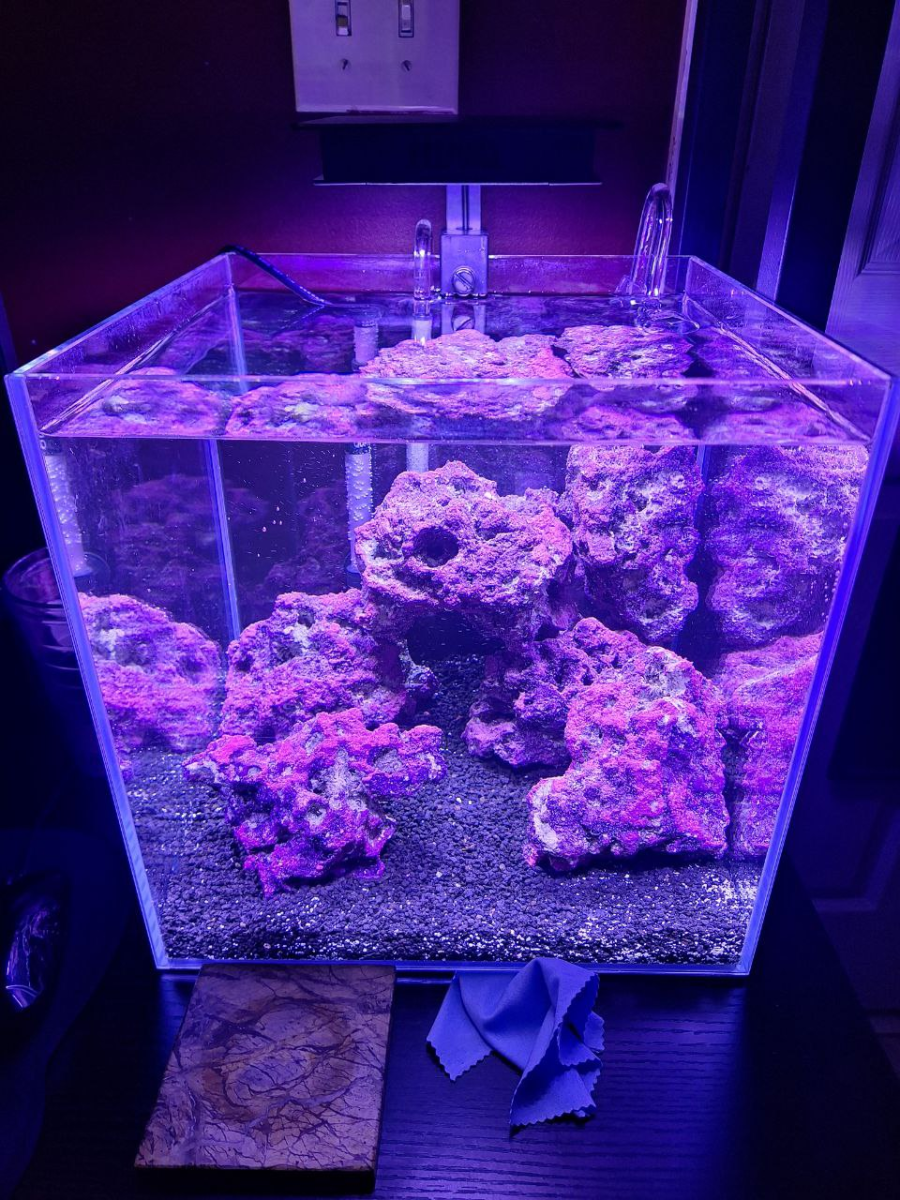
I am doing a 7 gallon Landen cube, with 10lbs of CaribSea dry rock and 10lbs of CaribSea Hawaiian Black Arag-Alive. I am using a small canister filter, filled with ceramic media, with glass inflow and outflow, but plan to get a Hygger Mini wavemaker soon. I am also running a Boxtech heater set at 28 degrees Celsius. I also plan to get a partial glass lid to offset some of the evaporation. I am using distilled water since I do not have space for an RO unit, and my salinity is sitting at 1.026 according to my refractometer.
My lighting is a Fluval Sea Nano currently on factory settings, with an 8 hour photoperiod. I am going to keep it off for the majority of the cycling period.
Now that all of that info is out of the way, I have questions about actually getting this ready for livestock:
1) Cycling a reef tank is different in many regards from cycling a high-tech planted tank. In a high-tech plant system, you add as many plants as possible from the start to offset the ammonia released by an active substrate, do tons of water changes, and allow the plants to establish before adding livestock. For a reef it seems more like allowing bacteria to colonize live rock is more important, while avoiding water changes at the start. I have heard good things about Fritz TurboStart, what is the consensus on cycling a new reef?
2) I know my tank is probably pushing the limits of what I can stock in it. Would it be possible to keep some of the smaller goby species in such a setup, such as prawn gobies, clown gobies, or pistol shrimp/watchman goby combo? I plan on keeping mostly inverts and soft corals.
3) I love the look of macroalgae. Would incorporating macroalgae in such a small system be beneficial, or deprive corals of necessary phosphates and nitrates?
Thank you all for your time, I look forward to getting hopelessly addicted to the saltwater side of the hobby!