Let Me ID Your Wrasse!

  • Thread starter Thread starter evolved
  • Start date Start date
  • Tagged users Tagged users None
Status
Not open for further replies.
I'm thinking Paracheilinus angulatus
 
Thanks guys, so an Angular Flasher Wrasse? I knew that place was clueless. Luckily they had a 25% off sale so I paid $48 for it. Is that a good price or should I go back and complain?
 
Thanks guys, so an Angular Flasher Wrasse? I knew that place was clueless. Luckily they had a 25% off sale so I paid $48 for it. Is that a good price or should I go back and complain?

That price is fine. They are usually priced comparably to mckoskers.
 
Is this correctly labelled, there are differing opinions?

Better than a picture I've got a video
 
Very pretty one at that, I love how red the filiments are against the yellow, just beautiful
 
Is this a female Chaoti leopard, male, or transitioning?
image.jpg
image.jpg
 
Male; I left your other thread open in a tab to comment on it later. :)

Note the pattern on the anal fin.
 
Male; I left your other thread open in a tab to comment on it later. :)

Note the pattern on the anal fin.
Very cool. My male blue star and ornate transitioning (I'll post a photo later) should hopefully leave him alone. Live aquaria has males in this size range for sale for 280. I got him for 150 from pet solutions (same supplier, QM).

I feel pretty lucky assuming he survives. I'm hoping they get along as well as my two male Bipartus and male Kuiteri in another tank. There's still 4 or 5 other females in the group :/.

Didn't see much if any aggression when he was out earlier with the group (both female m. Melagris weren't up for the day yet in this video)

(switch to 720p quality)

Can you see the ornatus in this video to tell me if it's a male, female, or transitioning?

If not does this one help?
(Older video when I first got it). (720 again for clarity)
 
Also, do you have a female vs male comparison of the anal fin? I was looking around the ear and face for the greenish color.

Is this one freshly transitioned or just not fully mature (and thus has less green or whatever on the face)
 
image.jpg
image.jpg
image.jpg
image.jpg
image.jpg
image.jpg
image.jpg
Here are more photos of my ornate and potters. I am pretty sure the smaller potters is female but while I am running it by you...

Thanks! Sorry for crappy photos took forever to take these! The little turds (especially the ornatus) dart everywhere!

And I know poor potters has a gimpy lip. She was my first leopard!
 
_MG_1064.jpg
This is supposed to be a Diamond Tail Flasher wrasse, but it seems to be a female if it is in fact a P. Attenuatus.

And I see the white string....it'll be starting Prazi in a day or too.
 
P. attenuatus; young male (transitional male)
 
image.jpg
image.jpg
image.jpg
image.jpg
image.jpg
image.jpg
image.jpg
Here are more photos of my ornate and potters. I am pretty sure the smaller potters is female but while I am running it by you...

Thanks! Sorry for crappy photos took forever to take these! The little turds (especially the ornatus) dart everywhere!

And I know poor potters has a gimpy lip. She was my first leopard!
How can you tell the difference between male and female in the potters?
 
How can you tell the difference between male and female in the potters?

Not sure, honestly. With ornatus I think it's the face patterns. Lines indicative of male, spots for female, but I am hoping hunter can let me know more definitively if the photos above are of a male or female ornatus and potters. I could be off base.

I know I have seen potters wrasse with 5x the color that mine exhibits, but mine is gorgeous compared to the female shown on live aquaria's website.
 
Last edited:
I'm really starting to enjoy the colors on my potters as well so I was curious as how to identify them so I'm gonna keep up with this one
 
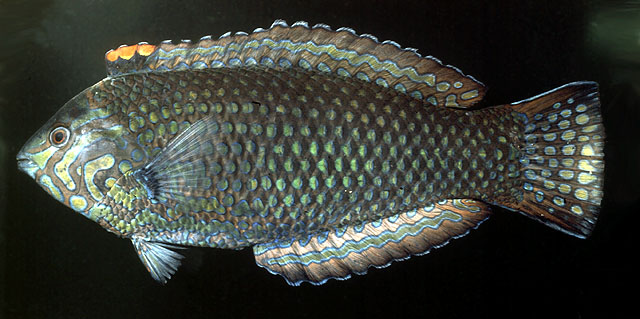
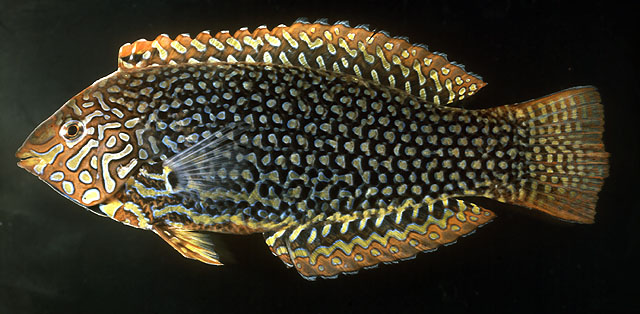
Let's cover male/female geoffroy/ornatus/choati all at once here. The characteristics of sex are not all that different amongst these three species.

M. geoffroy
facial pattern - continuous lines formed on male, broken lines on female
dorsal - males develop a large red spot at doral anterior
Older males lose the blue "background" on the body

Male:
Photo credit: Fishbase.org
Mageo_m0.jpg


Female:
Photo credit: Fishbase.org
Mageo_f0.jpg


M. ornatus
facial pattern - continuous lines formed on male, broken lines on female
anal fin - males develop a bold/wide nearly straight line, which has morphed from the zigzag line females posses
dorsal fin - similar pattern shift; males develop a continuous line in the dorsal; also gets a bright spot at the anterior
body pattern - the pattern becomes very uniform in the male
body color - males shift to a predominant green morphing from the more predominant brown female coloration

Male:
Photo credit: Fishbase.org
Maorn_m0.jpg


Female:
Photo credit: Fishbase.org
Maorn_f1.jpg


M. choati
anal fin - males develop a continuous line on the anal fin, morphing from the broken spots of the female (towards the body) - this is the most clear way to tell male/female apart here
facial coloration - older males do have more "blue" in the face between the orange stripes, but this is hard to distinguish on younger males.

Male:
Photo credit: Fishbase.org
Macho_u2.jpg


Female:
Photo credit: H. Tanaka

Macropharyngodon_choati.jpg
 
Last edited:
Status
Not open for further replies.

TOP 10 Trending Threads

As a buyer, how important are auctions to you on the NEW market?

  • As a buyer I like them

    Votes: 25 36.2%
  • As a buyer I don’t care for them

    Votes: 28 40.6%
  • I don’t care either way.

    Votes: 16 23.2%
Back
Top
Home
Post thread…
Market
What's new