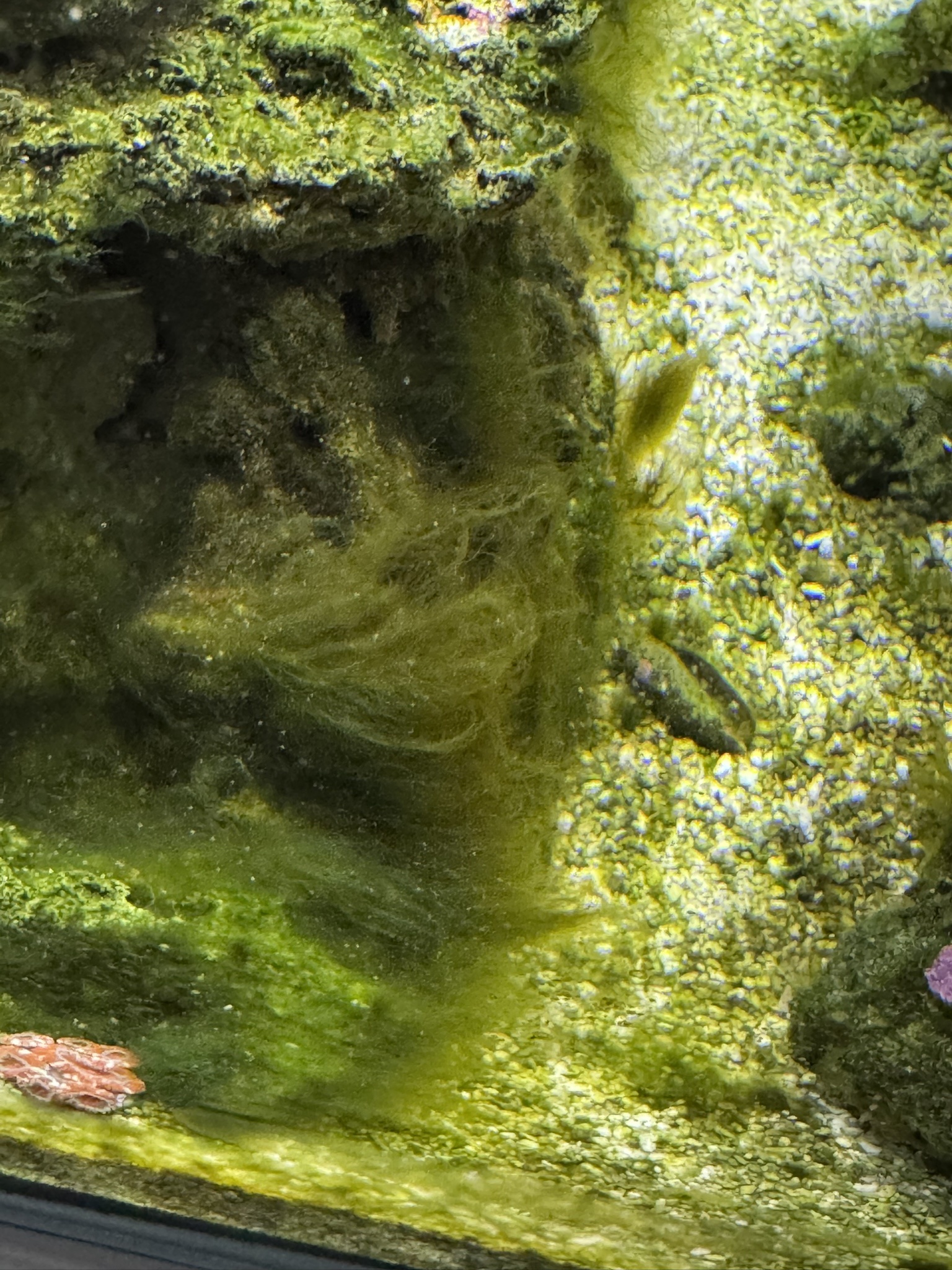
Lyngbya (I think) help

hardmermaid

New Member
View Badges
Joined
Oct 22, 2025
Messages
19
Reaction score
15
Location
San Diego
What state or country do you live in
California
Rating - 0%
0   0   0
Hi,

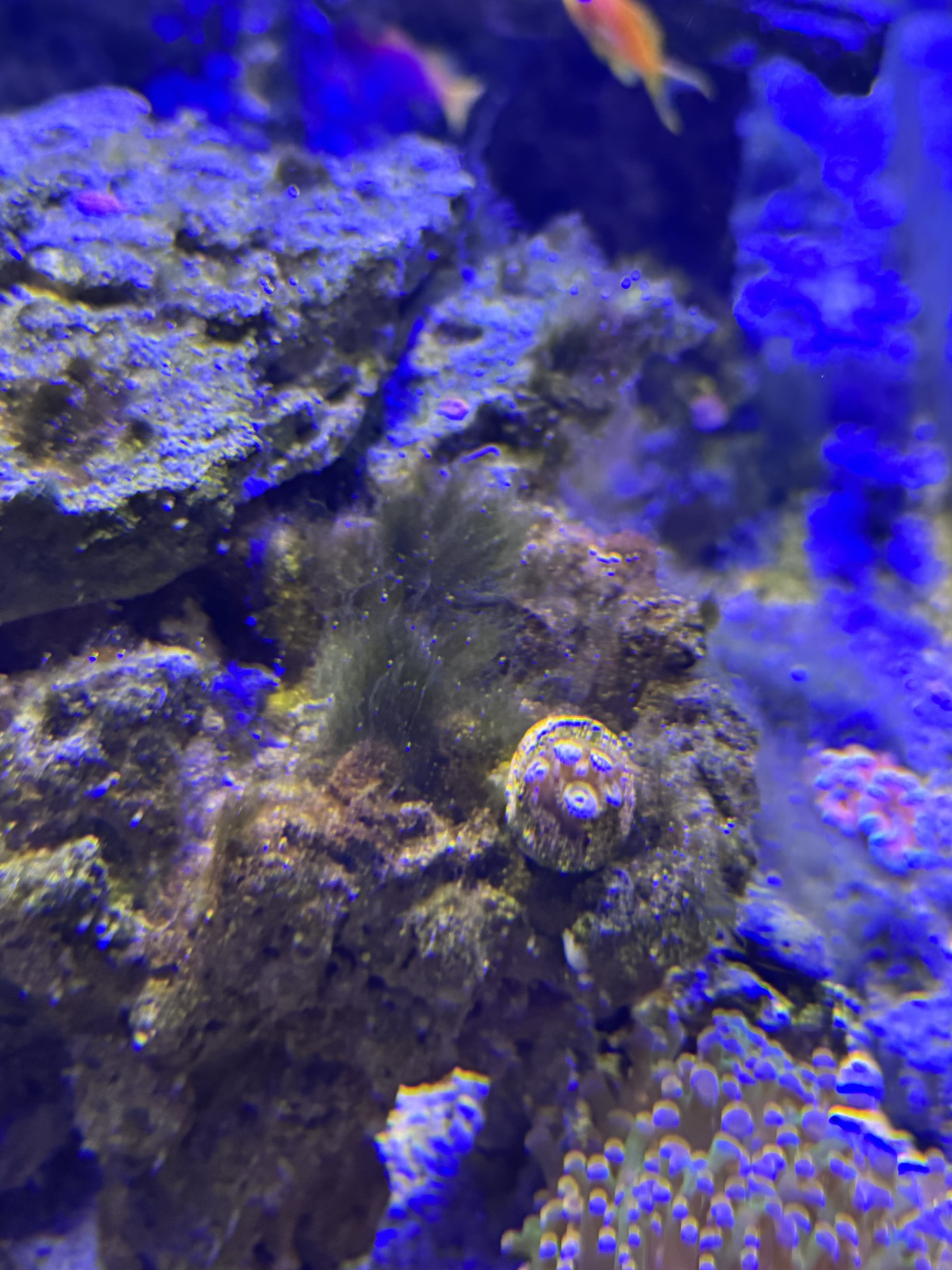
I believe I have a lyngbya problem starting and am seeking guidance and opinions.. I don't think it is GHA because I syphoned some about a week ago and it's still present in the can I syphoned it into and it hasn't been getting any light. I've also have low nutrients. There is also a small bryopsis outbreak (few patches and spreading) but I will deal with that later. I think this is different.

info:
Tank: 100gal of water. 10months old. 90% dry rock and 10% TBS live rock.
Nitrates: 3.5. Dosing Neonitro 5ml a day to maintain this or it will go to 0.
Phosphates had been steady at 0.08 for months but recently went to 0 when this started.
Dosing 5ml microbacter7 weekly
Calcium: 450
Alk 8.4
mag 1400
salinity 0.0125
Livestock: 8 anthias, 4 chromis, several turbos/other snails/hermits/2 conches (I don't think it is a CUC issue)

It is mostly one the end of my peninsula tank. I have greatly increased the flow on that end and it has not been coming back on the sand. It is spreading on rock though. I am about to go out of town for 2 weeks on Tuesday. I will do a 15 gal water change to siphon out what I can but it doesn't easily come off the rock. I have someone coming over once a day while I am out of town. I am wondering what I should have them dose.

My questions:
Does this look like lyngbya to you?
Should I dose to maintain nitrates 3.5 and phosphate 0.03-0.05? They will go to zero without dosing at this time.
Should I continue to dose microbacter 7?
qukJe5l.jpeg

PAuk4Ds - Imgur.jpg

There is plenty more :(

Thank you for the assistance!
 
Last edited:

A microscope would make the identification easier. 200-400x magnification should be enough, and you don't need an expensive scope at all.

Lyngbya tends to be less green and more brown in reef tanks, so there's a good chance you just have GHA. But color is a bad indicator, because cyanos can change color based on the environment.

I would stop dosing nutrients for now. Our tanks have nutrient levels orders of magnitude higher than the ocean. All the organisms we want to keep are well equipped to deal with levels below the detection limit of hobby-grade test kits, and the growth proves there is enough nitrogen and phosphorus available.

I would also stop dosing bottled bacteria for now. Many of these products are just nutrient bombs themselves, and we don't know how many of the contained bacteria manage to wake up from their cyst state and then attach to surfaces instead of ending up in the skimmer. If I remember correctly (don't quote me on that), the bacteria that actually establish long-term in reef tanks don't have cyst states or can't be cultured well, meaning they cannot be bottled. So even if there was an effect, it could be short-lived, and the cyanos appreciate the nutrients they get.

Unfortunately nutrient control is often insufficient for algae/bacteria control, because there is no set of parameters that allows coral growth but not algae/bacteria growth. Manual removal and appropriate CUC members will be an important part of the solution, but for Lyngbya this becomes more difficult. I'm not sure what actually eats it.

I would perform large water changes to get rid of dissolved organics. We don't know much about them yet, but people have theorized for a very long time that they might play a role in cyano blooms. That kind of makes sense if you think about how carbon dosing can boost bacteria growth. If nothing helps you will need to properly identify it and then use an appropriate antibiotic or fluconazole if its GHA.
 
For identification purposes; TURN OFF THE BLUE. WHITE LIGHT PLEASE.
 
first photo is white light. Will take some more this afternoon! Thanks

correction: I think nearuv was on

nEyPPfL.jpeg

xJ8txAM.jpeg
 
Last edited:
A microscope would make the identification easier. 200-400x magnification should be enough, and you don't need an expensive scope at all.

Lyngbya tends to be less green and more brown in reef tanks, so there's a good chance you just have GHA. But color is a bad indicator, because cyanos can change color based on the environment.

I would stop dosing nutrients for now. Our tanks have nutrient levels orders of magnitude higher than the ocean. All the organisms we want to keep are well equipped to deal with levels below the detection limit of hobby-grade test kits, and the growth proves there is enough nitrogen and phosphorus available.

I would also stop dosing bottled bacteria for now. Many of these products are just nutrient bombs themselves, and we don't know how many of the contained bacteria manage to wake up from their cyst state and then attach to surfaces instead of ending up in the skimmer. If I remember correctly (don't quote me on that), the bacteria that actually establish long-term in reef tanks don't have cyst states or can't be cultured well, meaning they cannot be bottled. So even if there was an effect, it could be short-lived, and the cyanos appreciate the nutrients they get.

Unfortunately nutrient control is often insufficient for algae/bacteria control, because there is no set of parameters that allows coral growth but not algae/bacteria growth. Manual removal and appropriate CUC members will be an important part of the solution, but for Lyngbya this becomes more difficult. I'm not sure what actually eats it.

I would perform large water changes to get rid of dissolved organics. We don't know much about them yet, but people have theorized for a very long time that they might play a role in cyano blooms. That kind of makes sense if you think about how carbon dosing can boost bacteria growth. If nothing helps you will need to properly identify it and then use an appropriate antibiotic or fluconazole if its GHA.
Thank you for the advice and information. I will get a microscope when I return to home after my trip if it is still a growing problem. Will boost up my water change before I go and maybe add a few more turbos/hermits if I make it to the LFS today. Will hold off on dosing and revisit it when I get back. The person watching my tank will only come by once a day to feed the fish. I believe the nutrient import will be much less than usual and will hopefully help.

I appreciate you and all the other people who take time to help others out!
 
This is what AI says about Lyngbya. If this is what you have, then consider using Cyanobacteria.

Lyngbya is a genus of filamentous cyanobacteria (blue-green algae) that forms thick, mat-like colonies in warm freshwater, marine, and estuarine environments. [1, 2, 3]

Characteristics and Identification
    • Appearance: Grows as long, unbranched filaments inside a thick, protective glycoprotein or mucilaginous sheath.
    • Growth habit: Forms dense benthic mats (dark blue to black) attached to bottom sediments, rocks, or seagrass.
    • Floating mats: Trapped gases can cause these bottom mats to lift to the water's surface, where oxidation turns them yellow-orange or a slimy green.
    • Common names: Often referred to as "mermaid's hair" or "fireweed". [1, 2, 3, 4]

Habitat and Blooms
    • Environment: Found globally in tropical, subtropical, and warm temperate coastal waters, lakes, and spring-fed rivers.
    • Triggers: Blooms thrive during warm summer months in waters rich in nutrients like nitrogen, iron, and phosphorus, often exacerbated by agricultural runoff, septic systems, and fertilized lawns. [1, 2, 3, 4, 5]

Health and Ecological Effects
    • Toxicity: Produces potent secondary metabolites and toxins—such as lyngbyatoxin A and debromoaplysiatoxin—that act as chemical defenses. [1, 2]
    • Human impacts: Contact with skin or eyes can cause acute dermatitis (swimmer's itch/rashes), eye irritation, and asthma-like respiratory symptoms. [1, 2]
    • Ecosystem impacts: Thick mats choke out submerged aquatic vegetation (SAV) by blocking sunlight, lower water quality, release foul odors, and disrupt local fish and crab populations. [1, 2, 3]

Control and Management
    • Difficulty: Extremely hard to eradicate because its tough outer sheath and associated surface microbiota shield it from standard algaecides and copper treatments. [1, 2]
    • Removal strategies: Physical removal via gentle vacuuming is often preferred over mechanical breaking, as disturbing or fragmenting the filaments can cause them to spread and re-root. [1, 2]
    • Chemical/Biological approaches: Advanced treatments often combine specialized biocatalysts (like wetting/sticking agents) with sequenced applications of peroxide and chelated copper algaecides to penetrate the protective barrier. [1, 2]
What I saw loops like GHA. Check out ReefCleaners link

https://www.reefcleaners.org/nuisance-algae-id-guides

“GHA is not coarse or wiry, it should break apart easily when pulled, and should lose form quickly when removed from water. If you can make out a root structure, or a stiff branching structure; it’s probably not GHA.
1788630033009.png

1788630033024.png


1788630033015.png

1788630033026.png

1788630033004.png

1788630032997.png

1788630033021.png

1788630033018.png

1788630033000.png

1788630033012.png

1788630033007.png
 
Last edited:

TOP 10 Trending Threads

HOW IMPORTANT ARE FISH TO MAKING A REEF TANK FEEL COMPLETE?

  • Essential! A reef needs fish movement and personality

    Votes: 26 65.0%
  • Very important, but one or two fish may be enough

    Votes: 4 10.0%
  • Optional... a coral-only reef can feel completely finished

    Votes: 2 5.0%
  • I actually prefer a coral-and-invertebrate-only system

    Votes: 0 0.0%
  • It depends on the tank’s size, style, or purpose

    Votes: 6 15.0%
  • I’ve kept a fishless reef (details in the comments)

    Votes: 1 2.5%
  • Well...it's complicated... (answer in the comments)

    Votes: 1 2.5%
Back
Top
Home
Post thread…
Market
What's new