

Nitrogen assimilation (anabolism) by bacteria

Yesterday testing

27-0ctober ( 8ml day - 0.04 grams day)
No3 5 mg/l
Po4 0.3 mg/l
Ph 8.2
Kh 10
O2 10 mg/l

First observation of phosphate reduction since the start
IMG_1221.jpeg


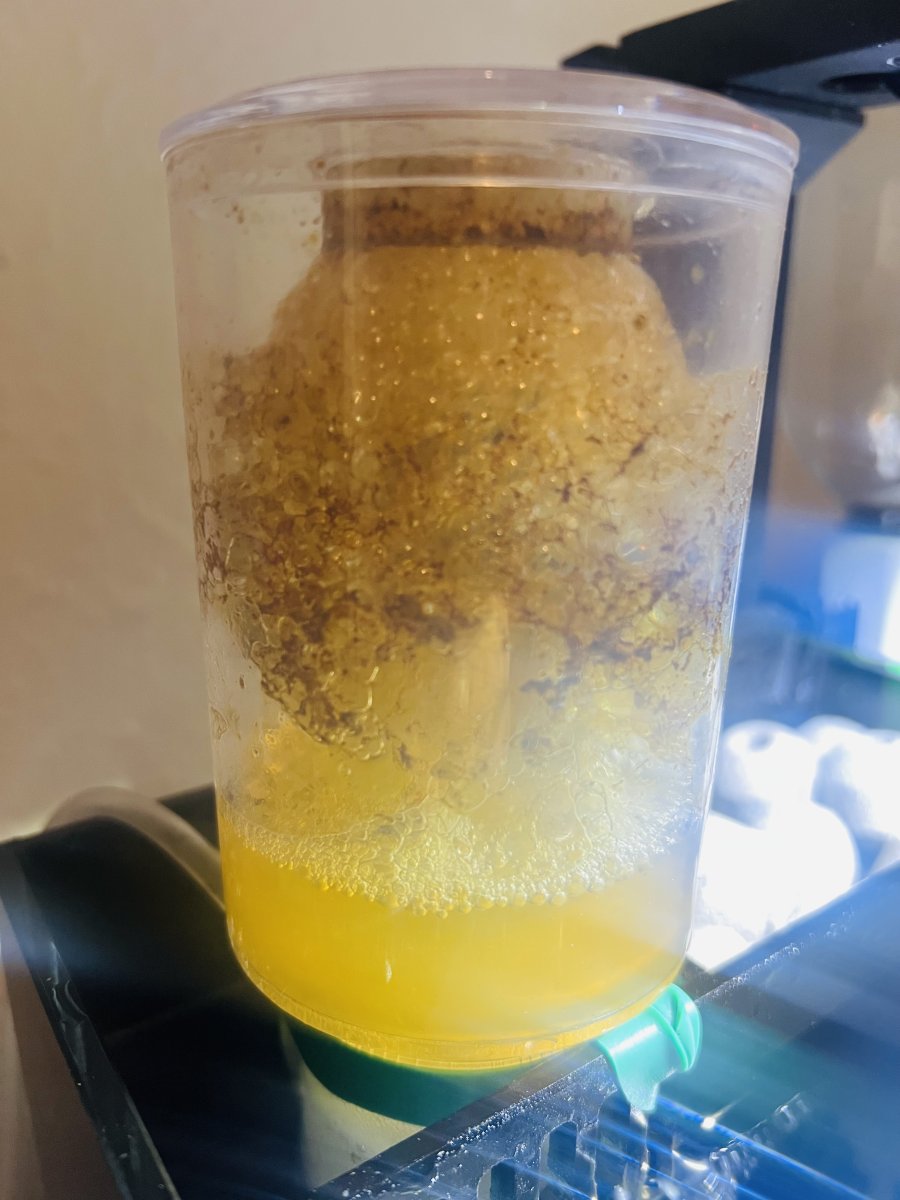
A image of a protein skimmer in a tank with just saltwater and one invert.
It would be crazy to say that one single invertebrate would be making all this skimate on its own imo.

 
It’s been two weeks since the introduction of a feather star to this experiment, there is small evidence that a feeding pathway could of been established due to the star fecal excretions that is happening around twice a day.

This is the biofilms in protein skimmer before introduction

IMG_1277.jpeg


Protein skimmer after introduction

2024-10-30-23-32-08-317.jpeg


Fecal excrement collection from tank

IMG_1278.jpeg


What pathway should I be looking into to try and evaluate results? @Dan_P is this in your field?

@Lasse is this something you familiar with?
 
Last edited:
It’s been two weeks since the introduction of a feather star to this experiment, there is small evidence that a feeding pathway could of been established due to the star fecal excretions that is happening around twice a day.

This is the biofilms in protein skimmer before introduction

IMG_1277.jpeg


Protein skimmer after introduction

2024-10-30-23-32-08-317.jpeg


Fecal excrement collection from tank

IMG_1278.jpeg


What pathway should I be looking into to try and evaluate results? @Dan_P is this in your field?

@Lasse is this something you familiar with?
Sorry, I feel a bit adrift. Which results are we evaluating?
 
Sorry, I feel a bit adrift. Which results are we evaluating?

Im trying to understand what could be possible feeding the crinoid introduced to this experiment.
I say possibly as I’ve never had a crinoid showing signs of feeding and popping, that makes me assume that he may be consuming something as a result of the soup made in this experiment.
The above images are samples collected before and after introduction.


We have only added, organic carbon, amino acids (other forms of early nitrogen) and phosphate in this tank that could potentially be:

• Increased heterotrophic dinitrification
• Increasing heterotrophic anabolism
• increasing single cell zooplankton (Protozoa feeding on bacteria or carbon)
• increasing particulate organic carbon
• increasing nitrogen
• increase of pelagic biofilms

I’m not sure if I missed some of the possibilities.
 
Last edited:
Im trying to understand what could be possible feeding the crinoid introduced to this experiment.
I say possibly as I’ve never had a crinoid showing signs of feeding and popping, that makes me assume that he may be consuming something as a result of the soup made in this experiment.
The above images are samples collected before and after introduction.


We have only added, organic carbon, amino acids (other forms of early nitrogen) and phosphate in this tank that could potentially be:

• Increased heterotrophic dinitrification
• Increasing heterotrophic anabolism
• increasing single cell zooplankton (Protozoa feeding on bacteria or carbon)
• increasing particulate organic carbon
• increasing nitrogen
• increase of pelagic biofilms

I’m not sure if I missed some of the possibilities.
Do we know the time interval between ingestion and egestion? It might have come into the aquarium with a gutful.
 
Do we know the time interval between ingestion and egestion? It might have come into the aquarium with a gutful.
The crinoid started doing this 2 or 3 days after introduction and it’s a daily occurrence now.

IMG_1219.jpeg


This image below is the same substance under microscope

IMG_1278.jpeg


At first I thought it was sand from other aquariums he’s been before I got him but it’s fairly light weight and dissolves in the water to touch.
I can see the same substance in the protein skimmer cup also that changed the colour from a light yellow (before introduction) to a dark orange colour.

IMG_1325.jpeg


Below it’s the microscopic examination of the orange substance in protein skimmer cup

2024-10-30-23-30-33-900.jpeg
2024-10-30-23-33-35-009.jpeg


My organic carbon is translucent/cristal look under the microscope

IMG_1277.jpeg


Another observation I’ve been making is that there is some evidence that this tank is producing more Protozoa than average tanks, I’ve compared it with two other videos I’ve found on YouTube and could easily be 100x more Protozoa.
I’ve asked other members to see if they could provide with some microscopic images of the content from their tanks but have been unsuccessful so far.
I’ve also found out recently that one of the ingredients in my organic carbon is used to grow Protozoa in laboratory settings.

Edit:

I just got home and the same substance is there again, I clean the tank every day to keep debris in suspension.

IMG_1420.jpeg
 
Last edited:
I believe this is the end of this thread

The theory that I’ve discussed in this thread

https://www.reef2reef.com/threads/c...eld-ratio-a-little-better-in-aquaria.1076135/
Was applied in the form of a test and the results seems to be a potential way to keep one off the hardest organism known in the hobby fed.

I don’t know if it will keep him alive long term as I’m not sure on what part of the make up of saltwater is feeding it at the moment.

Thank you for the cooperation.
 

TOP 10 Trending Threads

WHEN REEFING GETS TOUGH, WHAT KEEPS YOU MOST INVESTED?

  • My livestock depends on me, so I keep showing up for them

    Votes: 8 80.0%
  • I look for small signs that things are improving

    Votes: 0 0.0%
  • I want to figure out what’s going wrong

    Votes: 1 10.0%
  • I remind myself that rough stretches will pass...just keep reefing

    Votes: 0 0.0%
  • I lean on other reefers for advice or encouragement

    Votes: 0 0.0%
  • I simplify, step back from tinkering, and give the tank time

    Votes: 1 10.0%
  • Honestly, sometimes I wonder if I want to keep going

    Votes: 0 0.0%
  • Other (Post in the comments)

    Votes: 0 0.0%
Back
Top
Home
Post thread…
Market
What's new





