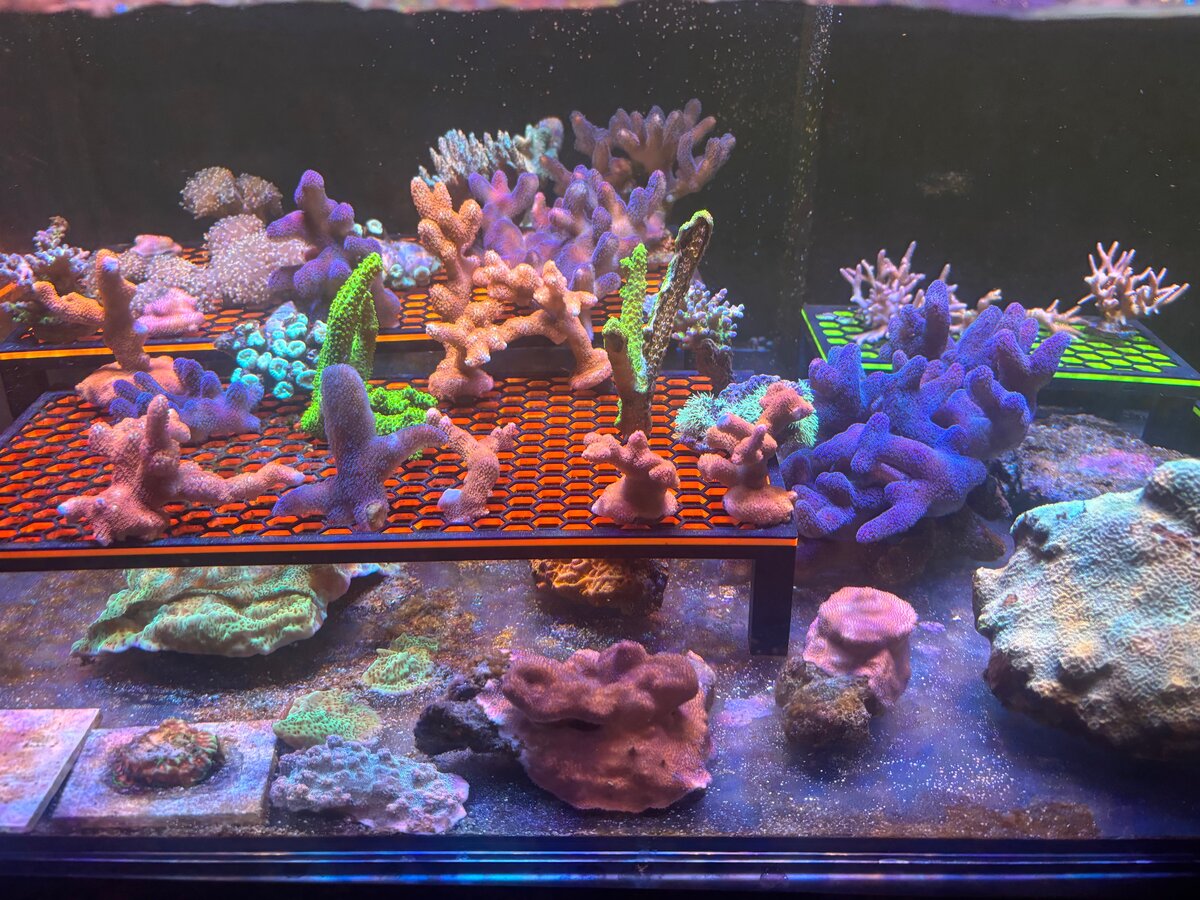
Nuke it, break it down, kill it with fire???????

wmatt140

Active Member
View Badges
Joined
Oct 2, 2021
Messages
116
Reaction score
163
Location
Houston-ish
What state or country do you live in
Texas
Rating - 0%
0   0   0
Not sure of my next move, so here I am.

Background. I had a successful SPS tank for years. I upgraded my tank, 140 gal to 300 gal. I didn't like how much the vermetid snails had taken over my rock work so I wanted to start the new tank with dry rock and dry sand and use bottled bacteria.

It looked good for a few months and then my SPS started slowly declining. I ran multiple ICP tests over several months with no major issues including the Organo test for medications, pesticides, etc. All good. Running out of options, I tried Aquabiomics to test my bacteria population. BIG PROBLEM.

My tank had the highest percentage of Vibrio Owensi they had ever seen. Over the last year or so I have:

Changed Tropic Marin Reef Pro Salt to Tropic Marin Syn-Biotic

Added a 55 watt UV

Added a reactor with Dr. Tim's Pearls

Gallons of liquid bacteria, MicroBacter 7 and Clean, Dr. Tim's Eco Balance and others, PNS, etc.

Water changes, leave sand alone, clean sand, added some new sand from TB aquatics.

I still have some SPS in my frag tank and try and move some to check the display but within a week or two they start declining or die. I have successfully moved some back to the frag tank to recover.

Fish are fine, and the only corals to survive are zoas, GSP, a photosynthetic Gorgo and recently two torches. Also tried hammers but they didn't survive.

Aquabiomics is no more so I can't do any follow up tests.

Treat with antibiotics, replace the sand, rocks, both?

Thanks for reading.

Full tank shot
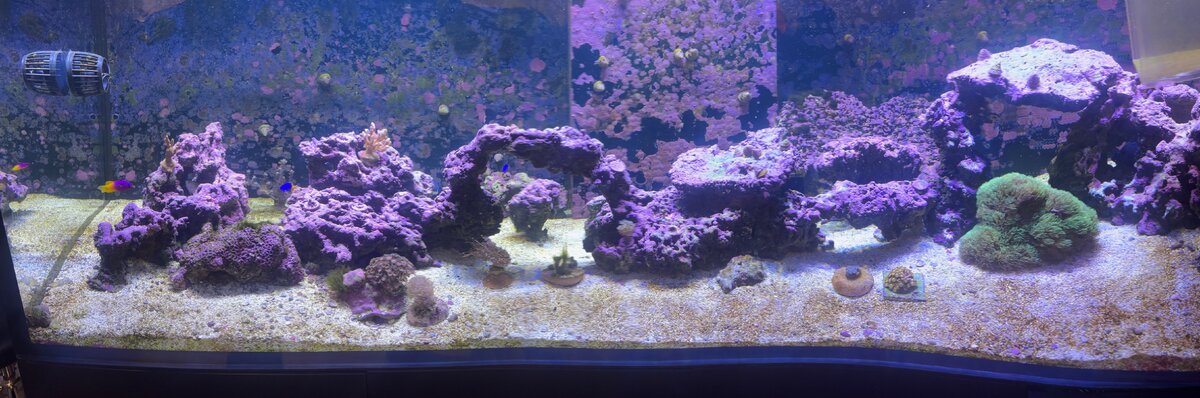
IMG_3708.jpeg


Example of what happens in the main display. Purple Stylo
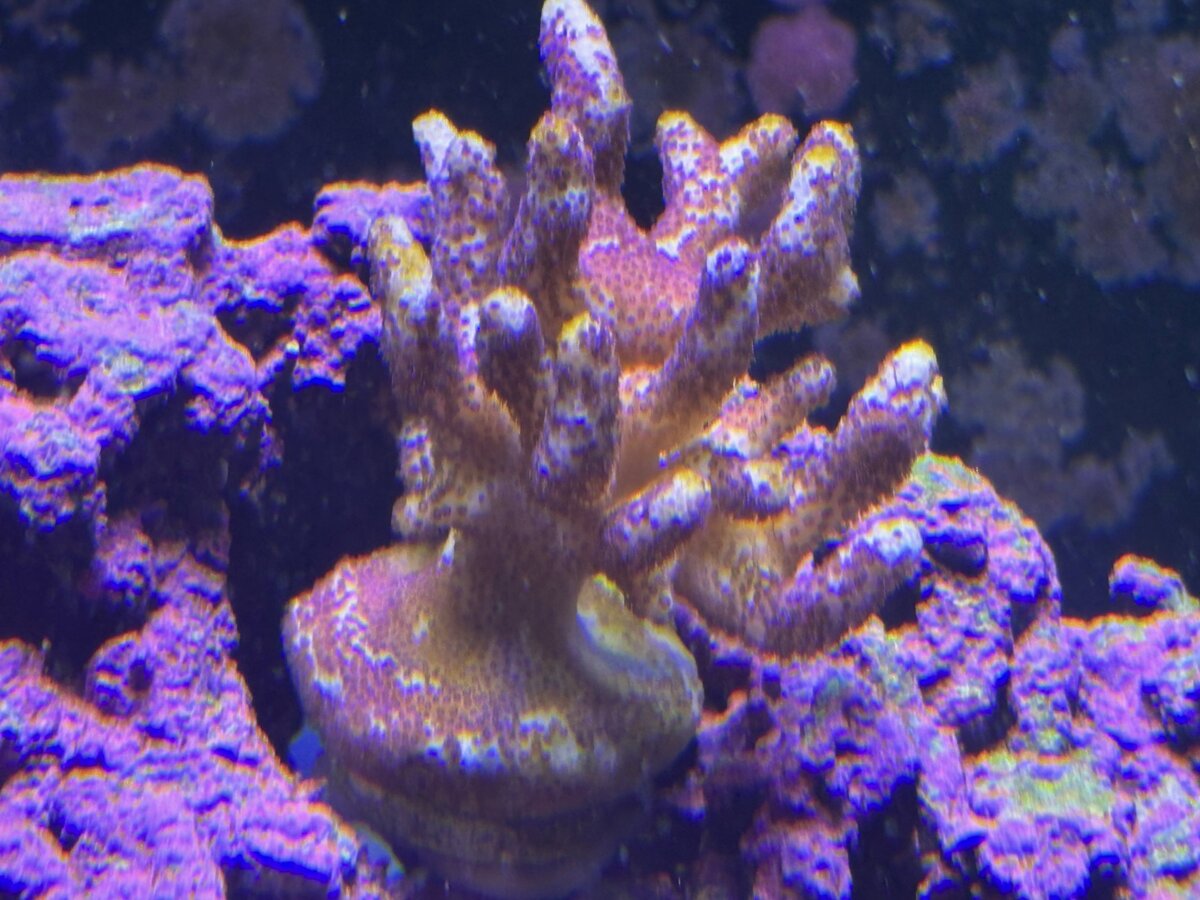
IMG_3707.jpeg


Frag Tank

IMG_3697.jpeg
 
You went from an established live rock system to a sterile new one, with only the carried over corals for seeding, this made your microbiome go crazy, which lead to coral problems, and then you made a huge correction maneuver to try and fix the problem, but even if it helped, a huge adjustment will make huge ripples for time to come.

You say it was good for a few months, but how old is the tank and how long has it been since the seeding correction? It could be that only now your live rock is getting fully colonized and even without the corrective steps would be starting to move in a good direction.

But the short of that angle is that it needs time. I do think that's true, but in upgrading, what did your equipment look like? For example, if you carried over the equipment that grew sps great in a 140 to the 300 with nothing more, both light and flow are probably too low.

It could also be checking the basic nitrate and phosphate - it's been observed that too high nitrate relative to phosphate can be particularly problematic within any normal limits. If your phosphate is low, it could be worth dosing/feeding to raise it relative to your nitrate.
 
For this issue, I'm trying to avoid this turning into a lengthy discussion about other parameters or equipment. Same equipment beefed up for the size, par readings good, ICP tests good. This is the only test that has come back abnormal.

Vibrio Community​

This section of the report is based on the new Vibrio-specific marker introduced in Microbiome 2.0. These data provide species-level identification for bacteria in the genus Vibrio that can’t be resolved using the standard marker. Read more here.


Vibrio Coral Pathogens
specieslevelpercentile
Vibrio_owensii22.8196.8
Note:
Level indicates percent of DNA matching each species,
Percentile refers to the fraction of samples with lower levels than yours

PS your report shows what may be the highest level of Vibrio owensii we've ever seen.. if you have coral issues this would be by far my top pick for whats causing them.


Eli Meyer

AquaBiomics - DNA testing for aquariums and aquaculture

https://aquabiomics.com/
 
My point is also that your issue is likely not a vibrio one and to point out the way it got to that place initially.

Vibrio species are known coral and fish pathogens, they are also present in quantity in every system. Bacteria grow to fill a nutrient vacuum (like a power vacuum, in that sense), and they do so extremely quickly. It is likely that even a day or two after that sample the number was noticeably down, and their explosion probably had a direct, but maybe not obvious trigger. Just the presence of sick corals could have multiplied the ambient vibrio population in your system by 10x the normal amount.

Since they are filling a nutrient void, if their food source goes away or another population springs up that can better exploit it, the balance can swing dramatically and quickly. The reason tank age and sterility at startup matter is that a microbiome that has seen more cycles and has more balanced and varied populations will tend to have nutrient vacuums filled by many types rather than just an abundance of one. The reason why nitrate, phosphate, flow, and par all matter is because those being off in a meaningful way mean coral stress, which promotes vibrio growth, which promotes tissue loss and a cascading increase in coral pathogens in the system.

Your problem now is not caused by the vibrio spike you saw a while ago, but the causes of the vibrio spike then very likely are still causing other issues in the system in the aftershocks of both the significant event and the dramatic treatment, and a still young system is less able to absorb those aftershocks.
 
I definitely don't have a low nutrient tank. I have a lot of fat fish. Phosphate .11 and nitrate 19. Same photons on my frag tank and similar par levels.

Circulation is a red dragon return pump and 4 MP 40's in the display.

Ok, I'm following you about the initial causes of the Vibrio spike. Shouldn't the tank have stabilized over the last year with few corals in it and gallons of "good" bacteria" and fish poop?

I'm going to do another ICP test since it has been awhile.
 
It seems like you tried to substitute a mature biomme for gallons of bottled bacteria. IME its very hard to keep acro's in a brand new tank, and despite the gallons of bottled bacteria it was a brand new tank.

Have you kept track of the parameters in the new tank, especially the alkalinity? Has it remained stable the whole time the corals were in the new tank?
My alk and other parameters have been steady. I've only had to do minimal dosing due to the lack of corals and water changes. My goal was to try and populate with good bacteria. That obviously failed spectacularly.

The question now is how do I fix it? After a year of trying various methods, I don't seem to have made any progress.
 
Has it been a year since the 300 was started? If it has, yeah that's usually sufficient to be mostly stabilized. While adding the bacterial supplements will likely have a more positive benefit, doing it all at once also can throw things off in a different way - it's hard to say for sure and even with testing populations can swing over every single day (I don't know where it is, but I know there was someone who setup a tank and regularly tested with aquabiomics, maybe every few days, maybe once a week for a few months and it was surprising how quickly populations changed.)

Circulation sounds like probably enough, but maybe not a lot. With 300G I feel like people often have a couple MP60s involved or a gyre or something else. Over water volume is probably enough, but I wouldn't be surprised if it was less than what your 140 got, and that may be some part of the puzzle.

An ICP as a sanity check is probably a good bet, also probably checking for stuff like stray voltage, splits in magnets, and those other subtle coral-hurting things that can occasionally a problem. From my understanding, with 0.1 ppm phosphate, I think 15ish ppm nitrate should be somewhat in balance, but it usually wouldn't hurt to be slightly less nitrate or slightly more phosphate, I'm just not sure it's actually necessary to chase.

And I think it's worth mentioning, of the proposed solutions - I'd avoid all of them: antibiotics, replacing sand, or replacing rocks. Building up a good microbiome seems to be very heavily weighted towards just running normally for a while, so things that would intentionally disturb it, while they could have some desired effect in the short term, would add months to the proverbial counter that needs to count all the way down for things to have stabilized. If you determine that something needs to be corrected in some direction, making a slower correction over a longer period is almost always preferable so that the ecosystem you have established has the time it needs to adapt to the change.
 
I feel flow is more important than light for SPS, tho light is very important as well. I can comment on all the testing results because I never do any ICP testing. I will say having 4 MP40s in a 300g probably isn't going to keep many SPS happy. I ran 4 MP40s on a 330g and there's no way any of my sticks would be happy with the flow the MP40s created in that tank. I have two MP40s running 70% and two orca 6075s sweeping the tank at 90% to keep across happy in a 48x22x22" 100g peninsula tank. When I had the same coral in a 36x22x22" lagoon I ran 4 MP40s and two Nero 5s and things did well.
The first SPS tank I started with a dry rock display was a struggle for the first year even with live rock in the sump.
 
I don’t think any of us can pinpoint your issue, but I will add a few comments from my perspective.

A new tank started the way that you did likely goes through a long series of progressions where different organisms come and go and compete. It’s not unreasonable to think that as this process unfolded, your attempted corrections kept stirring the pot and resetting or changing the direction of this progression. A year of constant correction isn’t a year of stability.

My best advice is to stop dumping all of that stuff into your tank, stop worrying about ICP or DNA testing, and just give it time. Alk, calcium, magnesium, and water changes. Minor trace if you must, but skip the bottles of bacteria, bottles of quick fixes, antibiotics with no indication, and just be patient. Feed the fish and let the system find its own direction without constant attempts at correction.
 

TOP 10 Trending Threads

WHEN REEFING GETS TOUGH, WHAT KEEPS YOU MOST INVESTED?

  • My livestock depends on me, so I keep showing up for them

    Votes: 11 73.3%
  • I look for small signs that things are improving

    Votes: 2 13.3%
  • I want to figure out what’s going wrong

    Votes: 1 6.7%
  • I remind myself that rough stretches will pass...just keep reefing

    Votes: 0 0.0%
  • I lean on other reefers for advice or encouragement

    Votes: 0 0.0%
  • I simplify, step back from tinkering, and give the tank time

    Votes: 1 6.7%
  • Honestly, sometimes I wonder if I want to keep going

    Votes: 0 0.0%
  • Other (Post in the comments)

    Votes: 0 0.0%
Back
Top
Home
Post thread…
Market
What's new