




Orphek Marketing Questions?

  • Thread starter Thread starter Hooz
  • Start date Start date
  • Tagged users Tagged users None

Hooz

Valuable Member
View Badges
Joined
Aug 16, 2020
Messages
2,071
Reaction score
2,049
Location
Heath, OH
What state or country do you live in
Ohio
Rating - 100%
1   0   0
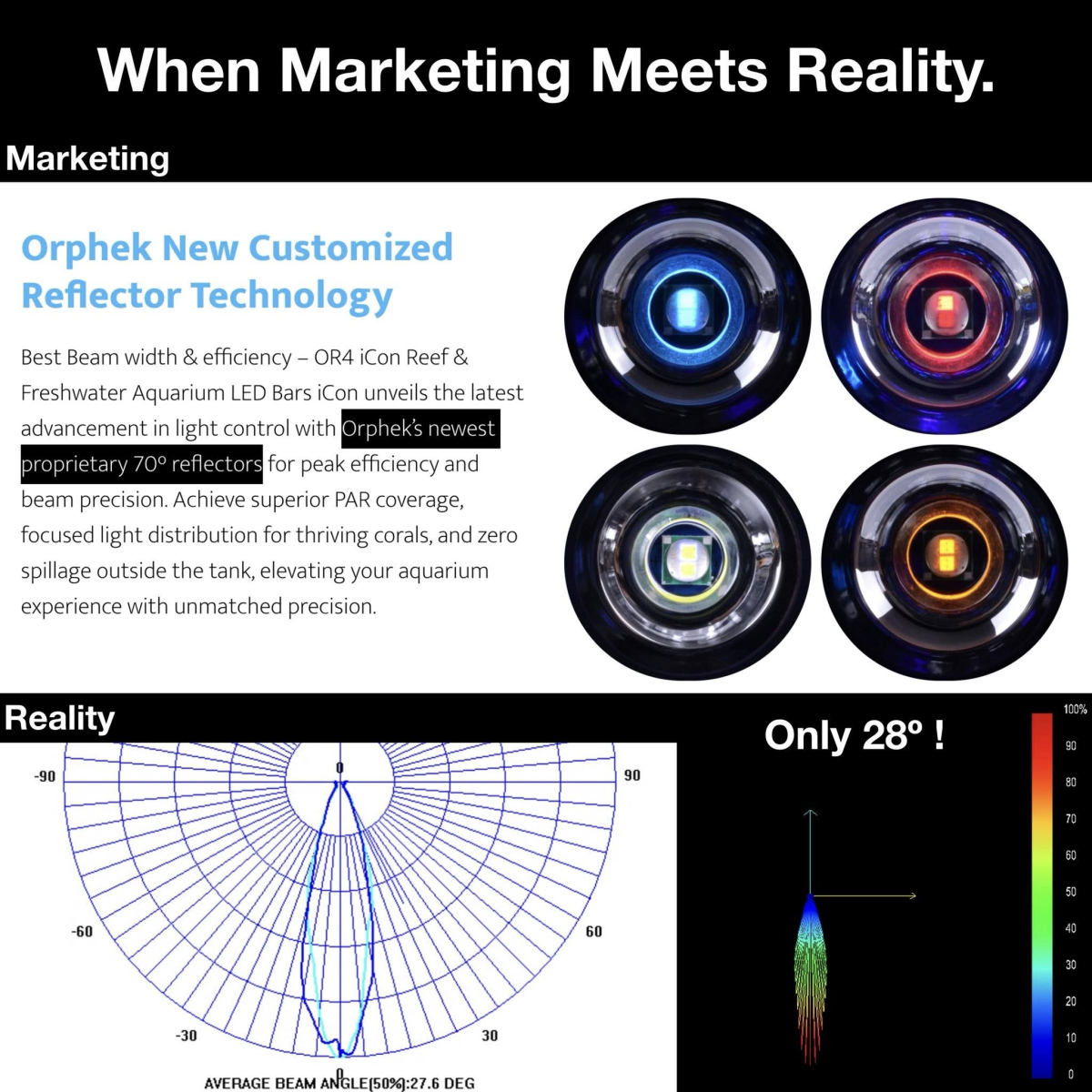
The new OR4 bars are marketed as having 70 degree reflectors, but some recent independent testing has proven that to be false.
1752164392388.png


1752164614703.png


1752164661579.png


28 degrees is certainly not 70 degrees!

1752164462553.png


That PAR map is also horrible, but exactly as you would expect from a string of laser beams. Look at the spectrum at each point, every 5" down the length of the bar. It's like you have a different light over your tank every 5", and that is with the measurements being taken 24" below the bar! My take away was this... If you plan on using Orphek bars to light your tank, plan on using twice the number of bars as you think you need, and mount those suckers on the ceiling so you can actually get some color blending!

I didn't post this to bash on Orphek (although the results speak for themselves). I posted it to point out the blatant dishonesty in marketing that seems to be prevalent, even in the reefing industry. Nobody is testing this stuff, and nobody is calling these people on their BS.

And for all the "AI lights melt lenses" people, guess what... Almost ALL reef LED fixtures can and will burn/melt lenses eventually.

1752164703888.png


@Ryan - Serious Reefs you asked if there was a need for bench testing. I think stuff like this shows there is ABSOLUTELY a need for bench testing, especially with lighting.
 
This is interesting information. I use the OR4 bars but just as supplemental lighting. I agree that there is always a need to test companies claims.
 
The new OR4 bars are marketed as having 70 degree reflectors, but some recent independent testing has proven that to be false.

1752164392388.png


1752164614703.png


1752164661579.png


28 degrees is certainly not 70 degrees!

1752164462553.png


That PAR map is also horrible, but exactly as you would expect from a string of laser beams. Look at the spectrum at each point, every 5" down the length of the bar. It's like you have a different light over your tank every 5", and that is with the measurements being taken 24" below the bar! My take away was this... If you plan on using Orphek bars to light your tank, plan on using twice the number of bars as you think you need, and mount those suckers on the ceiling so you can actually get some color blending!

I didn't post this to bash on Orphek (although the results speak for themselves). I posted it to point out the blatant dishonesty in marketing that seems to be prevalent, even in the reefing industry. Nobody is testing this stuff, and nobody is calling these people on their BS.

And for all the "AI lights melt lenses" people, guess what... Almost ALL reef LED fixtures can and will burn/melt lenses eventually.

1752164703888.png


@Ryan - Serious Reefs you asked if there was a need for bench testing. I think stuff like this shows there is ABSOLUTELY a need for bench testing, especially with lighting.
I’m surprised they’re off by so much. It’s not even the 40* of spread stamped on the reflector. Could this be a bad batch?
 
I’m surprised they’re off by so much. It’s not even the 40* of spread stamped on the reflector. Could this be a bad batch?

I suppose anything is possible, but this was just randomly purchased from a retailer, just like any of us would do.
 
The new OR4 bars are marketed as having 70 degree reflectors, but some recent independent testing has proven that to be false.

1752164392388.png


1752164614703.png


1752164661579.png


28 degrees is certainly not 70 degrees!

1752164462553.png


That PAR map is also horrible, but exactly as you would expect from a string of laser beams. Look at the spectrum at each point, every 5" down the length of the bar. It's like you have a different light over your tank every 5", and that is with the measurements being taken 24" below the bar! My take away was this... If you plan on using Orphek bars to light your tank, plan on using twice the number of bars as you think you need, and mount those suckers on the ceiling so you can actually get some color blending!

I didn't post this to bash on Orphek (although the results speak for themselves). I posted it to point out the blatant dishonesty in marketing that seems to be prevalent, even in the reefing industry. Nobody is testing this stuff, and nobody is calling these people on their BS.

And for all the "AI lights melt lenses" people, guess what... Almost ALL reef LED fixtures can and will burn/melt lenses eventually.

1752164703888.png


@Ryan - Serious Reefs you asked if there was a need for bench testing. I think stuff like this shows there is ABSOLUTELY a need for bench testing, especially with lighting.

Are you suggesting that every product be torn apart and tested to verify the product marketing? That sounds exhausting. If not, then what is the criteria for product selection?
 
I just looked at the AI Blade marketing since they’ll be frequently cross-shopped. They claim a 95* spread. In one paragraph they talk about tight LED grouping and shimmer and in the next they highlight “even PAR, smooth color mixing and exceptional spread.” I guess the Blade just does it all. *eyeroll*
 
Are you suggesting that every product be torn apart and tested to verify the product marketing? That sounds exhausting. If not, then what is the criteria for product selection?

No. This test went above and beyond for sure. A quick PAR map, even open air tells a LOT about a light, though. Anyone could look at that PAR map and tell something was off about the beam angle claim, and the added shots of the spectrum along the length of the bar was just icing on the cake. You don't have to split hairs on the difference between an 85 degree beam and a 90 degree beam, but a person with very little critical thinking skills could deduce that 28 degrees is NOT 70 as claimed.

The old BRS light tests did a great job showing stuff like this (recommended mounting heights, shadow tests, etc) over tanks full of water. They caught heat for which products they reviewed, potential for brand bias, etc, but the numbers didn't lie. Now, with Ryan gone, we don't even have that option anymore. All while "big name" companies are pulling this kind of crap.
 
No. This test went above and beyond for sure. A quick PAR map, even open air tells a LOT about a light, though. Anyone could look at that PAR map and tell something was off about the beam angle claim, and the added shots of the spectrum along the length of the bar was just icing on the cake. You don't have to split hairs on the difference between an 85 degree beam and a 90 degree beam, but a person with very little critical thinking skills could deduce that 28 degrees is NOT 70 as claimed.

The old BRS light tests did a great job showing stuff like this (recommended mounting heights, shadow tests, etc) over tanks full of water. They caught heat for which products they reviewed, potential for brand bias, etc, but the numbers didn't lie. Now, with Ryan gone, we don't even have that option anymore. All while "big name" companies are pulling this kind of crap.

Thank you for the reply. I appreciate it. Maybe I read too much into the last statement when I hit reply.

Honestly I think most of us are aware that our hobby is heavily market driven be it hardware such as a light, method such as moonshine or bolus (both examples, not picking on either), or additive (be it dosing, curing, or making one feel good). It is difficult to discern fact from anecdotal story or observation(s) and leaves many a hobbyist in precarious position. I've not even factored in the groupies and personal bias...

I guess my point is "so what" (not in a disrespectful way towards your post mind you)? Does this observation of a lens difference or par number change anything other than the curiosity of the person doing the test?

Again not directed at you just my thought as I read the original post. A subject line with marketing-lies is a powerful opening.

Edit: I do not work for, or use, or even interested in the light btw.
 
I guess my point is "so what" (not in a disrespectful way towards your post mind you)? Does this observation of a lens difference or par number change anything other than the curiosity of the person doing the test?

My point is mainly that the hobby is expensive enough, and most people have budgets that they need to work within. Doing the research on what type of light you like, then trying to determine how many fixtures you might need to get the coverage or intensity you're shooting for, budgeting, saving and eventually purchasing said light, only to find that you're not getting the results you expected. Then what? Buy another? Buy something else?

It's just nice to have a source for actual, real world information that ISN'T the manufacturer (for the reasons shown above), and ISN'T just a bunch of people on a forum saying "This is what I got! It's great!"
 
The new OR4 bars are marketed as having 70 degree reflectors, but some recent independent testing has proven that to be false.

1752164392388.png


1752164614703.png


1752164661579.png


28 degrees is certainly not 70 degrees!

1752164462553.png


That PAR map is also horrible, but exactly as you would expect from a string of laser beams. Look at the spectrum at each point, every 5" down the length of the bar. It's like you have a different light over your tank every 5", and that is with the measurements being taken 24" below the bar! My take away was this... If you plan on using Orphek bars to light your tank, plan on using twice the number of bars as you think you need, and mount those suckers on the ceiling so you can actually get some color blending!

I didn't post this to bash on Orphek (although the results speak for themselves). I posted it to point out the blatant dishonesty in marketing that seems to be prevalent, even in the reefing industry. Nobody is testing this stuff, and nobody is calling these people on their BS.

And for all the "AI lights melt lenses" people, guess what... Almost ALL reef LED fixtures can and will burn/melt lenses eventually.

1752164703888.png


@Ryan - Serious Reefs you asked if there was a need for bench testing. I think stuff like this shows there is ABSOLUTELY a need for bench testing, especially with lighting.
I applaud the independent testing of the product claims. thanks for sharing. orphek bars are indeed laser-beam-esque.

 
I just looked at the AI Blade marketing since they’ll be frequently cross-shopped. They claim a 95* spread. In one paragraph they talk about tight LED grouping and shimmer and in the next they highlight “even PAR, smooth color mixing and exceptional spread.” I guess the Blade just does it all. *eyeroll*

The Blade is MUCH closer to advertised. I guess that's a plus.

1752172277140.png
 
My point is mainly that the hobby is expensive enough, and most people have budgets that they need to work within. Doing the research on what type of light you like, then trying to determine how many fixtures you might need to get the coverage or intensity you're shooting for, budgeting, saving and eventually purchasing said light, only to find that you're not getting the results you expected. Then what? Buy another? Buy something else?

It's just nice to have a source for actual, real world information that ISN'T the manufacturer (for the reasons shown above), and ISN'T just a bunch of people on a forum saying "This is what I got! It's great!"

I hear you. However how does one define "getting the results you expect" when there are no actual coral growth tests over time. A pretty big data point that is missing. Par is just a number and one that is heavily marketed.

 
Yep I knew they looked a lot off but I mounted them high temporarily. I guess I just need to build my Next light and stop messing around! I think three big takeaway is they don't die like the or3 has been reported to do...
 
All you have to do is see (in person) a tank run with or3-4 bars and you know those are much tighter beams than advertised. There is virtually no blending of colors under 18" above the tank. You see the individual colors of the leds on the sand and rocks.

Not saying what you did wasn't appreciated by at least me.
 
The Blade is MUCH closer to advertised. I guess that's a plus.

1752172277140.png
That’s good to know. I use a blade grow as a supplement to my XR15 blue and I’ve been really happy with it. Having owned a Kessil in the past I wouldn’t say it excels in shimmer in any way at all but I guess that’s marketing for ya.
 
I hear you. However how does one define "getting the results you expect" when there are no actual coral growth tests over time. A pretty big data point that is missing. Par is just a number and one that is heavily marketed.


I think you're missing the forest for the trees as the old saying goes. The PAR map numbers are relevant, but the "map" itself tells a much bigger story about how the light is distributed and how the colors are blended over a certain area.

When I said "results", I was referring to the whole "experience" with the light, not just the PAR output.

Lets say I have a certain size tank I need to light. In my research I determine that, based on the manufacturer's specs, I can light the whole tank with a single fixture mounted 12" above the tank. But then, when I actually receive the fixture and mount it accordingly, I find that it really only adequately covers half the tank, and the rest is dimly lit or has a bunch of shadowing. That would mean it didn't meet my expectations based on the manufacturer's data, and now I need to come up with a plan on what to do... Raising it higher might get me better coverage, but then do I lose too much PAR? Do I need to add a second light? A third?

See what I mean? With a PAR map like the one posted above, I could've known what to expect before I even bought the light.
 
All you have to do is see (in person) a tank run with or3-4 bars and you know those are much tighter beams than advertised. There is virtually no blending of colors under 18" above the tank. You see the individual colors of the leds on the sand and rocks.

Not saying what you did wasn't appreciated by at least me.
I have 14 x OR3s and 2 x OR4s. My eyes are bad so can’t really tell the difference. They “blend” pretty well for me.

I haven’t measured PAR but visually my OR3 UV/Violet lights seems more intense than the new OR4 UV/Violet. I’m a little disappointed there. I should have gone with the AI Blades or some other mfg tbh.
 
I think you're missing the forest for the trees as the old saying goes. The PAR map numbers are relevant, but the "map" itself tells a much bigger story about how the light is distributed and how the colors are blended over a certain area.

When I said "results", I was referring to the whole "experience" with the light, not just the PAR output.

Lets say I have a certain size tank I need to light. In my research I determine that, based on the manufacturer's specs, I can light the whole tank with a single fixture mounted 12" above the tank. But then, when I actually receive the fixture and mount it accordingly, I find that it really only adequately covers half the tank, and the rest is dimly lit or has a bunch of shadowing. That would mean it didn't meet my expectations based on the manufacturer's data, and now I need to come up with a plan on what to do... Raising it higher might get me better coverage, but then do I lose too much PAR? Do I need to add a second light? A third?

See what I mean? With a PAR map like the one posted above, I could've known what to expect before I even bought the light.

It isn't the old adage just a disagreement. All good here.
 
My point is mainly that the hobby is expensive enough, and most people have budgets that they need to work within. Doing the research on what type of light you like, then trying to determine how many fixtures you might need to get the coverage or intensity you're shooting for, budgeting, saving and eventually purchasing said light, only to find that you're not getting the results you expected. Then what? Buy another? Buy something else?

It's just nice to have a source for actual, real world information that ISN'T the manufacturer (for the reasons shown above), and ISN'T just a bunch of people on a forum saying "This is what I got! It's great!"
Really appreciate your effort - keep up the great work. It would be very cool to have an independent, unbiased benchmarks for all these lights but serious commitment (and capital) is required (esp just one person).

After awhile, I stopped chasing lights (different mfg, newer models, etc) since it’s one expensive endeavor for little gain (IMO). I boils down to reliability and controllability. Once you set up the light, just don’t touch it. For example, my frag tank is running with Radion G4 Pros and corals are growing fine (if not better) than my other tank with G6 Blues, with all things being equal.
 

TOP 10 Trending Threads

WHICH TYPE OF MISTAKE TAUGHT YOU YOUR MOST EXPENSIVE REEFKEEPING LESSON?

  • Moving too quickly or adding too much at once

    Votes: 7 35.0%
  • Skipping—or shortening—quarantine or dipping

    Votes: 5 25.0%
  • Buying the wrong equipment the first time

    Votes: 4 20.0%
  • Ignoring maintenance, warning signs, or redundancy

    Votes: 6 30.0%
  • Chasing numbers or making too many changes

    Votes: 3 15.0%
  • Choosing incompatible fish, corals, or invertebrates

    Votes: 3 15.0%
  • Poor aquascaping or tank-design decisions

    Votes: 1 5.0%
  • Failing to research an animal’s needs

    Votes: 1 5.0%
  • Trusting bad advice

    Votes: 3 15.0%
  • Doing something on the tank when you should've gone to bed

    Votes: 4 20.0%
  • Something else—tell us below

    Votes: 4 20.0%
  • I’m still waiting for my first expensive lesson!

    Votes: 2 10.0%
Back
Top
Home
Post thread…
Market
What's new




