



- Joined
- Mar 9, 2025
- Messages
- 203
- Reaction score
- 137
- Location
- Ponte Vedra
- What state or country do you live in
- Florida
In attempts to research equipment for a new tank, I have come across a lack of knowledge and information when it comes to pumps. So, in order to give a little bit back to the hobby, allow me to offer a VERY BRIEF introduction to pumps.
First, let's note that there are a couple of main categories of pumps. These include centrifugal (~80% of pumps in general) and positive displacement.
Centrifugal pumps (think your return pump) use a spinning impeller and flow is significantly impacted by back pressure.
Positive displacement pumps (think your dosing pumps) move a defined volume of liquid per revolution or stroke.
I'll focus on centrifugal pumps below, but, if people like this, could discuss PD pumps in another post.
A centrifugal pump uses a spinning impeller to create a low pressure area at the impeller eye and then "throw" the liquid toward the discharge. If you close the discharge valve, the pump will just spin and build pressure up to the max it is capable of. If you close a suction valve (or obstruct the suction), the pump will cavitate (sounds like it is full of rocks) and either produce no pressure or very erratic pressure & flow (partial obstruction). Neither suction or discharge situation above is recommended, as they will accelerate wear on your pump. Here is a video (no affiliation) that illustrates a centrifugal pump:
Here is a curve for a centrifugal pump:

Head is on the Y axis and flow on the X axis. The pump will ONLY operate on that line (solid or dashed depending on power supply). The pump performance will ride up and down that line depending on how much pressure it must overcome. So, for this example, the pump can produce 5gpm at 13ft of head.
Why head and not psi? A centrifugal pump can push a liquid (regardless of density) up a certain number of feet (or meters if you live in the rest of the world) vertically. It doesn't matter if it is mercury or water (power required WILL change). The formula to convert head to psi is:
H = (2.31*P)/SG
So, 10psi would equal 23.1 ft of head for fresh water (specific gravity of 1.0)
10psi of salt water (at 35ppt / 1.026 SG) would be 22.5 ft of head.
Total Head (TDH) is the sum of static head (vertical distance you want to move the liquid) and dynamic head (friction losses from all the pipe and fittings in the system).
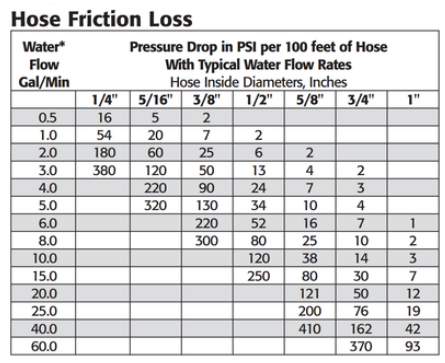
Now, your mixing station is in the basement 10ft below your tank. The above pump will probably work, but it will depend on your piping / hose / how much time you have. Mixing station on the same floor - I'm good to go right? Maybe - it depends on how much flow you want and your piping or hose length / configuration. Here is a chart for P loss (note it is in PSI and we need to convert to head to compare to our pump curve) for hose:
I went to look up the pump data for what others had used for mixing station pumps and could only find max flow and max head without a curve. So, would my water change be done in minutes or hours? Who knows!
Another common misconception - no pump can "pull" liquid, they only "push." Some may say, "what about a self-priming pump?" Good question - a self priming pump lowers the pressure in the pump and allows atmospheric pressure to push the liquid into the pump. This is why there is a limit for how much lift a pump is rated for. Don't believe me? Heat up some water and try to use your self priming pump to lift it - you will just boil the water (exact temp will depend on suction lift being attempted) and wear out your pump.
On that note, whatever liquid level you have above the pump centerline can be subtracted from the head the pump must produce. If you are "pulling" a lift, you must add it to whatever is on the discharge side of the pump.
Now, in the saltwater hobby you see a lot of magnetically driven pumps. These use a drive magnet to turn a driven magnet which are separated from each other. This avoids the need for a mechanical seal. Below is a Goulds industrial magdrive (the basic concepts apply). The motor is out of the picture to the left and turns the drive / driven magnets (dark grey lines parrallel to each other) which are separated by a containment shell. Flow enters from the right into the impeller and discharges out the top.

Not sure if you can make them out above, but the impeller shaft and driven magnet ride on product cooled / lubricated bearings. These bearings can be different materials, but even the best materials don't like being run dry. Did you also note that they are product cooled / lubricated? So, you should not leave these pumps (any pump really) running against a closed discharge valve. The liquid in the pump will get hot quickly and you are just asking to shorten the life of your pump. Also, if you do run the pump dry or dead headed for a period of time, allow it to cool down before you send cold water to it. If the pump has ceramic bearings, you can thermal shock / shatter them.
There is a lot more to this including the various styles of centrifugal pumps (it is a very different pump that feeds an industrial RO system vs propels a lazy river, but they are both centrifugal) and we haven't even touched on PD pumps. I hope this helps and clarifies some of the misconceptions I have seen out there. Happy reefing, I'm off to find a pump curve...
First, let's note that there are a couple of main categories of pumps. These include centrifugal (~80% of pumps in general) and positive displacement.
Centrifugal pumps (think your return pump) use a spinning impeller and flow is significantly impacted by back pressure.
Positive displacement pumps (think your dosing pumps) move a defined volume of liquid per revolution or stroke.
I'll focus on centrifugal pumps below, but, if people like this, could discuss PD pumps in another post.
A centrifugal pump uses a spinning impeller to create a low pressure area at the impeller eye and then "throw" the liquid toward the discharge. If you close the discharge valve, the pump will just spin and build pressure up to the max it is capable of. If you close a suction valve (or obstruct the suction), the pump will cavitate (sounds like it is full of rocks) and either produce no pressure or very erratic pressure & flow (partial obstruction). Neither suction or discharge situation above is recommended, as they will accelerate wear on your pump. Here is a video (no affiliation) that illustrates a centrifugal pump:
Here is a curve for a centrifugal pump:
Head is on the Y axis and flow on the X axis. The pump will ONLY operate on that line (solid or dashed depending on power supply). The pump performance will ride up and down that line depending on how much pressure it must overcome. So, for this example, the pump can produce 5gpm at 13ft of head.
Why head and not psi? A centrifugal pump can push a liquid (regardless of density) up a certain number of feet (or meters if you live in the rest of the world) vertically. It doesn't matter if it is mercury or water (power required WILL change). The formula to convert head to psi is:
H = (2.31*P)/SG
So, 10psi would equal 23.1 ft of head for fresh water (specific gravity of 1.0)
10psi of salt water (at 35ppt / 1.026 SG) would be 22.5 ft of head.
Total Head (TDH) is the sum of static head (vertical distance you want to move the liquid) and dynamic head (friction losses from all the pipe and fittings in the system).
Now, your mixing station is in the basement 10ft below your tank. The above pump will probably work, but it will depend on your piping / hose / how much time you have. Mixing station on the same floor - I'm good to go right? Maybe - it depends on how much flow you want and your piping or hose length / configuration. Here is a chart for P loss (note it is in PSI and we need to convert to head to compare to our pump curve) for hose:
I went to look up the pump data for what others had used for mixing station pumps and could only find max flow and max head without a curve. So, would my water change be done in minutes or hours? Who knows!
Another common misconception - no pump can "pull" liquid, they only "push." Some may say, "what about a self-priming pump?" Good question - a self priming pump lowers the pressure in the pump and allows atmospheric pressure to push the liquid into the pump. This is why there is a limit for how much lift a pump is rated for. Don't believe me? Heat up some water and try to use your self priming pump to lift it - you will just boil the water (exact temp will depend on suction lift being attempted) and wear out your pump.
On that note, whatever liquid level you have above the pump centerline can be subtracted from the head the pump must produce. If you are "pulling" a lift, you must add it to whatever is on the discharge side of the pump.
Now, in the saltwater hobby you see a lot of magnetically driven pumps. These use a drive magnet to turn a driven magnet which are separated from each other. This avoids the need for a mechanical seal. Below is a Goulds industrial magdrive (the basic concepts apply). The motor is out of the picture to the left and turns the drive / driven magnets (dark grey lines parrallel to each other) which are separated by a containment shell. Flow enters from the right into the impeller and discharges out the top.
Not sure if you can make them out above, but the impeller shaft and driven magnet ride on product cooled / lubricated bearings. These bearings can be different materials, but even the best materials don't like being run dry. Did you also note that they are product cooled / lubricated? So, you should not leave these pumps (any pump really) running against a closed discharge valve. The liquid in the pump will get hot quickly and you are just asking to shorten the life of your pump. Also, if you do run the pump dry or dead headed for a period of time, allow it to cool down before you send cold water to it. If the pump has ceramic bearings, you can thermal shock / shatter them.
There is a lot more to this including the various styles of centrifugal pumps (it is a very different pump that feeds an industrial RO system vs propels a lazy river, but they are both centrifugal) and we haven't even touched on PD pumps. I hope this helps and clarifies some of the misconceptions I have seen out there. Happy reefing, I'm off to find a pump curve...
Last edited:







