




Randy Holmes-Farley
Reef Chemist
View Badges
Staff member
Super Moderator
Ultimate Member
Partner Member 2027
Excellence Award
R2R App User
Expert Contributor
Article Contributor
R2R Research
My Tank Thread
This thread is for the general discussion of the Article Some Thoughts on Chemical Grading: What is "Best"?. Please add to the discussion here.
Some Thoughts on Chemical Grading: What is "Best"?
By Randy Holmes-Farley
There has long been an assumption in the reef hobby that "Pharma grade" was the best grade for a reefing chemical. This thought is seemingly helped along by a number of additive and salt mix suppliers who tout their use of such materials. I thought it would be worthwhile to delve into the world of such specifications to help reefers understand some of these issues, and perhaps save significant amounts of money without sacrificing anything needed for reefing.
First, what is a chemical grade?
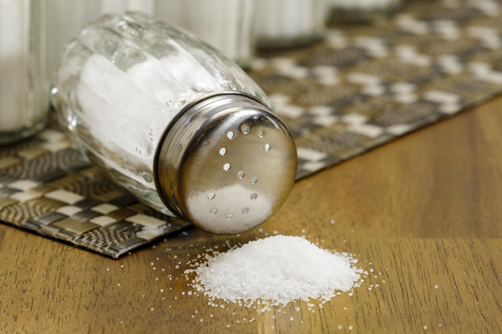
Various organizations and many large chemical suppliers have developed “grades” as a uniform set of specifications that will ensure that a chemical is adequately pure and potent every time a customer uses it. Of course, the adequately pure part depends entirely on the use, and users may need to determine for themselves what sorts of purity are acceptable. Table salt and road ice melting salt will both have specifications that are quite different, but both are important in use.

What Grades Exist?
There are a very large number of grades of chemicals, each trying to show that the chemical is suitable for some intended purpose. Food grade (FCC, food chemicals codex) tries to ensure the chemical is suitably pure to use in food. But exactly how the specifications are set is a bit unclear to many. It does not mean one could eat an unlimited amount of it. Persons setting the specification try to understand what is a likely amount for someone to eat, and then ensure that if they ate that amount, they are unlikely to be poisoned by an impurity.
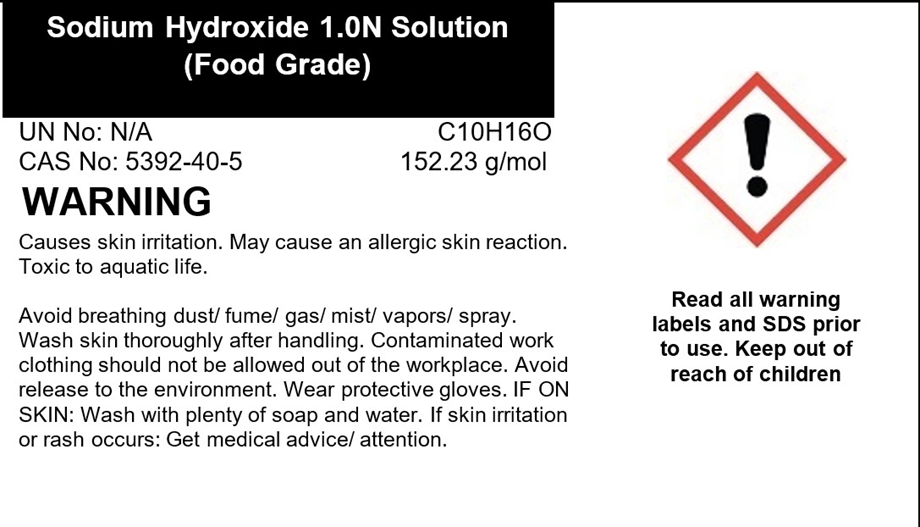
Obviously, how much of something someone might eat is both a bit of guesswork and will vary by person. It also does not literally mean one could eat the material and be OK. Sodium hydroxide is often used in foods and there are food grades, but eating sodium hydroxide by itself would cause serious issues due to its very high pH. In foods, it is mixed with other things that dilute it and lower the pH. The picture below is a commercial warning label for a sodium hydroxide solution. It is food grade, and yet should not be touched.
Here is a summary of various grades one might see in buying fairly pure reef chemicals, it is not a full list, which would be very long.
Pharma Grades
USP (United States Pharmacopeia): Standards established by the USP Convention, often enforced by the FDA. Recognized worldwide, it covers active pharmaceutical ingredients, excipients, and dietary supplements.
NF (National Formulary): Merged with the USP (now USP-NF), this specifically provides standards for pharmaceutical excipients.
EP (European Pharmacopoeia): Published by the European Directorate for the Quality of Medicines (EDQM); legally binding in the European Union
BP (British Pharmacopoeia): Official standards for the UK and many Commonwealth countries.
JP (Japanese Pharmacopoeia): Set by the Ministry of Health, Labor and Welfare and the Pharmaceuticals and Medical Devices Agency (PMDA) in Japan.
IP (Indian Pharmacopoeia): Sets standards for drugs manufactured in India, now part of the Pharmacopoeial Discussion Group (PDG).
Food Grades
Food Chemicals Codex (FCC): The primary, international standard for ingredients, ensuring identity, quality, and purity.
Food Grade (FG): A broad term indicating compliance with regulatory safety, such as FDA Generally Recognized as Safe (GRAS).
Drinking Water Chemicals
NSF/ANSI/CAN 60 American National Standard for Drinking Water Treatment Chemicals
Water Chemicals Codex (WCC) An older version of allowed impurities in drinking water chemicals but still sometimes used
Other Grades
There are many other grades, ranging from much more pure than any of the above specifications, to almost meaningless. At the writing of this article, the chemical supplier Sigma sells 39 different high-end grades of sodium chloride, intended for all sorts of different uses. While purity is not everything (the nature of the impurities matters a lot), these range up to 99.999% sodium chloride.
Another good grade for reefers to look for is AR or ACS (ACS Analytical Reagent grade). Its specifications are different than food grades, focusing more on chemical identity than consumability, but it will eliminate shoddy products.
Grades to avoid, if possible (it isn’t always possible) are technical grade and lab grade. Those have no standard meaning, and unless a supplier says what it means, assume it is a lower quality product.
Food Grade vs Pharma Grade
There seems to be a mantra in the reef hobby that pharma grade is best. That is just not true. It will almost always be a fine choice, but it is not inferior to FCC grade. The specifications may or may not be identical, but there is no generality that pharma is better. In fact, in terms of use based specifications, there are many chemicals that folks may eat a lot more of than they would get as an ingredient in a pharmaceutical tablet, and hence there should be no assumption that pharma should be higher purity.
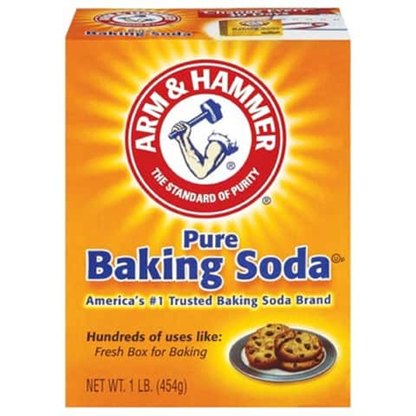
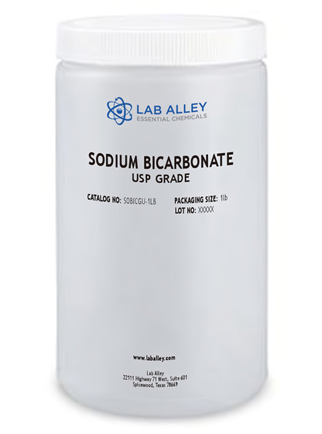
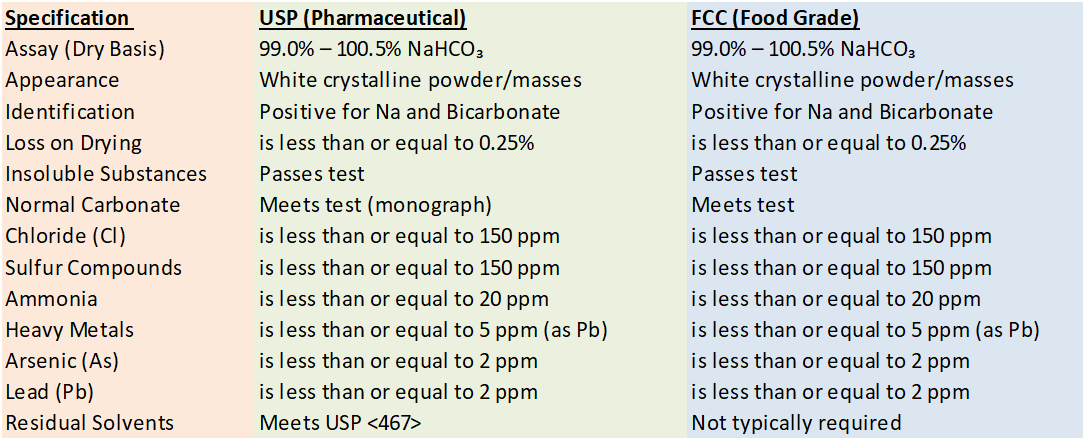
Let’s take a detailed example that many folks use: sodium bicarbonate as an alkalinity supplement. I asked an AI to put together a side-by-side comparison of these two specifications (to find the specs myself would require purchasing documents). The only difference appears to be in residual solvents, which surely is no concern in such a product. But food grade sodium bicarbonate is cheap and easy to obtain at any grocery store in the US. USP grade may be much more expensive and sold only by specialty resellers. Thus, don’t be fooled into thinking there is some impurity reason to buy pharma grade for reef aquarium purposes. The most important specifications are the same.
Does One Need High Purity?
Another question that often comes up is what purity is actually needed. The answer varies a lot for one reason: the amount used. It might seem illogical that one could need very high purity sodium chloride for a salt mix, but could use a low purity of a potentially toxic trace element such as nickel, but that is the reality.
Let’s assume one is making a salt mix, and uses sodium chloride that has 0.1 ppm of copper impurity in it.
Let’s also assume that in making that same salt mix, one uses nickel sulfate that has 1,000 ppm copper impurity in it.
Are either or both of these going to push copper too high?
A seawater salt mix will need about
1. 24 grams of sodium chloride in a liter. If it is 0.1 ppm copper (0.1 mg/kg), then that 24 grams contains about 0.0024 mg of copper. That will boost the new salt water to 2.4 ppb copper.
2. 1.8 ug nickel sulfate (to attain NSW level of 700 ng/L nickel). If it is 1,000 ppm (1 g/kg) copper, then it is adding 0.0018 ppb of copper.
Thus, even with 10,000 times more copper in the nickel additive than in the sodium chloride, it effectively adds more than a thousand times less copper to the final mix.
Lesson: the amount used in a reef tank is critical in determining the needed purity.
Summary
Most reefers do not make salt mixes, but this analysis brings up some important points that serve as a summary for this article.
1. In a salt mix, the purity of the big additives will almost totally drive impurities. Sodium chloride, magnesium chloride, magnesium sulfate or sodium sulfate, calcium chloride, potassium chloride, and sodium bicarbonate are the important ones to be pure. The things present at low levels to begin with really do not need high purity. Such purity of the trace element additives certainly cannot hurt, but may often be a marketing thing rather than a useful thing.
2. In an operating reef tank, hobbyists need to add many things. The big ones are the alkalinity and calcium additives. These are well worth getting in high purity, if possible and affordable. Food grade is a fine choice and spending more on a pharma grade may be throwing away money.
3. There is nothing wrong with buying and using food grade additives even for trace elements (say, iron or zinc). These are generally not expensive since they are sold for actual human consumption and very little is actually used.
4. In some cases, such as sodium silicate, it may not be easy to obtain (or afford) a high purity grade. Reefers will have to decide in what cases scrimping or compromising is acceptable. I have used a technical grade of sodium silicate in my reef. The lower the amount dosed, the lower the risk.
Some Thoughts on Chemical Grading: What is "Best"?
By Randy Holmes-Farley
There has long been an assumption in the reef hobby that "Pharma grade" was the best grade for a reefing chemical. This thought is seemingly helped along by a number of additive and salt mix suppliers who tout their use of such materials. I thought it would be worthwhile to delve into the world of such specifications to help reefers understand some of these issues, and perhaps save significant amounts of money without sacrificing anything needed for reefing.
First, what is a chemical grade?
Various organizations and many large chemical suppliers have developed “grades” as a uniform set of specifications that will ensure that a chemical is adequately pure and potent every time a customer uses it. Of course, the adequately pure part depends entirely on the use, and users may need to determine for themselves what sorts of purity are acceptable. Table salt and road ice melting salt will both have specifications that are quite different, but both are important in use.
What Grades Exist?
There are a very large number of grades of chemicals, each trying to show that the chemical is suitable for some intended purpose. Food grade (FCC, food chemicals codex) tries to ensure the chemical is suitably pure to use in food. But exactly how the specifications are set is a bit unclear to many. It does not mean one could eat an unlimited amount of it. Persons setting the specification try to understand what is a likely amount for someone to eat, and then ensure that if they ate that amount, they are unlikely to be poisoned by an impurity.
Obviously, how much of something someone might eat is both a bit of guesswork and will vary by person. It also does not literally mean one could eat the material and be OK. Sodium hydroxide is often used in foods and there are food grades, but eating sodium hydroxide by itself would cause serious issues due to its very high pH. In foods, it is mixed with other things that dilute it and lower the pH. The picture below is a commercial warning label for a sodium hydroxide solution. It is food grade, and yet should not be touched.
Here is a summary of various grades one might see in buying fairly pure reef chemicals, it is not a full list, which would be very long.
Pharma Grades
USP (United States Pharmacopeia): Standards established by the USP Convention, often enforced by the FDA. Recognized worldwide, it covers active pharmaceutical ingredients, excipients, and dietary supplements.
NF (National Formulary): Merged with the USP (now USP-NF), this specifically provides standards for pharmaceutical excipients.
EP (European Pharmacopoeia): Published by the European Directorate for the Quality of Medicines (EDQM); legally binding in the European Union
BP (British Pharmacopoeia): Official standards for the UK and many Commonwealth countries.
JP (Japanese Pharmacopoeia): Set by the Ministry of Health, Labor and Welfare and the Pharmaceuticals and Medical Devices Agency (PMDA) in Japan.
IP (Indian Pharmacopoeia): Sets standards for drugs manufactured in India, now part of the Pharmacopoeial Discussion Group (PDG).
Food Grades
Food Chemicals Codex (FCC): The primary, international standard for ingredients, ensuring identity, quality, and purity.
Food Grade (FG): A broad term indicating compliance with regulatory safety, such as FDA Generally Recognized as Safe (GRAS).
Drinking Water Chemicals
NSF/ANSI/CAN 60 American National Standard for Drinking Water Treatment Chemicals
Water Chemicals Codex (WCC) An older version of allowed impurities in drinking water chemicals but still sometimes used
Other Grades
There are many other grades, ranging from much more pure than any of the above specifications, to almost meaningless. At the writing of this article, the chemical supplier Sigma sells 39 different high-end grades of sodium chloride, intended for all sorts of different uses. While purity is not everything (the nature of the impurities matters a lot), these range up to 99.999% sodium chloride.
Another good grade for reefers to look for is AR or ACS (ACS Analytical Reagent grade). Its specifications are different than food grades, focusing more on chemical identity than consumability, but it will eliminate shoddy products.
Grades to avoid, if possible (it isn’t always possible) are technical grade and lab grade. Those have no standard meaning, and unless a supplier says what it means, assume it is a lower quality product.
Food Grade vs Pharma Grade
There seems to be a mantra in the reef hobby that pharma grade is best. That is just not true. It will almost always be a fine choice, but it is not inferior to FCC grade. The specifications may or may not be identical, but there is no generality that pharma is better. In fact, in terms of use based specifications, there are many chemicals that folks may eat a lot more of than they would get as an ingredient in a pharmaceutical tablet, and hence there should be no assumption that pharma should be higher purity.
Let’s take a detailed example that many folks use: sodium bicarbonate as an alkalinity supplement. I asked an AI to put together a side-by-side comparison of these two specifications (to find the specs myself would require purchasing documents). The only difference appears to be in residual solvents, which surely is no concern in such a product. But food grade sodium bicarbonate is cheap and easy to obtain at any grocery store in the US. USP grade may be much more expensive and sold only by specialty resellers. Thus, don’t be fooled into thinking there is some impurity reason to buy pharma grade for reef aquarium purposes. The most important specifications are the same.
Does One Need High Purity?
Another question that often comes up is what purity is actually needed. The answer varies a lot for one reason: the amount used. It might seem illogical that one could need very high purity sodium chloride for a salt mix, but could use a low purity of a potentially toxic trace element such as nickel, but that is the reality.
Let’s assume one is making a salt mix, and uses sodium chloride that has 0.1 ppm of copper impurity in it.
Let’s also assume that in making that same salt mix, one uses nickel sulfate that has 1,000 ppm copper impurity in it.
Are either or both of these going to push copper too high?
A seawater salt mix will need about
1. 24 grams of sodium chloride in a liter. If it is 0.1 ppm copper (0.1 mg/kg), then that 24 grams contains about 0.0024 mg of copper. That will boost the new salt water to 2.4 ppb copper.
2. 1.8 ug nickel sulfate (to attain NSW level of 700 ng/L nickel). If it is 1,000 ppm (1 g/kg) copper, then it is adding 0.0018 ppb of copper.
Thus, even with 10,000 times more copper in the nickel additive than in the sodium chloride, it effectively adds more than a thousand times less copper to the final mix.
Lesson: the amount used in a reef tank is critical in determining the needed purity.
Summary
Most reefers do not make salt mixes, but this analysis brings up some important points that serve as a summary for this article.
1. In a salt mix, the purity of the big additives will almost totally drive impurities. Sodium chloride, magnesium chloride, magnesium sulfate or sodium sulfate, calcium chloride, potassium chloride, and sodium bicarbonate are the important ones to be pure. The things present at low levels to begin with really do not need high purity. Such purity of the trace element additives certainly cannot hurt, but may often be a marketing thing rather than a useful thing.
2. In an operating reef tank, hobbyists need to add many things. The big ones are the alkalinity and calcium additives. These are well worth getting in high purity, if possible and affordable. Food grade is a fine choice and spending more on a pharma grade may be throwing away money.
3. There is nothing wrong with buying and using food grade additives even for trace elements (say, iron or zinc). These are generally not expensive since they are sold for actual human consumption and very little is actually used.
4. In some cases, such as sodium silicate, it may not be easy to obtain (or afford) a high purity grade. Reefers will have to decide in what cases scrimping or compromising is acceptable. I have used a technical grade of sodium silicate in my reef. The lower the amount dosed, the lower the risk.
Last edited by a moderator:








