Jay Hemdal
10K Club member
View Badges
Staff member
Forum Moderator
Partner Member 2027
Excellence Award
R2R App User
Expert Contributor
Article Contributor
Fish Medic
My Tank Thread
This thread is for the general discussion of the Article The Weedy Scorpionfish, Rhinopias sp.. Please add to the discussion here.
The Weedy Scorpionfish
Rhinopias frondosa
Jay Hemdal
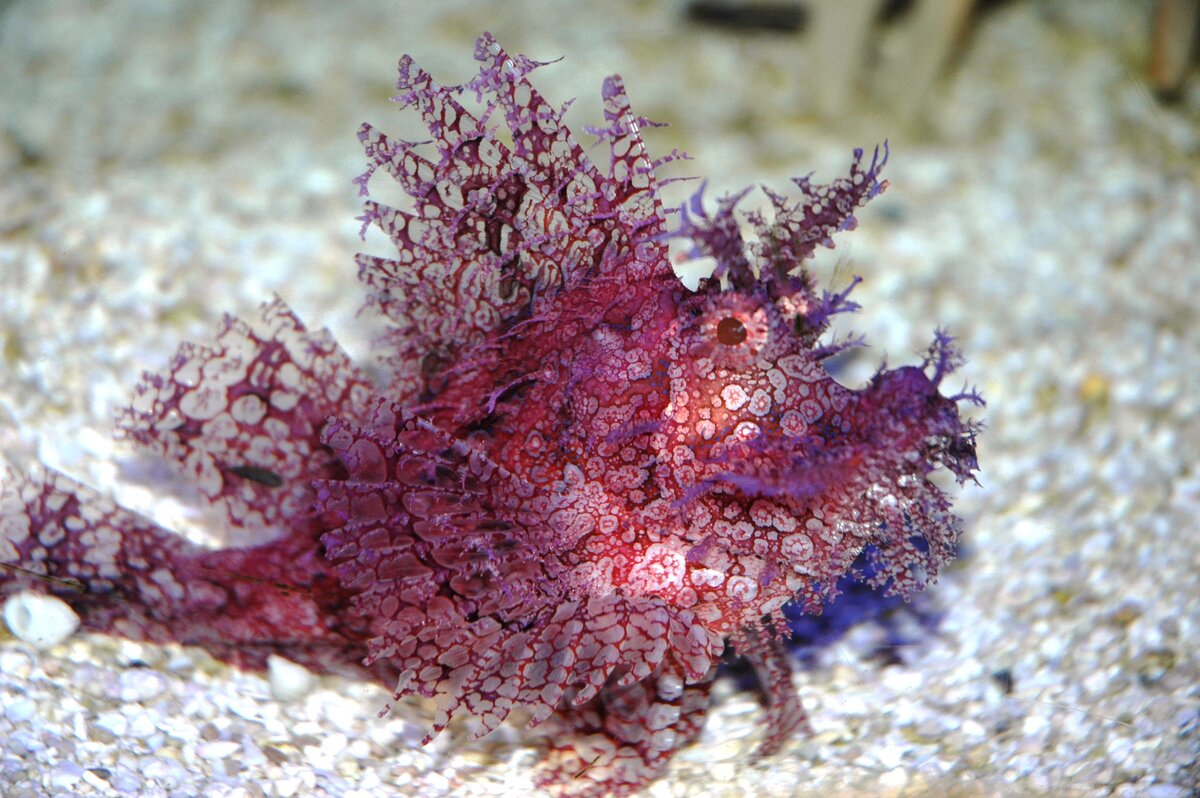
The outrageous looking Weedy Scorpionfish; with their lacy fins, grotesque mouth, goggle eyes and fabulous colors; a magnificent fish in anyone’s opinion. You see their picture in virtually every marine aquarium fish book, their likeness often graces the cover of dive magazines, and they are sometimes featured on nature shows. Growing to a length of 23 cm, the Weedy Scorpionfish is reported from rocky reefs near algae growth in the Indo-West Pacific: East Africa to the Caroline Islands, north to southern Japan at a depth of 13 to 90 meters (FishBase 1999).
This species has some unique natural attributes that it carries over to life in captivity. When excited by potential prey, or threatened by some nearby movement, the fish will often rock back and forth while resting on its pectoral fins – looking like a tangled ball of seaweed being tossed back and forth by the waves. Evidently the Rhinopias scorpionfish have great faith in this ability to look like a plant – they rarely hide in caves and spend most of their time at least partially in the open – “hiding in plain sight”. Some specimens of the weedy scorpionfish have two bright (almost reflective) white colored round spots below their eyes, and about halfway between their eyes and the end of their mouth. When viewed from the front (as if you were a prey item) these spots mimic the eyes of a smaller animal. The Weedy Scorpionfish’s real eyes are well camouflaged and are almost indistinguishable from the rest of the fish’s body. It is unknown exactly what purpose these “false eyes” may serve, but it may be that they confuse potential prey items. For example, a damselfish may key in on the distance between a larger fish’s eyes to determine if the animal is a possible predator. Seeing, the smaller, closer together white “eyespots” on the snout of a Weedy Scorpionfish might not elicit any sort of an escape response, at least it might fool the damselfish long enough for the scorpionfish to capture it.
Like some other members of the family, weedy scorpionfish shed their skin in an apparent attempt to reduce parasites and the growth of fouling organisms such as algae. The frequency of this feat seems to vary with individual fish from about once every two weeks (Michael 1998) to once every 8 weeks (personal observation). The difference in these rates may be a result of different aquarium lighting conditions, parasite load or other, unidentified factors. These fish also posses the ability to gradually change the color of their skin to better mimic that of surrounding tank decorations. It is unknown just how flexible they are in this regard, it is imagined that while a tan fish may turn slightly pinkish over time, it is doubtful that one would be able to turn from dull tan to bright purple.
Their upturned jaws are obviously designed to capture fish that swim overhead, and the speed of their strike rivals that of an anglerfish. Other scorpionfish such as Pterois sp. lionfish are a bit slower in swallowing their prey and they have terminal mouths, usually feeding on prey directly ahead of them. One Rhinopias frondosa refused all food, living or dead for 6 weeks following its importation. This has not been an issue reported by other aquarists who have worked with this and similar species in captivity. As the situation was unlikely to improve without intervention, it was decided to attempt force-feed the animal. Never a routine procedure with any fish, it was made more difficult by the animal’s toxic spines, requiring exceptional care during the process. Using MS-222 at 75 ppm, the animal was anesthetized and carefully turned upside down. Using a syringe and thin tubing, 10 ml of a mixture of powdered fish food and water was injected into its stomach. The fish was returned to its aquarium to revive. Interestingly, it began feeding on its own the next day.
Rhinopias soon learn to anticipate being fed by recognizing the movements made by an aquarist as they approach the tank. At first, these fish will feed only on living fish, but a healthy specimen should train over to non-living food very easily. This is much better for the animal due to reduced chances for disease introduction and is much less expensive for the aquarist. From a nutritional basis, it is usually best to train these fish to feed on some prepared foods (such as gelatin-based foods and other moist diets) as well.
As with many predatory fishes, if scorpionfish are fed substantial amounts of food on a frequent basis, they will usually develop fatty liver disease and will live much shorter lives as a result. Conversely, if an aquarist overreacts to this potential problem, and withholds too much food from the fish, starvation could result. Human nature usually errs the other way – most scorpionfish are “killed with kindness”; too much fatty food, fed to them much too often. Most adult scorpionfish need to be fed only twice a week, and then just enough to “round out” their bellies. One method I think works fairly well is to feed the fish a moderate amount of food on day one – so they develop a noticeable belly. On day three, feed the fish just enough to cause their stomach to again protrude, but just slightly this time. After this, fast the animal for the animal for four days, and then repeat this process. There are only two exceptions to this feeding regimen; young fish that are actively growing, and in the case when a fish’s appetite must be minimized in order to reduce their predation on smaller fish in the aquarium (of course, this will be done at the risk of the health of the predatory fish from over-feeding). I’ve never seen an adult scorpionfish die from starvation at the hands of an aquarist but have seen a large number succumb to fatty liver degeneration. Take a moment to look at underwater photographs of predatory fishes in nature; hollow bellied lionfish, sharks, and barracuda are the norm! “Lean and mean” seems to be the order of the day for predators both in the wild and in captivity.
The primary medical problem facing members of this genus in captivity is lesions that develop on their jaws from rubbing it against a solid surface. One aquarist identified the source of irritation in one fish as being the shipping bag (Michael 1998). In other cases, the lesions seem to develop from the fish too enthusiastically striking at prey and ending up hitting the aquarium’s substrate or tank decorations with their jaws.
As with any scorpionfish held in captivity, the caretaker must know how venomous the animals are and handle them with appropriate care. The toxicity of the various species to humans varies from minor discomfort to death. No listings could be found describing the actual toxicity of Rhinopias scorpionfish fish on humans, so one needs to assume the “worst case scenario” and treat these species with as much care as you would the deadly members of the family. First aid for a person being stung by one of these fish should be as follows: (Adapted from Halstead, 1978)
* Contact an emergency medical service immediately – in most areas by dialing 911.
* Stay with the injured person at all times and be prepared to treat for shock by having the person lie down and elevate their feet.
* Gently clean puncture wound as well as possible and encourage bleeding by massaging towards the wound.
* Soak injured area in hot water (as high a temperature as can be tolerated) until directed otherwise by a medical professional.
* Wait for emergency medical transport.
Other species of the genus Rhinopias are available from time to time but are generally much more rarely seen. R. aphanes, the Merlet’s scorpionfish is perhaps the most photographed member of this group. It is apparently a crinoid mimic and is often found in association with those echinoderms. They cost around twice the price of a weedy scorpionfish – if they are ever even available. They are reported to inhabit coral reef slopes in the Western Pacific: Australia, New Caledonia, New Guinea, and north to Japan (FishBase 1999). One public aquarium recently reported acquiring a specimen of R. eschmeyeri (endemic to Mauritius in the Indian Ocean) and it is doing very well so far. Some color forms of R. frondosa resemble a more brightly colored R. eschmeyeri while others tend to look like a dull colored R. aphanes. This can make exact identification of these three species difficult for the casual observer.
Rhinopias xenops is a relatively drab species found in deeper water around Hawaii. Aquarists report that this species offers no unusual husbandry challenges, and although rare, accept non-living food quite readily, and was not prone to developing lower jaw lesions (N. Chan 2001).
By far the most sought-after member of the group is the bright red R. argoliba, known only from Sagami Bay, Japan. Reported to feed on fishes and crabs, this temperate water species grows to around eight inches in length (FishBase 1999). Recently, a rare marine fish dealer in Japan had one of these available (price unknown!) and he remarked it was the first time they had ever had this species available, and that they had collected it themselves while diving. The only other species, Rhinopias cea is apparently known from one specimen collected at Easter Island at a depth of 5 meters (FishBase 1999). This remote location means that this species will probably never become available to marine aquarists. Recently however, two other Easter Island endemic species (A butterflyfish, Chaetodon litus and a pygmy angelfish, Centropyge hotumatua) were advertised for sale. Since R. cea is reported from the same region, it may just be a matter of time before it is also made available to aquarists (at least those who are willing to pay the price!).
Why is it that some species are so elusive to home aquarists? You often see pictures of weedy scorpionfish, ghost pipefish, conspiculatus angelfish, pollen’s groupers, and dragon morays. Much more rarely do you ever see them available for sale. Some aquarists do manage to acquire these, but it always seems to be somebody other than yourself – why? The answer is complicated and depends on two factors. The first consideration is that of supply. A particular species may be relatively rare throughout a wide range (such as the Scrawled filefish, Aluterus scripta). Another animal may be locally common, but hails from a region that does not have an adequate collection and distribution system (such as the Ascension Island hedgehog butterflyfish Chaetodon dichrous). Other species are difficult to transport (ghost pipefish) or are difficult to house (pelagic sharks). In some cases, years of collection pressure have made that species scarce in the trade (colored carpet anemones). The second consideration is that of demand. How many people want that species for their aquarium? To a certain extent, a specie’s rarity combined with its desirability will dictate its cost. A very beautiful, but rare fish will always be harder to acquire than a rare, but rather drab species. Other factors come into play. It seems that aquarists are only willing to spend a certain amount of money for their specimens. If it costs more to acquire a particular species than they are willing or able to pay, it becomes commercially unavailable. An example of this would be the cave basslet (Liopropoma mowbrayi). More commonly found in the same locations, but just as difficult to collect as the much prettier swissguard basslet, (Liopropoma rubre) the cave basslet is hardly ever offered for sale, while the swissguard has become a staple item for many pet stores. In other cases, a species is available at a reasonable cost, but only in limited numbers. There are simply more buyers available than there are fish. The result is the rumor of certain wholesalers notorious “back room”. While not always an actual physical space, the “back room” describes the suspected practice of holding back special animals for select clientele. An importer might bring in a shipment that might contain thousands of damselfish, hundreds of clownfish, dozens of pygmy angelfish, five emperor angelfish but just one mimic octopus. The rare octopus goes into the “back room”, while the rest of the animals are listed on the general in-stock list and sold to various pet stores around the country. When a particularly favorite customer calls, the octopus is offered to them on a special stock list. The small pet store in the Midwest is never even aware that the octopus had been available.
None of these factors is static; the best example is that of the mandarin dragonet. When it first became available in the Midwest, the first fish available in stores commanded a princely sum of $300 (in 1971 dollars!). Within one month, the price had dropped to $150, and by the end of the year, you could purchase a mandarin dragonet for $19.95 – a price that hasn’t changed all that much in the ensuing 50 years - when inflation is factored in. Conversely, the cost of fishes from the Red sea has always varied depending on the politics of the region at that particular point in time. During the 1970’s, a purple tang might cost $300 and during the 1980’s, fishes from this region were unobtainable. I recently saw an Internet advertisement for small purple tangs for under $100. Will the same sort of phenomena be seen with the weedy scorpionfish? It is difficult to predict, but their supply seems to be increasing over time.
References:
Chan, Norton. 2001 Personal communication
Fishbase Species Database: www.fishbase.org
Halstead, B.W. 1978. Poisonous and venomous marine animals of the world. The Darwin Press, Inc. Princeton, New Jersey
Michael, S.W. 1998. Reef Fishes Volume 1. Microcosm Shelburne, Vermont.
The Weedy Scorpionfish
Rhinopias frondosa
Jay Hemdal
C. 2026
The outrageous looking Weedy Scorpionfish; with their lacy fins, grotesque mouth, goggle eyes and fabulous colors; a magnificent fish in anyone’s opinion. You see their picture in virtually every marine aquarium fish book, their likeness often graces the cover of dive magazines, and they are sometimes featured on nature shows. Growing to a length of 23 cm, the Weedy Scorpionfish is reported from rocky reefs near algae growth in the Indo-West Pacific: East Africa to the Caroline Islands, north to southern Japan at a depth of 13 to 90 meters (FishBase 1999).
This species has some unique natural attributes that it carries over to life in captivity. When excited by potential prey, or threatened by some nearby movement, the fish will often rock back and forth while resting on its pectoral fins – looking like a tangled ball of seaweed being tossed back and forth by the waves. Evidently the Rhinopias scorpionfish have great faith in this ability to look like a plant – they rarely hide in caves and spend most of their time at least partially in the open – “hiding in plain sight”. Some specimens of the weedy scorpionfish have two bright (almost reflective) white colored round spots below their eyes, and about halfway between their eyes and the end of their mouth. When viewed from the front (as if you were a prey item) these spots mimic the eyes of a smaller animal. The Weedy Scorpionfish’s real eyes are well camouflaged and are almost indistinguishable from the rest of the fish’s body. It is unknown exactly what purpose these “false eyes” may serve, but it may be that they confuse potential prey items. For example, a damselfish may key in on the distance between a larger fish’s eyes to determine if the animal is a possible predator. Seeing, the smaller, closer together white “eyespots” on the snout of a Weedy Scorpionfish might not elicit any sort of an escape response, at least it might fool the damselfish long enough for the scorpionfish to capture it.
Like some other members of the family, weedy scorpionfish shed their skin in an apparent attempt to reduce parasites and the growth of fouling organisms such as algae. The frequency of this feat seems to vary with individual fish from about once every two weeks (Michael 1998) to once every 8 weeks (personal observation). The difference in these rates may be a result of different aquarium lighting conditions, parasite load or other, unidentified factors. These fish also posses the ability to gradually change the color of their skin to better mimic that of surrounding tank decorations. It is unknown just how flexible they are in this regard, it is imagined that while a tan fish may turn slightly pinkish over time, it is doubtful that one would be able to turn from dull tan to bright purple.
Their upturned jaws are obviously designed to capture fish that swim overhead, and the speed of their strike rivals that of an anglerfish. Other scorpionfish such as Pterois sp. lionfish are a bit slower in swallowing their prey and they have terminal mouths, usually feeding on prey directly ahead of them. One Rhinopias frondosa refused all food, living or dead for 6 weeks following its importation. This has not been an issue reported by other aquarists who have worked with this and similar species in captivity. As the situation was unlikely to improve without intervention, it was decided to attempt force-feed the animal. Never a routine procedure with any fish, it was made more difficult by the animal’s toxic spines, requiring exceptional care during the process. Using MS-222 at 75 ppm, the animal was anesthetized and carefully turned upside down. Using a syringe and thin tubing, 10 ml of a mixture of powdered fish food and water was injected into its stomach. The fish was returned to its aquarium to revive. Interestingly, it began feeding on its own the next day.
Rhinopias soon learn to anticipate being fed by recognizing the movements made by an aquarist as they approach the tank. At first, these fish will feed only on living fish, but a healthy specimen should train over to non-living food very easily. This is much better for the animal due to reduced chances for disease introduction and is much less expensive for the aquarist. From a nutritional basis, it is usually best to train these fish to feed on some prepared foods (such as gelatin-based foods and other moist diets) as well.
As with many predatory fishes, if scorpionfish are fed substantial amounts of food on a frequent basis, they will usually develop fatty liver disease and will live much shorter lives as a result. Conversely, if an aquarist overreacts to this potential problem, and withholds too much food from the fish, starvation could result. Human nature usually errs the other way – most scorpionfish are “killed with kindness”; too much fatty food, fed to them much too often. Most adult scorpionfish need to be fed only twice a week, and then just enough to “round out” their bellies. One method I think works fairly well is to feed the fish a moderate amount of food on day one – so they develop a noticeable belly. On day three, feed the fish just enough to cause their stomach to again protrude, but just slightly this time. After this, fast the animal for the animal for four days, and then repeat this process. There are only two exceptions to this feeding regimen; young fish that are actively growing, and in the case when a fish’s appetite must be minimized in order to reduce their predation on smaller fish in the aquarium (of course, this will be done at the risk of the health of the predatory fish from over-feeding). I’ve never seen an adult scorpionfish die from starvation at the hands of an aquarist but have seen a large number succumb to fatty liver degeneration. Take a moment to look at underwater photographs of predatory fishes in nature; hollow bellied lionfish, sharks, and barracuda are the norm! “Lean and mean” seems to be the order of the day for predators both in the wild and in captivity.
The primary medical problem facing members of this genus in captivity is lesions that develop on their jaws from rubbing it against a solid surface. One aquarist identified the source of irritation in one fish as being the shipping bag (Michael 1998). In other cases, the lesions seem to develop from the fish too enthusiastically striking at prey and ending up hitting the aquarium’s substrate or tank decorations with their jaws.
As with any scorpionfish held in captivity, the caretaker must know how venomous the animals are and handle them with appropriate care. The toxicity of the various species to humans varies from minor discomfort to death. No listings could be found describing the actual toxicity of Rhinopias scorpionfish fish on humans, so one needs to assume the “worst case scenario” and treat these species with as much care as you would the deadly members of the family. First aid for a person being stung by one of these fish should be as follows: (Adapted from Halstead, 1978)
* Contact an emergency medical service immediately – in most areas by dialing 911.
* Stay with the injured person at all times and be prepared to treat for shock by having the person lie down and elevate their feet.
* Gently clean puncture wound as well as possible and encourage bleeding by massaging towards the wound.
* Soak injured area in hot water (as high a temperature as can be tolerated) until directed otherwise by a medical professional.
* Wait for emergency medical transport.
Other species of the genus Rhinopias are available from time to time but are generally much more rarely seen. R. aphanes, the Merlet’s scorpionfish is perhaps the most photographed member of this group. It is apparently a crinoid mimic and is often found in association with those echinoderms. They cost around twice the price of a weedy scorpionfish – if they are ever even available. They are reported to inhabit coral reef slopes in the Western Pacific: Australia, New Caledonia, New Guinea, and north to Japan (FishBase 1999). One public aquarium recently reported acquiring a specimen of R. eschmeyeri (endemic to Mauritius in the Indian Ocean) and it is doing very well so far. Some color forms of R. frondosa resemble a more brightly colored R. eschmeyeri while others tend to look like a dull colored R. aphanes. This can make exact identification of these three species difficult for the casual observer.
Rhinopias xenops is a relatively drab species found in deeper water around Hawaii. Aquarists report that this species offers no unusual husbandry challenges, and although rare, accept non-living food quite readily, and was not prone to developing lower jaw lesions (N. Chan 2001).
By far the most sought-after member of the group is the bright red R. argoliba, known only from Sagami Bay, Japan. Reported to feed on fishes and crabs, this temperate water species grows to around eight inches in length (FishBase 1999). Recently, a rare marine fish dealer in Japan had one of these available (price unknown!) and he remarked it was the first time they had ever had this species available, and that they had collected it themselves while diving. The only other species, Rhinopias cea is apparently known from one specimen collected at Easter Island at a depth of 5 meters (FishBase 1999). This remote location means that this species will probably never become available to marine aquarists. Recently however, two other Easter Island endemic species (A butterflyfish, Chaetodon litus and a pygmy angelfish, Centropyge hotumatua) were advertised for sale. Since R. cea is reported from the same region, it may just be a matter of time before it is also made available to aquarists (at least those who are willing to pay the price!).
Why is it that some species are so elusive to home aquarists? You often see pictures of weedy scorpionfish, ghost pipefish, conspiculatus angelfish, pollen’s groupers, and dragon morays. Much more rarely do you ever see them available for sale. Some aquarists do manage to acquire these, but it always seems to be somebody other than yourself – why? The answer is complicated and depends on two factors. The first consideration is that of supply. A particular species may be relatively rare throughout a wide range (such as the Scrawled filefish, Aluterus scripta). Another animal may be locally common, but hails from a region that does not have an adequate collection and distribution system (such as the Ascension Island hedgehog butterflyfish Chaetodon dichrous). Other species are difficult to transport (ghost pipefish) or are difficult to house (pelagic sharks). In some cases, years of collection pressure have made that species scarce in the trade (colored carpet anemones). The second consideration is that of demand. How many people want that species for their aquarium? To a certain extent, a specie’s rarity combined with its desirability will dictate its cost. A very beautiful, but rare fish will always be harder to acquire than a rare, but rather drab species. Other factors come into play. It seems that aquarists are only willing to spend a certain amount of money for their specimens. If it costs more to acquire a particular species than they are willing or able to pay, it becomes commercially unavailable. An example of this would be the cave basslet (Liopropoma mowbrayi). More commonly found in the same locations, but just as difficult to collect as the much prettier swissguard basslet, (Liopropoma rubre) the cave basslet is hardly ever offered for sale, while the swissguard has become a staple item for many pet stores. In other cases, a species is available at a reasonable cost, but only in limited numbers. There are simply more buyers available than there are fish. The result is the rumor of certain wholesalers notorious “back room”. While not always an actual physical space, the “back room” describes the suspected practice of holding back special animals for select clientele. An importer might bring in a shipment that might contain thousands of damselfish, hundreds of clownfish, dozens of pygmy angelfish, five emperor angelfish but just one mimic octopus. The rare octopus goes into the “back room”, while the rest of the animals are listed on the general in-stock list and sold to various pet stores around the country. When a particularly favorite customer calls, the octopus is offered to them on a special stock list. The small pet store in the Midwest is never even aware that the octopus had been available.
None of these factors is static; the best example is that of the mandarin dragonet. When it first became available in the Midwest, the first fish available in stores commanded a princely sum of $300 (in 1971 dollars!). Within one month, the price had dropped to $150, and by the end of the year, you could purchase a mandarin dragonet for $19.95 – a price that hasn’t changed all that much in the ensuing 50 years - when inflation is factored in. Conversely, the cost of fishes from the Red sea has always varied depending on the politics of the region at that particular point in time. During the 1970’s, a purple tang might cost $300 and during the 1980’s, fishes from this region were unobtainable. I recently saw an Internet advertisement for small purple tangs for under $100. Will the same sort of phenomena be seen with the weedy scorpionfish? It is difficult to predict, but their supply seems to be increasing over time.
References:
Chan, Norton. 2001 Personal communication
Fishbase Species Database: www.fishbase.org
Halstead, B.W. 1978. Poisonous and venomous marine animals of the world. The Darwin Press, Inc. Princeton, New Jersey
Michael, S.W. 1998. Reef Fishes Volume 1. Microcosm Shelburne, Vermont.
Last edited: