Voltage in aquarium

Also a ground probe will be of no help if you indeed are plugging your aquarium equipment into an ungrounded electrical system. One thing you could do to test your ungrounded outlets is to take your meter set to line voltage and put one probe into one slot of the outlet and the other probe to the center screw that holds the plate on. Do that for both slots of the outlet. If the meter shows voltage you are at least on a grounded wiring system. You would then only need to get a grounded outlet and get a wire from the outlet ground screw to the (assumed) metal box.
The GFCI is used to protect ungrounded receptacles. We should not be advising users in apartments to alter wiring or replace receptacles, or measure line voltage with meters. The advice is to use a plug in GFCI device or have the landlord call an electrician.
 
Last edited:
Absolutely correct you can open the drywall enough all along to redrill the studs to code then run new wire . When your done pulling it all then turn off the main breaker and redo all receptacles ect . May cost and a lot of work to finish but what is more important to you .
 
It should be very easy to install cable with grounds simply by pulling it through with the existing cable.
Residential wiring is not typically pulled through conduit. Fishing new cable into existing locations is often an extremely involved process, regardless of the age of the home.

The requirement for 3 prong grounded receptacles was adopted in the early 70s. There are countless homes that still have grandfathered ungrounded circuits, otherwise grounded circuits with 2 prong receptacles, and even live knob and tube wiring.
 
Last edited:
Also a ground probe will be of no help if you indeed are plugging your aquarium equipment into an ungrounded electrical system. One thing you could do to test your ungrounded outlets is to take your meter set to line voltage and put one probe into one slot of the outlet and the other probe to the center screw that holds the plate on. Do that for both slots of the outlet. If the meter shows voltage you are at least on a grounded wiring system. You would then only need to get a grounded outlet and get a wire from the outlet ground screw to the (assumed) metal box.
Not likely OP's outlet is grounded. I wouldn't even bother checking it. Just replace your extension cord with one of these. I use these on all my QT Tanks.
1772402898661.png
 
You couldn't be more wrong. Pulling cable is a real pain in the you know what. And code requires staples so you can't pull with the existing cable. That's why you always see the Electricians making small rectangular cutouts in the Drywall to install a new run. And usually a job for the Apprentice.
You do not need to open the walls to staple new cable in old work. However, you then must use old work boxes with proper clamping. It must be stapled as normal in open areas like attics, basements and crawl spaces. See NEC 334.30 for details.
 
Also (for everyone) NEC not law, it is a model code body. Your AHJ adopts all, part-of, or amends as they wish from NEC (or other body) from whatever year they wish. Your AHJ is the law, not the NEC.
 
Bean, to clarify I know you don't need to staple the new work. I meant it's impossible to pull out the old cable with a new run attached to it because old runs are typically stapled to the studs, so you just leave the old run in place. 😀
 
Bean, to clarify I know you don't need to staple the new work. I meant it's impossible to pull out the old cable with a new run attached to it because old runs are typically stapled to the studs, so you just leave the old run in place. 😀
I don't know your codes nor do I know if it is different state to state . I would assume so . Here the hole in the stud has to be a certain distance from the face to try and prevent a screw being driven into it . Is that not so ? No staples required. Also its a townhouse . Is it 2 Story ? Or can you rewire using the attic ? The staples had to be done near the boxes only or a turn in the stud space within a certain distance as well
 
Bean would know U.S. code, but you are mostly correct. In horizontal wire runs, holes need to be drilled in center of the Studs and in some cases, metal face plates must be used. I'm talking about vertical runs and say attics. Don't quote me, but I think wire needs to be secured every 4 ft. Can't say what Canada does though.
 
Bean, to clarify I know you don't need to staple the new work. I meant it's impossible to pull out the old cable with a new run attached to it because old runs are typically stapled to the studs, so you just leave the old run in place. 😀
Ohh - yeah 10% you can't use the old run to pull in the new run... I misread what you were trying to say.
 
I don't know your codes nor do I know if it is different state to state . I would assume so .
We have what are called "AHJs" That is the Authority Having Jurisdiction.

Could be the state, town, municipality, village, etc. "We as the town of xyz recognize the state of ABC to the be source of electrical and building code". Or "We as the town of xyz recognize the county of 123, in the state of ABC" or "We the incorporated village of 2B3 are the AHJ and we adopt THIS particular document as our building and electrical code"

The reality is that state usually adopts a code base and their ruling preempts any lower jurisdiction. Lower jurisdictions are often allowed to amend code to be more restrictive, but not discard the base code or make it less restrictive. They State may say NEC 2020 is the minimum base code. The AHJ may adopt 2024 as their model and add to it.

So it can and does vary. What the AHJ adopts is the law. Most AHJ's now use some modern version of the NEC. Many are a few revisions back and/or add their own code rules like in the vein of "We don't care if the NEC allows NM cable in a commercial zone, we want all cable to be MC, no exceptions".

Here the hole in the stud has to be a certain distance from the face to try and prevent a screw being driven into it . Is that not so ? No staples required. Also its a townhouse . Is it 2 Story ? Or can you rewire using the attic ? The staples had to be done near the boxes only or a turn in the stud space within a certain distance as well
It depends on the actual code that is adopted, most of those things are common no matter what. As I said, most areas are enforcing some recent version of the NEC and adding their own amendments. as well as building code. IBC replaced BOCA as the code model in most places, but the AHJ chooses what parts to adopt or amend.

Hope that helps.

 
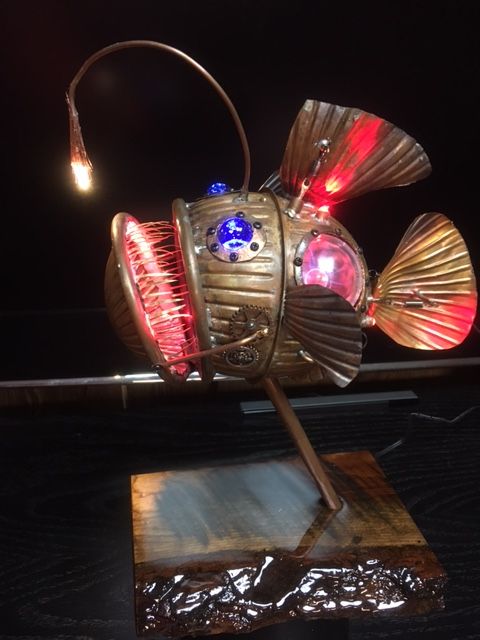
Hey Bean. I have my ground probe connected to this copper fish. Is that OK and code compliant? 🤓

 
Last edited:
bureaucrats got to love them . We have one for Electrical The Electrical safety authority . Then one one that covers Fuels right from residential to industrial The TSSA . Absolute Power can condemn anything , shut down a refinery if they want . I could tell a story but I don't know if the statute of Limitations would apply
 
I am not an electrician but know some good ones . I could ask but sometimes you don't want to know the answer. Here the owner of a home can do their own work until the insurance company does their investigation as to why your house burnt down or exploded and doesn't have to pay . I have personally seen both. One I heard of that is true . Someone disconnected a gas pipe in the wall and let it run . Many believe trying to commit suicide most just ran the gas stove . Anyway someone smelt gas called the authority having jurisdiction ( the local police ) The cop came why I don't know we at Union Gas did those investigations . Anyway it was the perfect storm The volume of gas to air was within the LEL . He rang the doorbell which we were trained NEVER to do and supposedly ended up waking up with the front door on top of him . I don't think you can run wire in an attic reason I would think insulation may create a perfect habitat for mice in the winter , and they love eating insulation off wires . I pulled many a dead mouse out of AC electrical areas although my brothers was luckily in the attic because I was making 2 bathrooms into one and discovered the wiring to be aluminum . I spent 2 weekends fixing that mess told this before . I don't mess in panels though . Clint Eastwood straightened my mind out
 
I just realized what a dopy thing I said about wire in attics . I am going to try and not comment when it comes to things I am trying to learn about
 
Hey Bean. I have my ground probe connected to this copper fish. Is that OK and code compliant? 🤓


No - it is not compliant. You should send it this way for inspection. I will return it when I am finished with it.
 
You got mad at me last time I asked you something which given your situation I understood .
Impossible. I have never gotten mad at anyone on a fish site that I remember, but I could have had a senility moment.

When did I get mad at you? Still impossible. 😬
 

TOP 10 Trending Threads

ARE YOU READY TO CONFESS TO CRAZIEST, DUMBEST, FUNNIEST THING YOU’VE EVER DONE IN REEFING?

  • Yeah, I'll confess! (Share your story in the comments!)

    Votes: 54 54.5%
  • Nah, I'll keep mine a secret...(Don't be like that, share with the class!)

    Votes: 45 45.5%
Back
Top
Home
Post thread…
Market
What's new