Some ideas how much one gram of aquarium pellets food will contribute with to the water column (adult fish) Pellets normally contain between 40 to 50 % protein. Let us say 45 %. This means that it is around 0.45 g of proteins in normal pellet food. Around 16 % of this is N - it means that around 0.07 grams of pure N will enter the aquarium. Average uptake (into fish biomass) of N is around 20% which means that 80% of added N will end up in the aquarium - which means that around 0.06 g inorganic N will enter the aquarium in worst case. If all of this will end up as NO3 - it means that around 0,27 g NO3 per gram pellets food added. See the graph below in order to understand how much this is in mg/L (nearly equal to ppm in this case of low concentration) for different volumes of aquarium water. I´m living in Europe - I am not entirely comfortable working with systems other than the metric system—consequently, calculation errors may occur. Please let me know if you spot any miscalculations. I use the conversion 1 gallon = 3.79 liters, and 1 ounce = 1/28.35 of a gallon (rounded to two decimal places).
NO3 concentration ending up in a Fish Only aquarium in different feed regimes (dry food) and aquarium sizes. If you use only wet food (frozen natural food) - divide the figures with around 7
The same with PO4 - dry pellets contain around 1 % P. This means that around 0.01 g pure P will enter the aquarium for each gram added. With the same formula for primary bio-accumalion (fish biomass) around 0.008 g P will enter the water column with every 1 g of dry pellets added- corresponding to around 0.024 g PO4
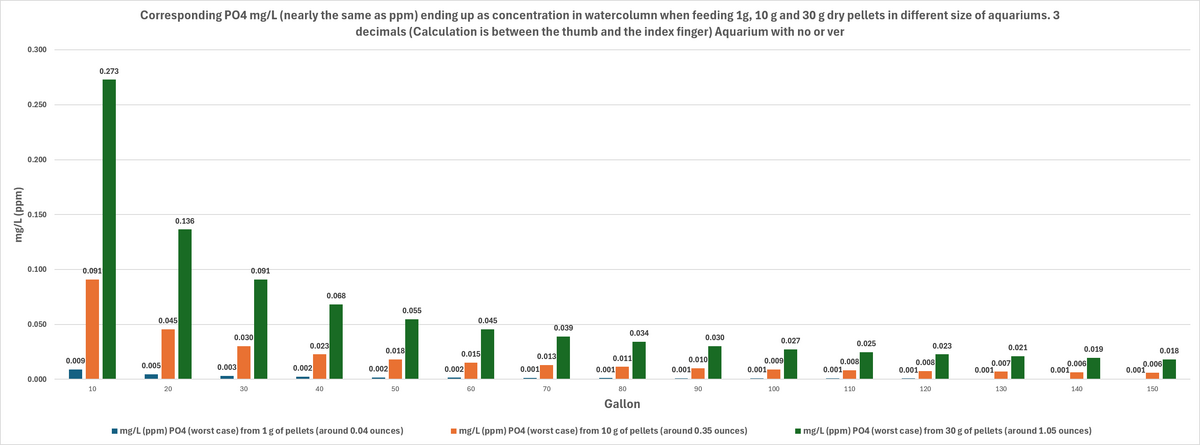
Importen to mention is also that the rise of the N species is rather fast after the addition - after a couple of hours is around 80 % of the N not needed for fish biomass excreted through the gills as NH3/NH4 and in a well function aquarium - nitrification happens more or less directly. With the P - its different - the not needed P is normally excreted by the pop and need som bacterial treatment before it released into the water column. With the PO4 - its also important to mention that the graph above reflect a mature aquarium where the binding capacity of PO4 into gravel and stones has reach its balance point. In a young aquarium - much of the added PO4 will be bound in gravel and stones.
As with the NO3 - if you use frozen natural food - divide the figures with around 7. However sometimes frozen foods can be polluted with extra PO4. Its sometimes used as a preservative.
Sincerely Lasse
The graphs above its not carved into stones – there are variations in every aquarium – view these as a guide to how it might turn out

















