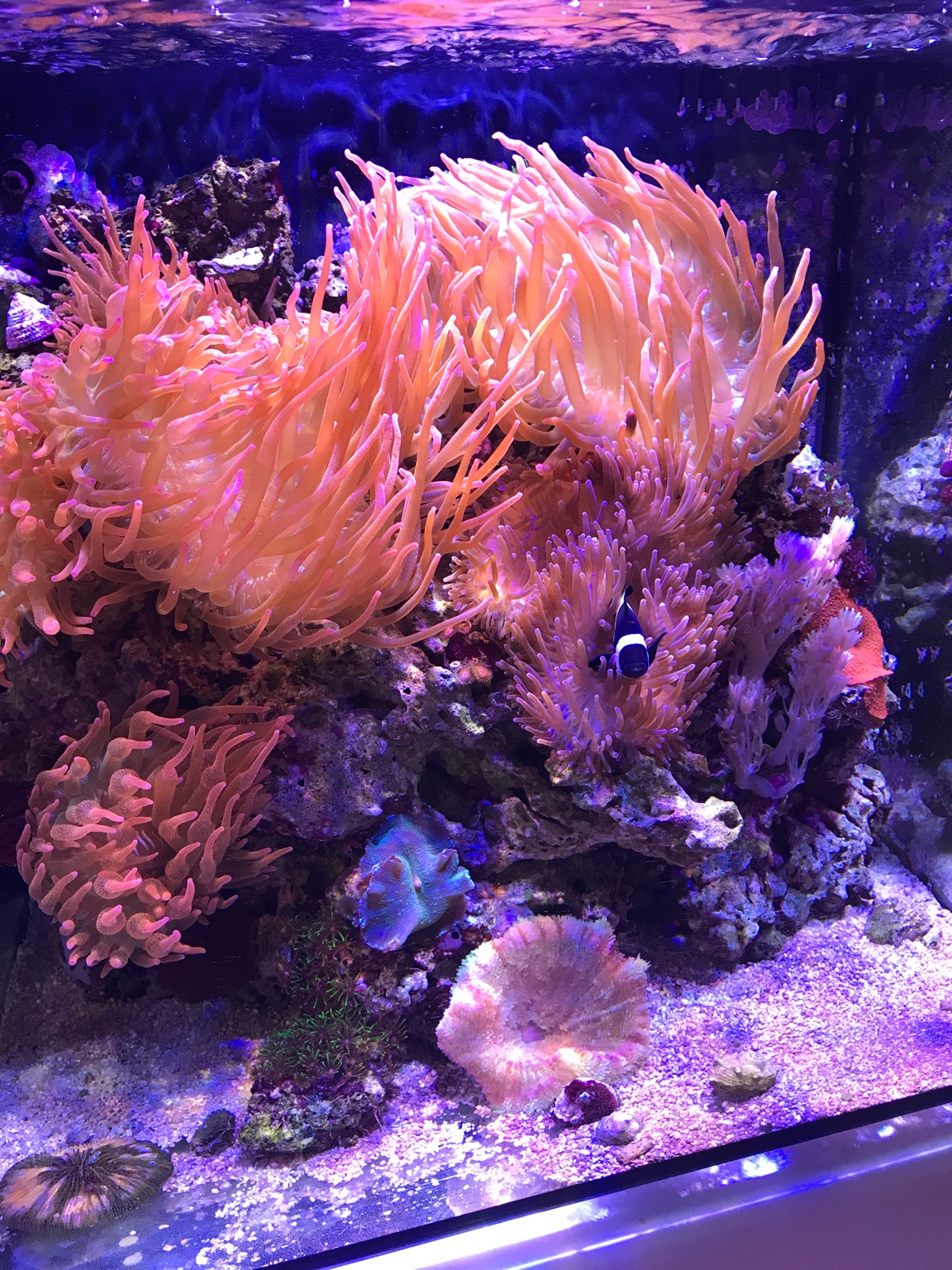
Now you got it!
New forum for fish breeding discussion is now open!
Let's fill it up and also if you know people that have this knowledge lead them here to R2R. We need some stickies and a resident pro to keep an eye on this forum.
Maybe there is someone already here! If so let's get busy!! :D
Thanks.
REEF LIFE CREATIONS · BREEDING RECORD
Species Accomplishments
A record of breeding work carried out under Reef Life Creations, drawn from Breeder's Registry entries, published industry credit, and direct documentation. Where a claim is independently confirmed, the source is linked. Where it isn't yet, that's stated plainly.
One bowl behind all of it. The newer species on this page share one vessel: the Whitecap Goby, the Silver Streak Blenny, the Orange Spotted Goby, the Bluestripe, Janss' and Yellow Banded Pipefish, and the Yellow Brotulid were all raised in their earliest stages in an ordinary 2-gallon glass punch bowl. So was Jackie, the blue crab. CORAL Magazine named the Whitecap Goby a species first in its 2023 list, and it sent its subscribers a digital announcement of my Silver Streak Blenny, a hybrid, which is not a species and so is not on that list. The rest are documented here with the evidence I have, and I say plainly where nothing has been published. A glass punch bowl, an air line and patience is a small, cheap setup, and a species first came out of it. That is the point of this site: if it can happen on my counter, it can happen on yours. The proof is in the punch bowl.
PUBLISHED RECORDS
Published and Credited
Whitecap Goby, also called the Dancer Shrimp Goby (Lotilia klausewitzi)
Species-first captive breeding, named directly in CORAL Magazine's 2023 Captive-Bred Marine Fish Species List writeup, and sold commercially through The Biota Group. Both CORAL Magazine and The Biota Group use Lotilia klausewitzi as the correct name. (CORAL Magazine, 2023 Captive-Bred List; The Biota Group)
"Consider the very recent success of aquarist David Sowash, who just claimed an astonishing species first with the Dancer Shrimp Goby, better known as the Whitecap Goby (Lotilia klausewitzi). Someone had to do it! There can't be a positive result without taking the initiative."
— CORAL Magazine, 2023 Captive-Bred Marine Fish Species List
When CORAL's editors first heard about the Whitecap Goby, their response was cautious: Matt Pedersen wrote that most of their captive-bred successes come from established companies or well-documented examples, and he asked for photos that would show the success. The Biota Group's Florida Facility Manager forwarded photos I had taken of the parents guarding eggs and of the settled young. Matt's reply:
"Having bred marine gobies myself, I can tell this is legit and downright AMAZING."
— Matt Pedersen, Publishing Partner, Aquatic Media Press (publisher of CORAL Magazine), email, October 11, 2023
That same list puts the 2023 total at 468 marine aquarium fishes successfully bred in captivity at least once.
One of the rarest gobies in the aquarium trade — most experienced aquarists have never seen one in person. Wild-caught individuals are notoriously difficult to feed, but Biota's listing notes that these captive-bred, Reef Life Creations-raised fish are already trained onto prepared foods (frozen baby brine, chopped mysis, PE Calanus), making them significantly easier to keep than wild stock; while still growing, they should be fed 3 to 4 times daily. Sale size is roughly 1.5 cm, topping out around 2 inches — small enough that a species-only tank is recommended, with a peaceful, reef-safe temperament and no interest in corals or sessile invertebrates, but a tight-fitting lid is essential since, like many gobies, they jump when startled. (The Biota Group)
Shrimp symbiosis. In the wild, the Whitecap Goby pairs with the pistol shrimp Alpheus rubromaculatus, sharing a burrow the shrimp builds and maintains; the goby stands lookout while the shrimp — whose eyesight is poor — keeps an antenna on the goby at all times to stay in contact, retreating together the instant the goby signals danger. In aquariums, Whitecap Gobies may also pair with Alpheus bellulus, Alpheus randalli, Alpheus ochrostiratus, or Alpheus djiboutensis, though not every pistol shrimp forms this kind of partnership — many are free-living or partner with other invertebrates instead, and an "adopted" pairing in captivity is less predictable than the natural one. The shrimp itself isn't currently aquacultured, and the goby doesn't need a shrimp partner to thrive on its own. (The Biota Group)
Silver Streak Blenny — hybrid, Meiacanthus grammistes × Meiacanthus kamoharai
I announced this through Biota as the first hybrid of these two fang blenny species seen or created, bred from captive-bred parents. A M. kamoharai male paired with M. grammistes females rather than his own species, producing the hybrid. The two groups of brood stock were housed in the same tank because of space, not to make a hybrid. CORAL sent it to its subscribers as a digital announcement, posted online under New Products via The Biota Group, and quoted me by name. It was not a magazine article. A hybrid is not a species, so it is not on CORAL's captive bred species list, and from the two species' ranges I noted at the time that a natural hybrid is possible. (CORAL Magazine, June 2023; The Biota Group)
My fang blenny work is also in the Breeder's Registry, in two reports. Meiacanthus grammistes, one of the hybrid's parent species, is logged under MEIGRA-032094-SOWDAV-001 (received 3/20/94). Meiacanthus mossambicus (Smith, 1959), a separate species and not part of the cross, is logged under MEIMOS-012800-SOWDAV-009 (received 1/28/00), reared to metamorphosis at day 14–18. Both are listed in the Breeder's Registry Record below. (Breeder's Registry)
Each individual's coloration is unique, mixing silver metallic stripes with black and, in the latest batches, yellow facial striping that shows more green on some fish — strong lighting brings out the metallic sheen most clearly. Like other Meiacanthus species, it carries venomous fangs used defensively; bites to aquarists are extremely rare and generally only occur if the fish is squeezed or harassed. Unlike most blennies, which stay hidden, fang blennies are gregarious and swim out in the open, giving the Silver Streak Blenny an outgoing, entertaining presence in the tank. It's reef-safe, hardy, and easy to feed on frozen mysis, PE Calanus, Hikari Mysis, and prepared pellets, and does well in 30-gallon-plus tanks kept singly, in pairs, or in small groups. (CORAL Magazine; The Biota Group)
Bluestripe Pipefish (Doryrhamphus excisus), Red Sea and African subspecies.
Captive-bred and raised, marketed by Biota Aquariums with the breeder named directly: "Red Sea and African Bluestripe Pipefish available now" from Reef Life Creations. The species is split into three recognized geographic subspecies — D. e. abbreviatus (Red Sea), D. e. excisus (the nominal form, spanning East Africa across the Indo-Pacific to East Asia), and D. e. paulus (Eastern Pacific, restricted to Mexico's Revillagigedo Islands). (Biota Aquariums customer/social media announcement; taxonomy per FishBase and Wikipedia)
Janss' Pipefish (Doryrhamphus janssi)
Wild-caught individuals of this flagtail pipefish typically only accept live foods, but Biota Aquariums has marketed captive-bred stock from Reef Life Creations already trained onto frozen baby brine shrimp, chopped mysis, and PE Calanus — noting they are "quite hardy when provided with the proper environment and care." Native to the central and western Pacific, from the Gulf of Thailand to the Solomon Islands and north to the Philippines. Independently reposted and credited on Reddit as "Captive bred Janss' Pipefish from Reef Life [Creations]," bred by David Sowash. (Biota Aquariums customer/social media announcement; Reddit r/ReefTank; taxonomy per Wikipedia)
DOCUMENTED WORK
Documented, Not Yet Independently Published
These records retain their qualifications: documented possibilities and personal recollections are not presented as settled, independently published claims.
Yellow Brotulid (Brutus's group, the species behind Mr. Limpet)
The credit belongs to Brutus, the female I had kept for about 34 years when her young were born, who earned it. I don't know her true age: she was already past the juvenile stage when I got her, so she is older than the years I have kept her. She was the first in her group to turn gravid, her larvae are born live, like small adults. Beyond the punch-bowl chronology on the Life History page, this breeding line has outside eyes on it: a friend with a PhD in Aquaculture, and his wife, a fish veterinarian, visited a few days after one of the brood releases and saw a handful of surviving larvae firsthand, and they have followed along with survival updates since. Nearly two years of reproductive events have now been recorded on this same broodstock, a record I haven't seen matched elsewhere. I believe the Yellow Brotulid is another species first, raised in a punch bowl like the others. Unlike the species above, it has not been sold to Biota or anyone else; this line stays on my bench. None of this has gone through formal review or publication, so it is noted here as a documented, expert-observed possibility rather than a settled claim.
Orange Spotted Goby (Amblyeleotris guttata)
Bred in a 2-gallon punch bowl in polyculture with a settled batch of Whitecap Gobies. A gravid female was photographed guarding her burrow, and larvae were documented in the same bowl as the Whitecap larvae. In a February 2026 email, Matt Pedersen of Aquatic Media Press raised, unprompted, the possibility that this result could stand as a species first:
"I'm not SURE, but I THINK that your success with A. guttata would be a SPECIES FIRST!"
— Matt Pedersen, Publishing Partner, Aquatic Media Press (publisher of CORAL Magazine), email, February 2026
That claim has not appeared in a published list, so it is noted here as a documented possibility rather than a settled fact. The Orange Spotted Goby I raised did not survive: it was lost to a Hydra outbreak. I include that because failures are part of the record.
Yellow Banded Pipefish
(Dunckerocampus pessuliferus, formerly Doryrhamphus pessuliferus).
A related but distinct species from the Bluestripe and Janss' pipefish group, native to the Western Central Pacific and Eastern Indian Ocean, recognizable by its bright yellow body and dark banding. I raised this pipefish from start to sale in 2-gallon punch bowls. It is not a species first: CORAL's captive-bred lists have included it since at least 2019 (CORAL, 2019 list; CORAL, 2023 list). Like the Janss' Pipefish, it is prized as a captive-bred fish; it is covered in the brood stock section of The Manual. I was told that some of my fish traveled to a trade show in Germany, to public aquariums in the United States, and to Singapore and Japan. In March 2024 I sent Biota a photo of these pipefish starting in a punch bowl, before Biota's product page for the species existed. There is no Breeder's Registry entry or published third-party credit for my work with it; it is my own record. (Wikipedia, Dunckerocampus pessuliferus)
Captive-bred clownfish (Amphiprion ocellaris) shipped to the Smithsonian
An earlier milestone, years before the Whitecap Goby and my work with Biota: I shipped captive bred clownfish to the Smithsonian. This is my own record, not a published one.
Breeder's Registry
The Breeder's Registry Record
The Breeder's Registry was a grassroots record kept mostly by hobbyists. Breeders reported their own spawnings and rearing, without the review that scientific publications require. Some of the species I reported there were later credited as firsts to others.
I include them because they are the honest record of the work, filed under Breeder ID SOWDAV between 1994 and 2000. These repeated reports are also how the owner of C-Quest first noticed my work. That led to a long friendship, many conversations and, eventually, an offer and a week-long visit.
001
Meiacanthus grammistes ★
Striped fang blenny
3/20/94
Reared to metamorphosis
002
Lysmata amboinensis
Skunk cleaner shrimp
3/20/94
Reared to metamorphosis
003
Lysmata debelius
Fire shrimp
3/20/94
Reared to metamorphosis
004
Lysmata rathbunae
Rathbun's cleaner shrimp
3/20/94
Reared to metamorphosis
005
Lysmata wurdemanni
Peppermint shrimp
3/20/94
Reared to metamorphosis
006
Opistognathus aurifrons
Yellowhead jawfish
7/5/95
Reached metamorphosis (18-22 days); none survived past a week.
007
Cryptocentrus cinctus
Yellow shrimp goby
7/15/95
Reared to metamorphosis
008
Pseudochromis dilectus
Dilectis dottyback
10/11/99
Reared to metamorphosis
009
Meiacanthus mossambicus (Smith, 1959) ★
Mozambique fang blenny
1/28/00
Reared to metamorphosis
★ Also covered above. Report numbers are as written in each report.
About the jawfish: the larvae reached metamorphosis at 18–22 days, but losses were heavy, and the survivors died within a week. The report still got noticed. Someone who said she was calling for a nature documentary, I believe for the Discovery Channel, found me through this Breeder's Registry report. She asked for a quote to set up the pair with eggs for filming. I gave her a quote but never heard back.
Shared results travel. A hobbyist's report led to a friendship, an offer and a documentary call. Share what you learn; you never know who is reading.
See all reports under SOWDAV at the Breeder's Registry.