A filter sock fulla dinos (I think)

obanarama

Active Member
View Badges
Joined
Jul 23, 2025
Messages
157
Reaction score
170
Location
Taos
Rating - 0%
0   0   0
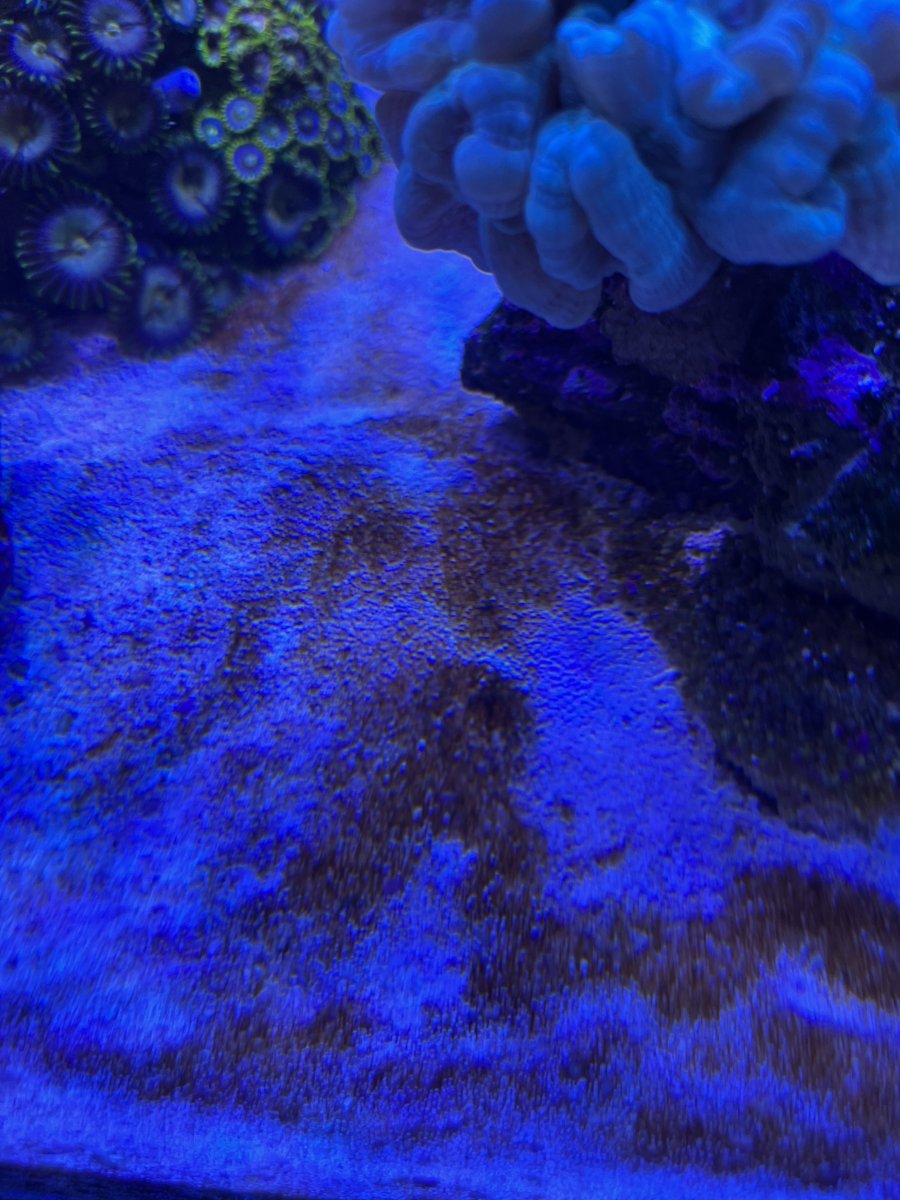
Our 180g office tank, which has been online for about 10 weeks after upgrading from a 75, has what we're fairly certain are Dinos. The tank has a 57w UV that we've been running 24/7 since the day the tank went live. We believe that these are Amphidiniums since they disappear at night, come back in full strength during full light hours, seem to prefer low flow areas, are only in the sand as far as we can tell, have no bubbles, are not stringy, are reddish brown, and the 24x7 UV that we run hasn't seemed to slow them down one bit. We've had cyano before, and this is nothing like that. We have a microscope arriving tomorrow for identification. A couple conches have died and the Hammers and Frogspawn closest to the biggest bloom are retracted, so we added activated carbon to the tank a few days ago.

Here's a video of them. First five seconds is from 9:30am, the last half is from 1:30pm, the same day.
IMG_3774.jpg


We've also got a 3D UV sweeper ordered and should be arriving soon and are looking forward to using that on the dinos.

In the meantime we're dosing silicates and siphoning the dinos into a 5 micron filter sock. And oh boy, here's what the 5 micron filter sock looked like after our first dyno siphon today. Pretty nasty stuff!

pxl_20260224_211819493_720.jpg


At any rate, I don't believe that our nutrients ever bottomed out, but they were running low for awhile, as in NO3 around 2-3 and PO4 around .02 - .03. These guys started showing up soon after a diatom bloom cleared up. We've been dosing ammonia and feeding reef roids to keep the nutrients up. Current parameters are:

ALK: 8.5
CAL: 420
MG: 1450
NO3: 5.2
PO4: 0.08
Salinity: 1.0255

The plan is to positively identify the dino type with a microscope (will post microscope images to this thread), keep NO3 and PO4 up, keep dosing silicates (using Brightwell NeoSci at 1/2 dose, 9 drops, for now), and keep siphoning the jerks into this 5 micron filter sock during high light hours every day.

Is there anything else that we should be doing?

 

Attachments

  • Screen Recording 2026-02-24 at 4.34.24 PM.mov
    19.3 MB

Gumbies R Us

God, Bouldering, and Reefing
View Badges
Joined
Nov 10, 2022
Messages
28,984
Reaction score
51,366
Location
North Georgia
Rating - 0%
0   0   0
Your plan sounds good! Curious to see the microscope pictures when you get them.
 
OP
OP
obanarama

obanarama

Active Member
View Badges
Joined
Jul 23, 2025
Messages
157
Reaction score
170
Location
Taos
Rating - 0%
0   0   0
The Microscope arrived today, and boy is this cool! Here's the results. Definately dinos! What do you think, Amphidinium (Large-Cell) or Prorocentrum?
PXL_20260225_195521949.jpg

 
OP
OP
obanarama

obanarama

Active Member
View Badges
Joined
Jul 23, 2025
Messages
157
Reaction score
170
Location
Taos
Rating - 0%
0   0   0
Well, I guess it doesn't matter if these Dinos are Amphidinium (Large-Cell) or Prorocentrum as they are both treated the same. So we're going to keep daily siphoning into 5 micron filter sock, daily silicate dosing, and weekly bacteria dosing. Microbacter 7 is on hand so that's what we'll use. We're also hoping that the 3D UV sweeper that is supposed to arrive in a few days makes this a quicker battle than we'd normally have to fight.
 
OP
OP
obanarama

obanarama

Active Member
View Badges
Joined
Jul 23, 2025
Messages
157
Reaction score
170
Location
Taos
Rating - 0%
0   0   0
Our 3D UV scanner arrived yesterday and after the first sweep it seems super promising. It made the Dino’s disappear as well as a good siphon makes them go away. Hopefully a bit more permanent disappearance tho.

Also, we’ve lost 5 of our 7 conches, which is sad. Presumably because of these Dino’s. No other CUC seems to be affected tho. Sand sifting starfish, tige tail cucumber, hermits and snails all seem fine.
 
Last edited:

Idech

2500 Club Member
View Badges
Joined
Feb 21, 2021
Messages
4,809
Reaction score
4,023
Location
Canada
Rating - 0%
0   0   0
I believe those are LCA. The UV sweeper will work perfectly on it. Don’t hesitate to sweep anything that might have Dino’s on it, like the overflow box, powerheads, outlets, etc. Just avoid your corals as they will instantly die.
 
OP
OP
obanarama

obanarama

Active Member
View Badges
Joined
Jul 23, 2025
Messages
157
Reaction score
170
Location
Taos
Rating - 0%
0   0   0
I believe those are LCA. The UV sweeper will work perfectly on it. Don’t hesitate to sweep anything that might have Dino’s on it, like the overflow box, powerheads, outlets, etc. Just avoid your corals as they will instantly die.
Thank you. We're definately being careful with that UV sweeper.
 
OP
OP
obanarama

obanarama

Active Member
View Badges
Joined
Jul 23, 2025
Messages
157
Reaction score
170
Location
Taos
Rating - 0%
0   0   0
Two days and two sweeps into the UV Sweeper and its totally decimating Prorocentrum dinos. Really impressive and so easy to use. It takes about 15 minutes to zapp all of the dinos throughout the entire sandband on this 180g, as well as hit some on the rocks. We're continuing to dose silicates but may start to taper that off as we're seeing good algae growth on the glass and hoping to not swing into a full diatom bloom next. But I'm probably getting a little full of myself there.

Dinos in the sand from a few days ago:
Screenshot 2026-02-28 at 9.40.33 PM.png


Dinos today. Same time of day.
Screenshot 2026-02-28 at 9.39.11 PM.png


Excuse the crappy webcam snapshots. It looks even better in real life.

Screenshot 2026-02-28 at 9.41.19 PM.png
 
1

141918

Guest
View Badges
Our 180g office tank, which has been online for about 10 weeks after upgrading from a 75, has what we're fairly certain are Dinos. The tank has a 57w UV that we've been running 24/7 since the day the tank went live. We believe that these are Amphidiniums since they disappear at night, come back in full strength during full light hours, seem to prefer low flow areas, are only in the sand as far as we can tell, have no bubbles, are not stringy, are reddish brown, and the 24x7 UV that we run hasn't seemed to slow them down one bit. We've had cyano before, and this is nothing like that. We have a microscope arriving tomorrow for identification. A couple conches have died and the Hammers and Frogspawn closest to the biggest bloom are retracted, so we added activated carbon to the tank a few days ago.

Here's a video of them. First five seconds is from 9:30am, the last half is from 1:30pm, the same day.

IMG_3774.jpg


We've also got a 3D UV sweeper ordered and should be arriving soon and are looking forward to using that on the dinos.

In the meantime we're dosing silicates and siphoning the dinos into a 5 micron filter sock. And oh boy, here's what the 5 micron filter sock looked like after our first dyno siphon today. Pretty nasty stuff!

pxl_20260224_211819493_720.jpg


At any rate, I don't believe that our nutrients ever bottomed out, but they were running low for awhile, as in NO3 around 2-3 and PO4 around .02 - .03. These guys started showing up soon after a diatom bloom cleared up. We've been dosing ammonia and feeding reef roids to keep the nutrients up. Current parameters are:

ALK: 8.5
CAL: 420
MG: 1450
NO3: 5.2
PO4: 0.08
Salinity: 1.0255

The plan is to positively identify the dino type with a microscope (will post microscope images to this thread), keep NO3 and PO4 up, keep dosing silicates (using Brightwell NeoSci at 1/2 dose, 9 drops, for now), and keep siphoning the jerks into this 5 micron filter sock during high light hours every day.

Is there anything else that we should be doing?
Based on my experience with LCA dinos:

1. Maintain 10:1 No3 to po4.
2. Get a positive ID when the scope arrives. Gotta be 100% sure on the type of dinos.
3. UV sweeper is the harbinger of dino death. But this isn't a one step approach. Need to facilitate multi stages to ensure best success. Good filter pads, maintain balanced nutrients, siphon out as much as possible before treatment.
3. Silica dosing is highly discouraged with the UV sweeper as per instructions.
4. Do not dose anything like reef roids or aminos as this will just fuel the dinos. They literally eat all available nutrients in the tank just like everything else.
5. Bacteria like PNS or Microbe lift is recommended. But in my experience, this stuff doesn't help that I can conclusively say.
6. When sweeping, do it daily for 10 days minimum without breaks. really gotta burn those jerks to hell and suffering lol.

Will attach my LCA battle before and current to the thread

20260216_182905.jpg 20260305_202624.jpg
 
Last edited by a moderator:
OP
OP
obanarama

obanarama

Active Member
View Badges
Joined
Jul 23, 2025
Messages
157
Reaction score
170
Location
Taos
Rating - 0%
0   0   0
Based on my experience with LCA dinos:

1. Maintain 10:1 No3 to po4.
2. Get a positive ID when the scope arrives. Gotta be 100% sure on the type of dinos.
3. UV sweeper is the harbinger of dino death. But this isn't a one step approach. Need to facilitate multi stages to ensure best success. Good filter

Yeah, the UV Sweeper is decimating the LCA (or Prorocentrum) dinos. The sand looks great again. The dinos are still coming back but in small, light patches in the afternoon so we're UV sweeping them every day. One week into this and it feels like a miracle after everything I've heard about months and years long battles. I'm also dosing NeoNitro to keep the Nitrates up, dosing silicates (tho backing off there), and letting algae grow on the back wall - which the tangs and snails are very happy about - and dosing Microbacter Clean after the UV sweeps. Really happy with this so far.
 
OP
OP
obanarama

obanarama

Active Member
View Badges
Joined
Jul 23, 2025
Messages
157
Reaction score
170
Location
Taos
Rating - 0%
0   0   0
Just an update for those curious about UV Sweepers and dinos. It seems that after four weeks our dino battle has been won and shockingly by us, not them! We literally can no longer find a dino in our microscope viewing.
To recap:

Days 1 thru 3: Prior to us having a microscope and UV Sweeper, we siphoned a ton of dinos into a 5 micron filter sock and dosed silicates assuming these were one of the sand-based dinos, since we were running a 57w UV 24x7 for the three-month-life of this tank without effect. We also consciously starting dosing nitrate to get our nitrates up from about 3ppm~ and added more Reef Roids to our feeding to get our phosphates up from about .02.

Days 3 thru 14: Microscope confirmed that these were sand based dinos. See earlier in this thread for photos and discussion. Once the UV Sweeper arrived we started daily (weekdays only since this is an office tank) sweeping of dinos, which showed immediate results and was quite satisfying seeing them immediately die. We also dosed Microbacter 7 after each dose and stopped dosing silicates as per the official UV Sweeper Instructions. That said we had some hair algae growing on the back wall of the tank which we'd normally scape off every couple of weeks, but instead we began just letting it grow, which our Tangs and snails were pretty happy about. The dinos did come back the next day, every day, after our UV sweeps, but always at a lower level.

Days 14 thru 21: We were seeing so few dino patches that we kind of slacked off on UV Sweeping, and only swept maybe three times this week. There were some small dino patches in hard to reach places tho.

Days 21 thru today: We UV Swept and MB7 dosed pretty hard for the last week, then we noticed that our tangs were grazing on the sand again, and that the color of what was appearing on the sand was much more greenish-brown instead of Dino-red. So we pulled out the microscope and didn't find a single dino on the slides. Oh yeah! Nitrates are now 8ppm and phosphates around 0.08. And we're just so happy to see a little green on the sand again. We'll likely keep an eye on things and maybe even scrape off the back wall hair algae at some point. This feels really good.

These are not dinos....
PXL_20260323_205309396.MP.jpg


Dino-free sand...
Screenshot 2026-03-23 at 3.10.01 PM.png

There really weren't any downsides to this entire process - other than when we killed a couple of Zoa heads that were touching the sand with the UV Sweeper. But that Zoa is a growing menace anyway, so even that was fine. Heck, we've got GSP that is growing on a rock that we haven't been able to successfully scrape off so we're thinking of using the UV Sweeper on it to kill it. Dual-use UV Sweeper!

I'd say the trickiest part of all of this was keeping our nitrates up while dosing the Microbacter 7, as that stuff would bring our nitrates down each time we dosed it. But it was just a matter of feeding the fish more and dosing a bit more nitrates and finding the right balance.

😃
 

TOP 10 Trending Threads

WHAT AMOUNT OF LIVE ROCK AND SAND SHOULD BE PRIORITIZED FOR OPTIMAL BIODIVERSITY/FILTRATION?

  • 100% live rock + bagged sand

    Votes: 37 27.4%
  • 100% dry rock + 100% live sand

    Votes: 46 34.1%
  • 50/50 live/dry rock, 50/50 live/bagged sand

    Votes: 30 22.2%
  • 75% live rock, 25% live sand

    Votes: 12 8.9%
  • 25% live rock, 75% live sand

    Votes: 10 7.4%
Back
Top