



Captive bred vs. wild caught

Isosceles

Community Member
View Badges
Joined
Nov 24, 2024
Messages
84
Reaction score
49
Location
Mid Atlantic
Rating - 0%
0   0   0
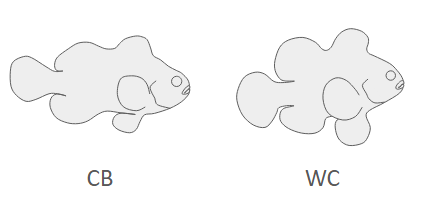
In a few threads I've responded to, a few people asked what the difference between wild and CB clowns is. I've made a quick little diagram to show the physical differences:

1749462316881.png

For this diagram I've just used ocellaris. Ocellaris of course has been bred a lot more than percula, however I feel like percula isn't as susceptible to the disfiguration that comes from line breeding, as the worst I'll see is stubby bodies/disproportionate fins. As you can see it can get pretty extreme in ocellaris. All of the illustrations in this figure are traced off of pictures of real fish. I just figured that without color and other details it'd be easier to see the differences in shape between different "grades" of body conformation. The average CB ocellaris isn't too bad, just kinda weird proportions, but other than that not a physically unhealthy fish. Occasionally I'll see some pretty well proportioned designer clowns. The ones under "good" were actually traced off a black storm and a domino.

Evidently you'll still see some differences between them and wild fish, namely the length of the peduncle, height of the dorsal fin, and relative size of the paired fins. The head shape is generally a bit different as well. Percula tends to have a kind of football shaped body, with mature females having an almost bullet shaped head, but I notice wild ocellaris will have this kind of... beak(?) shaped head, where the actual face/head sits a bit higher than the mid line of the fish, and there's a flat slope from the mouth to the pelvic fins. The mouth also comes to a bit of a point, with the bottom jaw making that slight sort of hooked shape, hence my rough comparison to a beak. This is more prominent in male WC maroons.

Thankfully ocellaris doesn't really get the extreme disfiguration within the first few generations from WC broodstock, but maroons aren't as lucky, as some... unfortunate looking fish can show up within the first generation of captive breeding from wild parents.
1749463139457.png

Quite the difference...

I had a whole thing written up about comparing and contrasting the ethics/pros/cons of WC vs CB but a lot has been said already, and it's 6 am. If anyone wants clarification I'll bring it back later.
 

LovinlifeinGuam

5000 Club Member
View Badges
Joined
May 31, 2020
Messages
6,648
Reaction score
5,698
Location
Guam
Rating - 0%
0   0   0
Good explanation.

Personally, I've never understood why the tiny differences make such a difference to people and affect price (sometimes significantly). That's just me though and I'm also not the biggest clownfish guy, myself.
 

Cheese Griller

Well-Known Member
View Badges
Joined
Mar 19, 2018
Messages
579
Reaction score
628
Rating - 0%
0   0   0
great write up!!! IMO, perculas suffer just as badly as occellaris, just in a different way. Most of the CB percs I’ve seen have smaller fins proportionally, longer, stiff bodies, as well as the smashed faces. Where I notice it most, though, is the tail. I feel like BC perculas have a much more rectangular tail as compared to WC. Also, just the was they swim is vastly different. All the CB percs I’ve seen at my LFS just look “awkward” and have a very rigid swimming posture, whereas the wilds they keep in the next tank over are much more fluid. I’ve attached a few images to illustrate! The top picture is the stock image for CB percs from ORA, and the bottom image is the female from my WC pair when she was smaller. I feel like the easiest difference to see here is the tail shape.
IMG_4701.jpeg
IMG_3564.jpeg
 

OrionN

Anemones
View Badges
Joined
Jul 28, 2013
Messages
11,302
Reaction score
22,511
Location
Corpus Christi, TX
Rating - 0%
0   0   0
The deformities are not genetic (likely a minor contribution), but it has more to do with poor environment (major contribution). Even with CB from WC parents where there is NO inbred, we see all these deformities, therefore definitely is not genetic as the major cause.
 

Randy Holmes-Farley

Reef Chemist
View Badges
Joined
Sep 5, 2014
Messages
89,236
Reaction score
92,254
Location
Massachusetts, United States
Rating - 0%
0   0   0

Largeangels

Active Member
View Badges
Joined
Nov 17, 2010
Messages
485
Reaction score
443
Location
Ann Arbor
Rating - 0%
0   0   0
I agree with OrionN. I believe it is poor environment and poor diet.

For those of us who grew up on mostly wild caught clownfish we often have a hard time with the physical deformities of tank raised and it seems that not much attention is paid to the deformities because they still are selling.
 
OP
OP
I

Isosceles

Community Member
View Badges
Joined
Nov 24, 2024
Messages
84
Reaction score
49
Location
Mid Atlantic
Rating - 0%
0   0   0
The deformities are not genetic (likely a minor contribution), but it has more to do with poor environment (major contribution). Even with CB from WC parents where there is NO inbred, we see all these deformities, therefore definitely is not genetic as the major cause.
I agree, given it appears quickly in CB maroons, I imagine it's similar to breeding bettas or freshwater angels where they start to show deformities when improperly raised. I do however also think these individuals likely show up in nature, but natural selection gets them before they make it to adulthood. I still also believe the likelihood of these deformities is increased with poor genetic diversity, like in anything. Mix of a bunch of different factors. That only makes me wonder about the ecology of wild maroons though, because in that case what do they need in particular for them to come out looking normal in captivity?

A recent study shows that clownfish can become more stubby in the wild, and it gives them a survival advantage under stress.

Very interesting. I wonder if this explains why a lot of wc percula have been coming in kinda stubby recently. Mine were stubby when I first got them but they've since kinda lengthened out.
1749485543244.png
1749485407375.png

Same fish 6 months apart.

great write up!!! IMO, perculas suffer just as badly as occellaris, just in a different way. Most of the CB percs I’ve seen have smaller fins proportionally, longer, stiff bodies, as well as the smashed faces. Where I notice it most, though, is the tail. I feel like BC perculas have a much more rectangular tail as compared to WC. Also, just the was they swim is vastly different. All the CB percs I’ve seen at my LFS just look “awkward” and have a very rigid swimming posture, whereas the wilds they keep in the next tank over are much more fluid. I’ve attached a few images to illustrate! The top picture is the stock image for CB percs from ORA, and the bottom image is the female from my WC pair when she was smaller. I feel like the easiest difference to see here is the tail shape.
IMG_4701.jpeg
IMG_3564.jpeg
I was just about to respond to @LovinlifeinGuam about their behavior and swimming patterns. I definitely notice that stiff swimming pattern in long term CB strains. They have it a little less as babies but quickly seem to lose it. Some more responsibly bred ones will be more bouncy/wiggly but for the most part there's definitely a difference in their swimming patterns. As many are familiar, CB are also less inclined to try and bond with nem type things. I refrain from saying the clowns are hosting them because it's the nems that are hosting the clowns. That aside, I'll see storms being kept in baskets full of bubble tips without even touching them, meanwhile the WC pair of ocellaris I just got went into my rhodactis mushrooms within 10 minutes of being in the tank. There's definitely a different appearance to WC fish with the big fanned out fins, long peduncle and fluid swimming pattern. In WC clowns in general I've noticed this funny behavior where when they're going back to something, they fan all their fins out and do this sort of figure 8 swimming pattern over to it. My maroon would do that to go back behind his rock, and the ocellaris will do that when swimming across the tank to meet back up with the other one. I'll try to get a video.
 

Cheese Griller

Well-Known Member
View Badges
Joined
Mar 19, 2018
Messages
579
Reaction score
628
Rating - 0%
0   0   0
I agree, given it appears quickly in CB maroons, I imagine it's similar to breeding bettas or freshwater angels where they start to show deformities when improperly raised. I do however also think these individuals likely show up in nature, but natural selection gets them before they make it to adulthood. I still also believe the likelihood of these deformities is increased with poor genetic diversity, like in anything. Mix of a bunch of different factors. That only makes me wonder about the ecology of wild maroons though, because in that case what do they need in particular for them to come out looking normal in captivity?


Very interesting. I wonder if this explains why a lot of wc percula have been coming in kinda stubby recently. Mine were stubby when I first got them but they've since kinda lengthened out.
1749485543244.png
1749485407375.png

Same fish 6 months apart.


I was just about to respond to @LovinlifeinGuam about their behavior and swimming patterns. I definitely notice that stiff swimming pattern in long term CB strains. They have it a little less as babies but quickly seem to lose it. Some more responsibly bred ones will be more bouncy/wiggly but for the most part there's definitely a difference in their swimming patterns. As many are familiar, CB are also less inclined to try and bond with nem type things. I refrain from saying the clowns are hosting them because it's the nems that are hosting the clowns. That aside, I'll see storms being kept in baskets full of bubble tips without even touching them, meanwhile the WC pair of ocellaris I just got went into my rhodactis mushrooms within 10 minutes of being in the tank. There's definitely a different appearance to WC fish with the big fanned out fins, long peduncle and fluid swimming pattern. In WC clowns in general I've noticed this funny behavior where when they're going back to something, they fan all their fins out and do this sort of figure 8 swimming pattern over to it. My maroon would do that to go back behind his rock, and the ocellaris will do that when swimming across the tank to meet back up with the other one. I'll try to get a video.
You're spot on about the "figure 8" swim pattern, my old pair of CB black and white occellaris displayed it, but they're one of the only examples of CB clowns I've seen that do it. My current WC percs do it all the time
 

D-Nak

Valuable Member
View Badges
Joined
Oct 15, 2011
Messages
2,029
Reaction score
1,743
Location
Bay Area, CA
Rating - 0%
0   0   0
Let's be clear that it makes no difference if the clownfish is wild or CB in terms of accepting an anemone as a host. It is innate is not something that is lost through generations. Natural host anemones will always be accepted at a higher rate than non-natural hosts. Since natural hosts for percula and ocellaris (the species most common in our tanks) are not easily accessible in the hobby, this myth has gotten to the point where people believe it as fact. When I introduce my baby percula to tanks with S. gigantea or H. magnifica, they go to the anemones immediately, 100% of the time, having never encountered an anemone before.
 

TOP 10 Trending Threads

WHAT AMOUNT OF LIVE ROCK AND SAND SHOULD BE PRIORITIZED FOR OPTIMAL BIODIVERSITY/FILTRATION?

  • 100% live rock + bagged sand

    Votes: 34 27.0%
  • 100% dry rock + 100% live sand

    Votes: 45 35.7%
  • 50/50 live/dry rock, 50/50 live/bagged sand

    Votes: 27 21.4%
  • 75% live rock, 25% live sand

    Votes: 11 8.7%
  • 25% live rock, 75% live sand

    Votes: 9 7.1%
Back
Top






