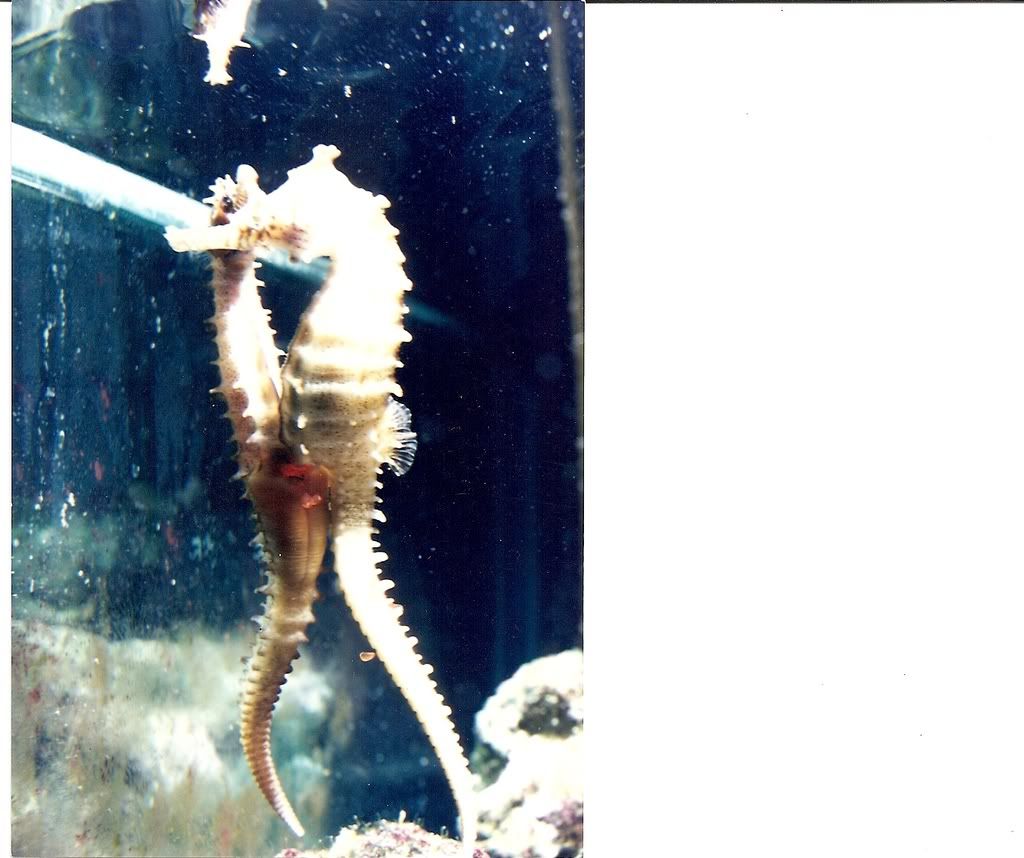
I second Seahorse Savvy--Alyssa and her crew are great. As far as your current plan:
Frogspawn and hammers are not recommended for seahorses because of their ability to sting and capture fry. Pintail wrasse are great, but I thought they required a larger tank. As such, any stressed fish due to a small environment might act erratically or aggressively and may not do well with seahorses as a result. Midas blennies can be hit or miss--I have read that a large number of folks never had issues with theirs, while others do have aggressive or territorial blennies. Coral beauties are similar--tend to be territorial. Royal gammas wouldn't be a problem at all, but because of their timid nature, might be picked on by a coral beauty. Diamond gobies are hilarious and I have one with my herd, and although he does sometimes gum the ponies' tails during feeding time but they don't seem bothered by him in the least. He IS a food thief, though! YWG/shrimp pair would also be fine.
While seahorses aren't great swimmers, they do benefit and enjoy some flow so long as it isn't overwhelming. You do need to absolutely ensure they can't get their tails into any crevices because they WILL, the impeller will injure your horse's tail, and it'll be a potential infection risk while you have to hand feed (multiple times per day, of course) for about a week until they recover. Ask me how I know

And as others have said, seahorses do require a lot of one on one care. First thing to note is that they prefer a cooler tank than most marine fish, with 72-73 degrees f being the sweet spot.
Second thing to note is that seahorses have no stomach! This means they must be fed multiple times every single day to keep their calorie count up--I feed mine twice every day, but they also have a population of copepods to pick at all day long as well. I've even seen them fight over a snail that was taken out by the hermits! And of course, these creatures don't eat pellets, so you have to thaw mysis shrimp multiple times every day, supplement periodically with adult brine shrimp for enrichment, etc. I love this; I work from home and am homebody, so I'm not exactly doing a lot of travel, but I acknowledge this kind of husbandry is not for everyone.
Third, it is important to note that seahorses need hitching posts. I highly recommend gorgonians, as mine adore those over all other items, including macro algae, which is sometimes the top recommendation. Mine have never hitched on any macro algae I've offered, but perhaps that is because I've offered so many gorgs. Branching sea sponges are also loved, but they are among the hardest to keep long term. Their next favorite hitching post type are wires, so the temperature gauges are often a sitting spot as well. Finger leather also seem to suffice, and can even be used as enrichment if you place some mysis shrimp within, they will perch on the fingers and "hunt." Anything they don't find is gobbled up by the leather!
Fourth, setting up the tank itself is important for a happy herd. If you have any mated pairs, you'll be to make sure you have an open space in your tank that has a clear vertical area of about twenty inches in height. Mated seahorses do a coupling dance regularly that requires entangling tails and falling through the water column. This is also similar to their actual mating dance in which the pair meet belly to belly at the top of the water column and the girly moves the eggs to her gentleman's pouch. This happens as the pair are entwined and drift downward, so they need ample space--and that space should have minimal water flow so the aiming of egg transfer doesn't get blown around.
Phew. I think those are all the basics but I'm sure I've missed something! Happy to answer any questions!