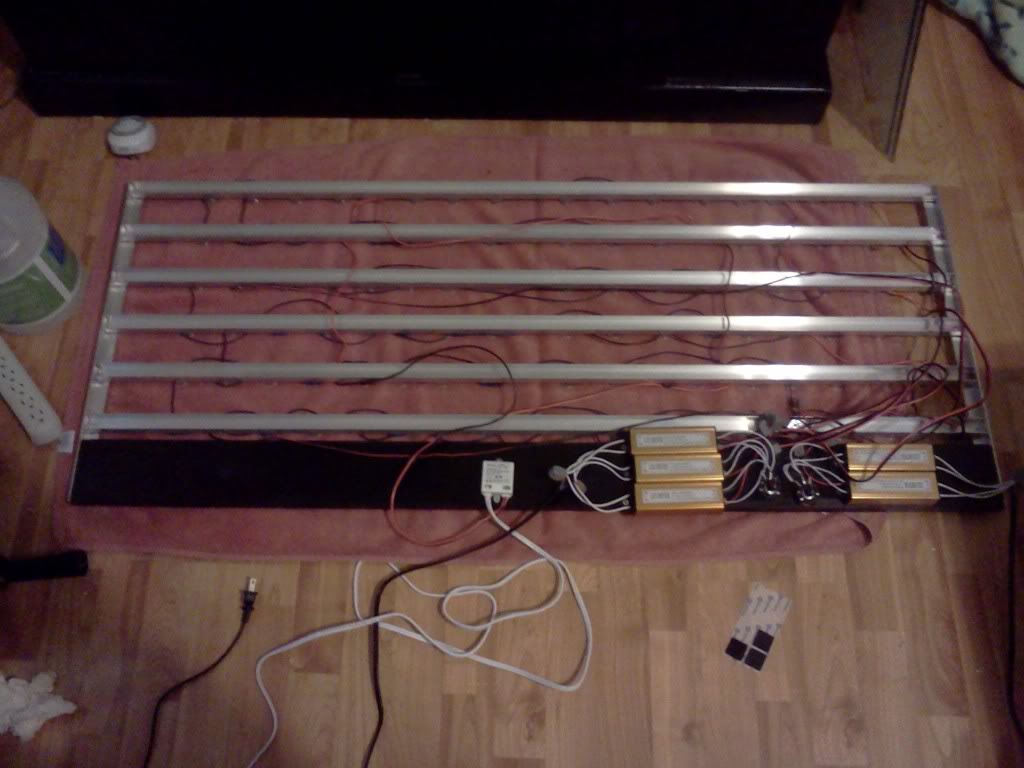
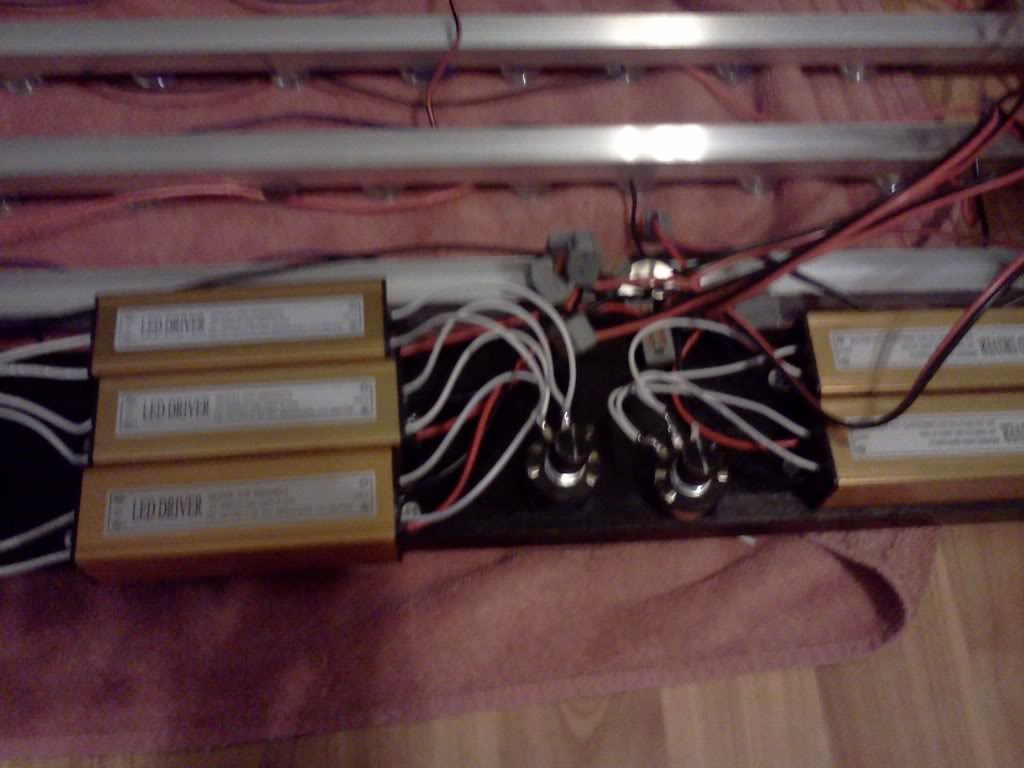
diy canopy and led

  • Thread starter Thread starter gmoney243
  • Start date Start date
  • Tagged users Tagged users None
hahahaha...he's on no sleep watching gross videos and on the Rox.

Looks nice! need to come check it out
 
hey wait im not the one who had "seen it to many times" lol .. thx all im happy with the results so far after about 4 hors of working c-channel still ice cold!
 
is there a way to check for cold solder joints besides it looking grey and dull and messed up? lol i mean if its smooth looks nice and shiny means its a good solder right?
 
Yep. If its how you described it then joints should be good. How much thermal glue did you put under the leds? It almost sounds like that stuff is acting like an insulator instead of a conductor. If the leds are transfering heat to the u channel then the solder iron will heat the u channel up while trying to solder the wires to the leds. The u channel should get hot behind the led surface. Looking good!
 
Nice job. I would've responded quicker, but man are there some crazy gross videos out there.... LOL
 
rofl ... well they are turned down to about 33% .. so i did some initial quick par readings ill give more accurate later but im getting max 150 on sandbed in 31" deep tank with lights 7" above water. about a foot down where my rocks start says 350-400. i know they arnt suppose to be accurate but take them how u will.
 
found this online


-----------

Yes, the SQ-120 (electric calibration) would be our best option for your application. These units are sealed and submersible up to 30m and are compatible with salt water. The SQ-100's are considered self-powered and will generate a mV output that you can measure with your voltmeter. We calibrate everything to a factor of 5.0 µmol/m2/s per mV, so just multiply your mV output by 5 to derive the photon flux value.

In regards to measuring LED's with the quantum sensor, there are some caveats to doing so. The following link shows the spectral response of our quantum sensor (Apogee Instruments Quantum Sensor - Spectral Response). As the graph shows, Apogee quantum sensors underweight blue light, and as a result, photon flux measurements for blue LEDs will be too low. They also overweight red light up to a wavelength of approximately 650 nm, above which they do not measure, and as a result, photon flux measurement for red LEDs will either be too high (if the LED output is all below 650 nm) or too low (if a non-negligible fraction of the LED output is above 650 nm). Additionally, LED's often have a very narrow spectral output, with a sharp peak of only a few nanometers. So, unless the quantum sensor has a perfectly flat spectral response, meaning it weights all wavelengths of light exactly the same, there will be errors. Electrically calibrated Apogee quantum sensors will likely provide a reasonable measurement for white LED's because they are broadband, and because electrically calibrated quantum sensors are calibrated under CWF lamps. However, for narrowband LEDs, like red and blue, Apogee quantum sensors will not provide an accurate measurement.

You can use the same spectral response graph (Apogee Instruments Quantum Sensor - Spectral Response) to get a relative idea of the error. For example, a 450nm blue LED will have a relative response of approximately 0.8. Therefore, you can figure that the photon flux reading from the sensor is probably reading approximately 20% low. Just remember, this approach is only relative so give yourself a wide margin of potential error. A blue/white configuration should give you reasonable accuracy, particularly from the broadband spectrum of the white.

Hopefully, that makes sense. Please let me know if there are any questions.

Regards,

Jacob Bingham
Applications Engineer
[email protected]
Apogee Instruments
721 W 1800 N Logan, UT 84321
ph: 435.792.4700 fax: 435.787.8268

 
so basically this tells me that your reading are up to 20% low so my pars should be 150-180 and 400-480. if im reading correct and if this is correct info or w/e like i said take them how u will lol
 
So at 33% you are getting 480 at a foot down? that's insane. You could turn them up and poach some eggs, we'll have brunch tomorrow morning
 
Very interesting. I had read that the par meters don't measure led output well. That's alot of mumbo jumbo he was speaking. Was waiting to him to refer to a flux capacitor and time travel.
 
So at 33% you are getting 480 at a foot down? that's insane. You could turn them up and poach some eggs, we'll have brunch tomorrow morning
If those readings are correct and he leaves them like that, I'll bet he will fry his coral in a matter of days as it happened to me with similar numbers that are way too high.
It needs to be more in the 300 or a little below 1/2 way down in the tank and 200 or below on the sandbed IME
Bill
 
No chris sry the reading was full blast .. 33% is what par that I'm currently running to acclimate.. 50 on sand and 150 top of rocks. also full blast is to much white for my taste so I wouldn't run them that high
 
Last edited:
lets see the corals with the LEDS not just the lights

You'll have to come by to see cause my cameras only pick up the blues so id need a good camera to show anything. But the colors are as good as I've seen any led cree setup. But imo t5 bring out some extra colors I don't get cause of my purple bulb I think. really only 1 of my acas looks better in. T5 its red in led but has some orange in it with my old t5 .. but I'm still happy and would switch anyday
I can always add a 2 bulb t5 for extra pop if I wanted.
 
Last edited:
Nice build!

Did you get that aluminum channel at home depot/lowes?

**edit** - Nevermind!!

All of you DIY LED experienced people around here gives me a lot of confidence in being able to actually do it as well.
 
Last edited:
finshed product.

011812090942.jpg


011812090934.jpg


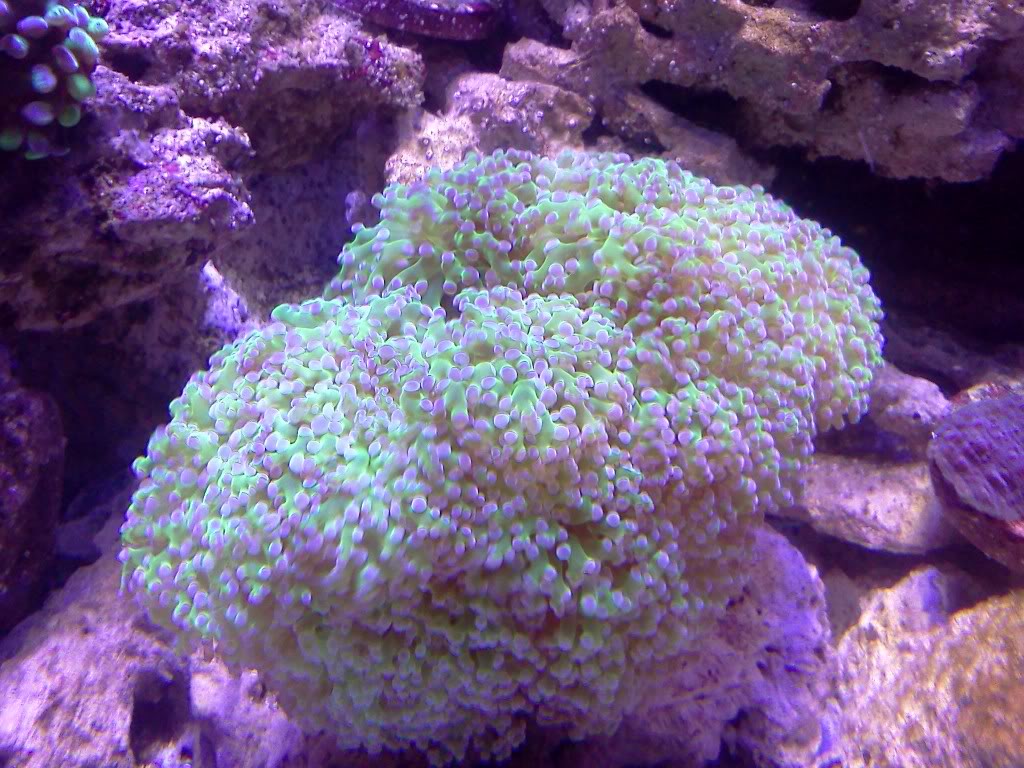
coral pic under leds

012012142302.jpg


the coral in this pic was bleached when i got it but colors are comming back. my montis that were browned out are also coloring up. acros are growing my pink lemonade has nice color still and the base is spreading nicely. pic was taken with crappy 3.2mp cam phone but trust me the colors are good :)
 
Last edited:
Very nice! I was under the impression that each driver needed its own power cord - glad that seems to not be the case! I'm sure there is lots of head-scratching and calculator use involved though. I tried throwing my wallet at the screen, but an awesome DIY LED light didn't appear in my living room.

I look forward to hearing about how well they preform. The anti-bridgelux LED mentality is hard to get around when asking for help on various forums.
 

WHAT’S THE HARDEST PART OF REEFING TO EXPLAIN TO A NON-REEFER?

  • Why a tiny coral frag can cost that much

    Votes: 11 26.2%
  • Why I spend time testing and adjusting water

    Votes: 7 16.7%
  • Why the fish I want might not fit my tank

    Votes: 8 19.0%
  • Why I have buckets, tubing, and salt around the house

    Votes: 1 2.4%
  • Why corals are living animals, not decorations

    Votes: 12 28.6%
  • How much time and attention a reef takes

    Votes: 9 21.4%
  • The difference between freshwater and saltwater creatures

    Votes: 2 4.8%
  • I’ve stopped trying to explain

    Votes: 13 31.0%
  • Other (Post in the comments)

    Votes: 5 11.9%
Back
Top
Home
Post thread…
Market
What's new