


Do we think this is Dino’s?

  • Thread starter Thread starter cruxNC
  • Start date Start date
  • Tagged users Tagged users None

cruxNC

Community Member
View Badges
Joined
Dec 28, 2025
Messages
33
Reaction score
7
Location
Raleigh
What state or country do you live in
North Carolina
Rating - 0%
0   0   0
I just had to do a restart. I had another thread and I lost my rank to Algae. It smothered everything killing most of my coral. I had been in the battle, left four days for business and came back to death. I reset several weeks ago saving the rock and the filter media for bio.

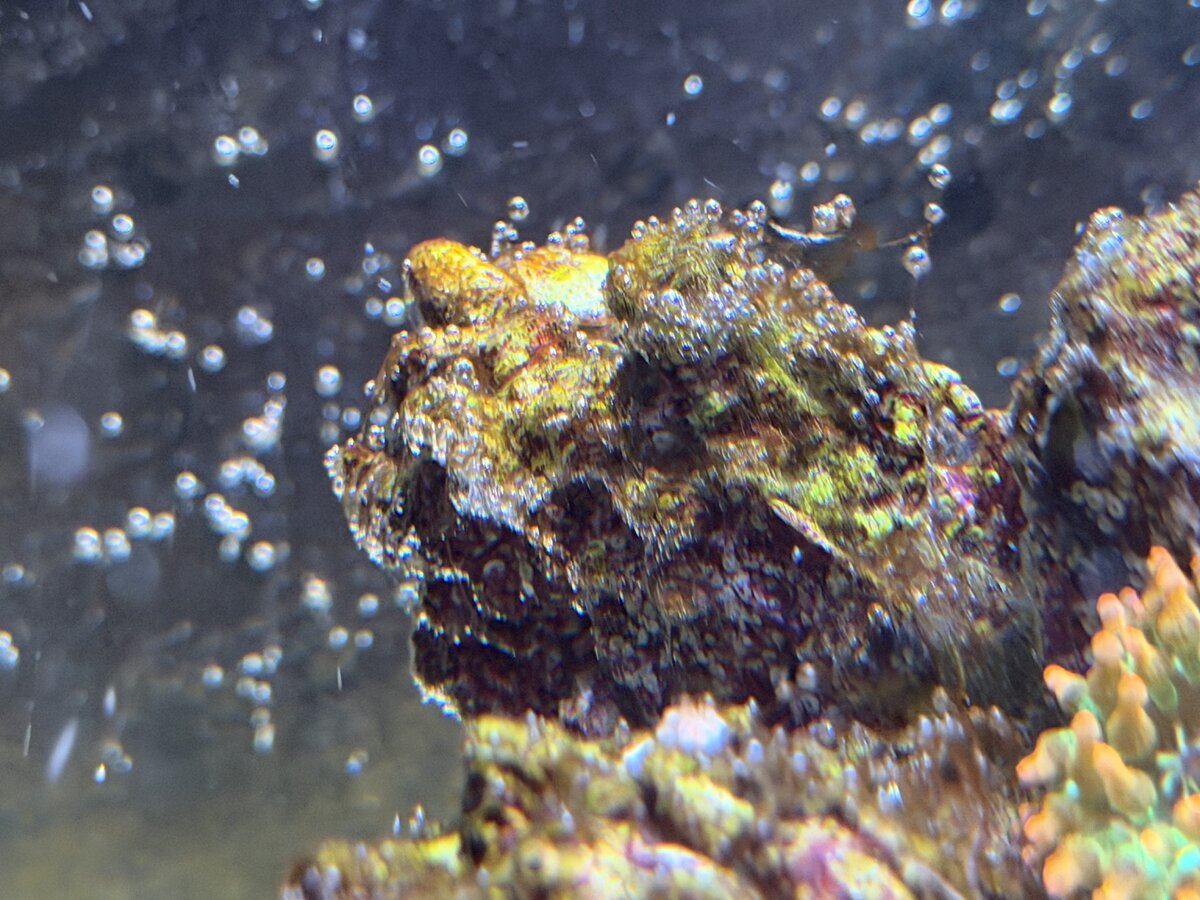
About 4 days ago, the brown showed up on the substrate. It improved with water change but came right back. It is stringy and there is air bubbles on the back glass. My nitrate and Phos aren’t zero, but they are low. I am feeding a bit more, but how do I keep this from getting out of hand. I can’t lose again. I had just established and things were starting to come together.
IMG_5412.jpeg


IMG_5411.jpeg

IMG_5395.jpeg

IMG_5389.jpeg
 
Looks very much like dinoflagellates. The strings/filaments are quite long, even severe diatom outbreaks don't build such long structures. Nutrient levels don't have to bottom out, dinoflagellates can very much appear in other conditions as well.
 
What can I do? I can’t have this escalate
 
I would get my hands on a cheap microscope and ID the type. In the meantime I would suck some out and add a bag of granular activated carbon.

I think I see a snail. If so, that’s a good sign.

You might want to check out Jason Mack’s Dino group on Facebook.
 
Depending on who you ask you will get a variety of different answers. I personally think trying multiple approaches is the best way to go. If someone claims they have the "perfect" answer, ignore their advice, they don't 😅

Here is a list of stuff you can try:
  • Changing nutrient levels and ratio (Nitrate and Phosphate). I would try lowering nutrients first (because that's more difficult) and then increasing if the problem gets worse. As long as there is growth, there have to be nutrients in some shape or form.
  • UV sterilizer. Make sure you are connecting a pump that is large enough but not too large. The instructions of the sterilizer will tell you how many gallons per hour you have to push through.
  • Manual removal. Very tedious, but still very effective. Whatever they consume to bloom, you will remove it with them.
  • Water changes. Yes, I know many people say that's a bad idea because the introduced trace elements will help with the dinoflagellates' growth, but if there are other organisms that need to "outcompete" those dinos they will need the trace elements as well.
  • Blackouts Not my favorite, but still worth a try. I don't think you can really starve dinoflagellates this way. Many can feed on other organisms (the mucus traps them and may contain digestive enzymes) and it also weakens corals and other photosynthetic organisms.
  • Bacteria dosing. Also not my favorite but some people swear it was the only way to get rid of the dinos: Choose a product with bacteria that actually survive being bottled. Tropic Marin Nitribiotic might be a decent choice.
  • Silicate dosing. The idea is to outcompete the dinoflagellates with diatoms. Diatoms look ugly as well, but they aren't harmful in a way dinoflagellates are during a bloom. They don't produce toxins, and they also disappear on their own once silicate levels go down again.
  • Increased water flow to loosen up those strings and hope to get them into the skimmer.
  • Fine mechanical filtration such as diatom filters.
  • Live Phytoplankton dosing. I personally see Tetraselmis suecica survive for quite a while in my tank, so it could be a candidate. In a worst case scenario, you feed the dinoflagellates, but that can also happen with diatoms (silicate dosing) or bacteria (bottled bacteria dosing).
  • Add Copepods & Amphipods. In theory unarmored dinoflagellates might get eaten. I personally have not seen this yet for the dinoflagellates in reef tanks, but that doesn't mean anything.
  • Fauna Marin DinoX / DinoM. "Chemical" solution. Might be worth a try.
  • Granular Activated Charcoal (GAC). Reduces dissolved organics which may or may not play a role.
  • Experimental: Ozone. If you have an ozone-compatible skimmer. You may try it, but you have to read how to do it properly.
  • Very Experimental: H₂O₂ or Bleach dosing. Sounds dangerous, but in minute amounts it isn't. It increases ORP / Redox just like Ozone. It apparently worked for some people. It's difficult to explain why this could even work at all, but indirectly ORP may have an effect on the microbiology, so even if it is very experimental, I would still like to include it int this list of options.

I might have forgotten something, but that's a very typical list of approaches to try... I can also recommend getting an ICP-MS test (not ICP-OES in your case so you can actually see if certain trace elements are really depleted). Once you have the results I would try to bring all major, minor, and trace elements back on track with appropriate solutions.
 
Thank you. I have a lot of work to do.
 
Thank you. I have a lot of work to do.
I would start with manual removal combined with water changes which helps with nutrient level adjustment. UV can be done in parallel.
If that doesn't work, silicate dosing is your friend. I would leave chemical solutions, blackouts, and the other experimental stuff till the end.
 
Thank you. I THINK I have made a lot of progress. I have take out all white. Blue and Violet are at 25%. I have been feeding well. No water change in two weeks now. Turkey basting at least once a day (started with aggressive back glass scrapping (where all the bubbles were). I have been running UV filter 24 hours a day. We are about 5 days into this. I have added peroxide several times. Not every day 1ml per 10 gallons. There is almost no stringy, dusty, bubbles, etc. Looks pretty good! Fingers crossed. I might wait until Friday and start increasing the lights and keep UV on for another week. The discontinue the UV after 2 weeks.
 

TOP 10 Trending Threads

WHAT DO YOU ALWAYS RUN OUT OF AT THE WORST TIME?

  • Salt mix

    Votes: 17 19.3%
  • Fish or coral food

    Votes: 5 5.7%
  • Test kits or reagents

    Votes: 8 9.1%
  • Filter media or replacement fleece

    Votes: 5 5.7%
  • RO/DI filters or supplies

    Votes: 14 15.9%
  • Fragging and repair supplies, like glue or epoxy

    Votes: 10 11.4%
  • I keep a backup of everything

    Votes: 22 25.0%
  • Other (Post in the comments)

    Votes: 7 8.0%
Back
Top
Home
Post thread…
Market
What's new





