

Silicate Dosing for Reef Tanks

Miami Reef

Reef Chem Enthusiast
View Badges
Joined
Sep 8, 2017
Messages
17,255
Reaction score
29,628
Location
Miami
Rating - 0%
0   0   0
Silicate feeds diatoms and sponges in reef tanks. Diatoms in particular are good at outcompeting dinos, feeding copepods, and might even feed corals and filter feeders when scraping the glass. Diatoms are also less visible than the standard green film algae they replace.

There is no need to test for silicate because it depletes quickly and the dose I’m suggesting will not accumulate over time. In addition, the dose has absolutely no interference with phosphate test kits. It will not cause false positives.

Here are Amazon links to purchase sodium silicate:


Sodium silicate is very thick. It’s not as simple as saying 1 gram of silicate = 1 mL of silicate. I accounted for this by using its density, so pick whatever’s most convenient.
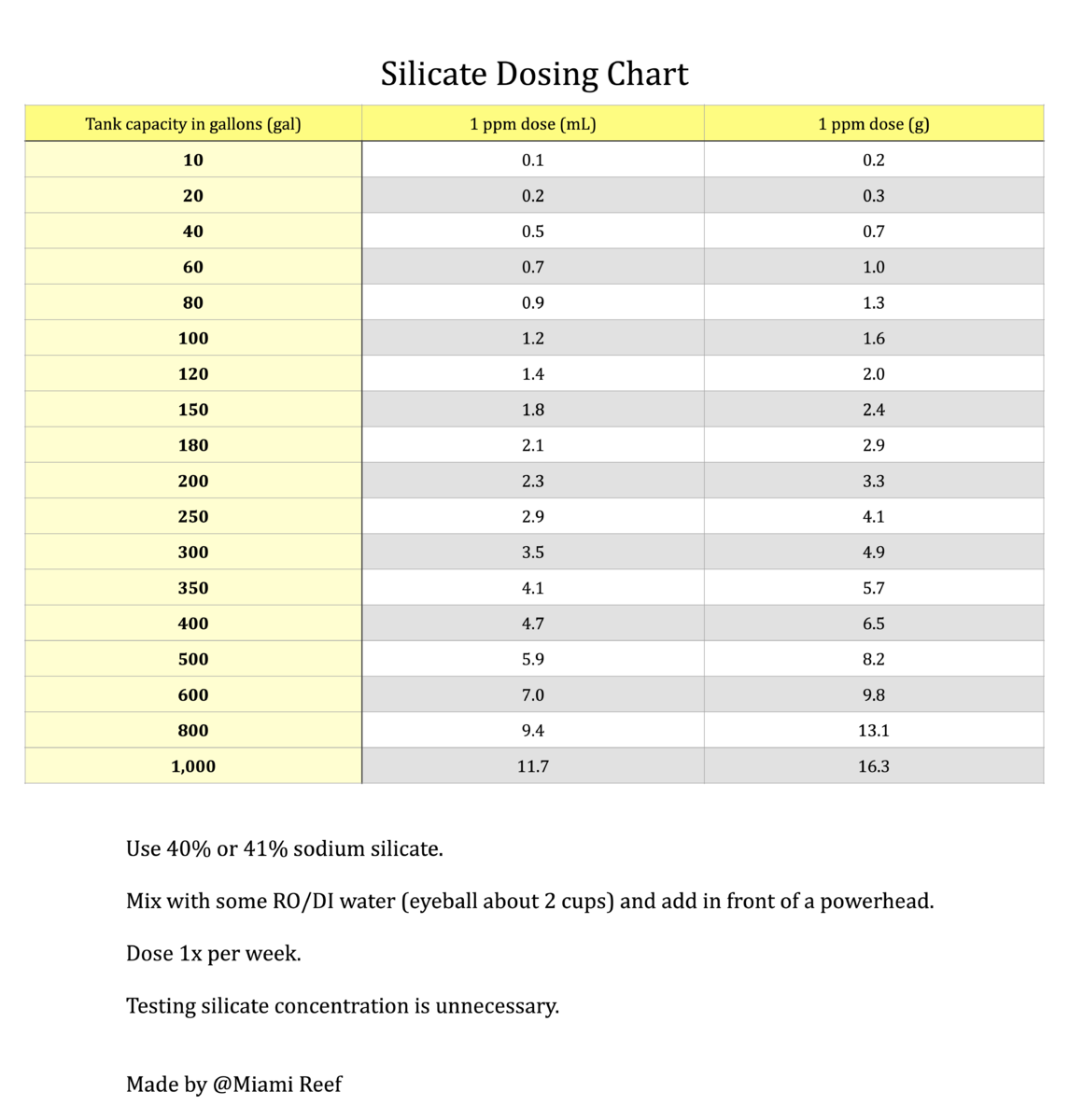
Silicate Dosing Chart.png
 
Last edited:

MeganV

Community Member
View Badges
Joined
Dec 10, 2022
Messages
51
Reaction score
50
Location
Findlay, OH
Rating - 0%
0   0   0
I have had great results out-competing dinos and lyngbya by dosing silicates. Epiphytic diatoms wiped out the lyngbya, which was super cool to see under the microscope.
 

Dan_P

7500 Club Member
View Badges
Joined
Sep 21, 2018
Messages
9,876
Reaction score
9,740
Rating - 0%
0   0   0
Well,, it's a confusing world, perhaps space, maybe something else, lol.
This might be a case of correlation is not causation.

The Lyngbya probably has ways to discourage epiphytes and when it can’t the diatoms grow on it. The Lyngbya could have been declining before silicate addition and had a declining capability to ward off epiphytes.
 
OP
OP
Miami Reef

Miami Reef

Reef Chem Enthusiast
View Badges
Joined
Sep 8, 2017
Messages
17,255
Reaction score
29,628
Location
Miami
Rating - 0%
0   0   0
Diatoms are fierce competitors of dinos. Dosing silicate is nothing new. People have been doing it a long time.

Even Taricha agrees.

Silicate is helpful generally, since diatoms are fast growers, good competitors, have similar requirements and niches to dinos, and in almost all cases are much preferable to grow than dinos. This is especially true for sand dwelling types, and prorocentrum spends almost all of its time in the sand & rock. But UV is also useful for any type that can be made to go in the water, and prorocentrum does have that trait.
People can argue which is the more effective intervention, and I'm not sure which I would say in this case. But either or both can be helpful.
 
OP
OP
Miami Reef

Miami Reef

Reef Chem Enthusiast
View Badges
Joined
Sep 8, 2017
Messages
17,255
Reaction score
29,628
Location
Miami
Rating - 0%
0   0   0
Diatoms are a known food source of dinoflagellates…

https://link.springer.com/content/pdf/10.1007/s12601-010-0007-2.pdf
That’s a non sequitur.

Competition isn’t just about predation. Diatoms can bloom massively when silicate is available, often at a rate that would overwhelm dinos’ grazing capacity. So even if dinos graze on them, they might still be pushed back by a large diatom bloom.

There is enough empirical evidence to show it’s effectiveness. The fact that dinos have the ability to eat them is not a reason to avoid dosing silicate. Dinos can also “eat” nitrate and phosphate, but we already know those are the gold standard treatments.
 

Garf

5000 Club Member
View Badges
Joined
Oct 23, 2020
Messages
6,776
Reaction score
7,578
Location
BEEFINGHAM
Rating - 0%
0   0   0
That’s a non sequitur.

Competition isn’t just about predation. Diatoms can bloom massively when silicate is available, often at a rate that would overwhelm dinos’ grazing capacity. So even if dinos graze on them, they might still be pushed back by a large diatom bloom.

There is enough empirical evidence to show it’s effectiveness. The fact that dinos have the ability to eat them is not a reason to avoid dosing silicate. Dinos can also “eat” nitrate and phosphate, but we already know those are the gold standard treatments.
If only things were that simple, lol. It appears diatoms can make themselves less appetising to grazers whilst making their competitors delicious;

(PDF) The Allelopathic in the Diatoms https://share.google/ouEQymC7Xio5dNzbq
 

CHSUB

2500 Club Member
View Badges
Joined
May 4, 2015
Messages
2,759
Reaction score
2,816
Location
Punta Gorda, FL
Rating - 0%
0   0   0
People have been doing it a long time.
Just because “people” do something for a long time does not mean it is the right something.
they might still be pushed back by a large diatom bloom.
Maybe, not what I would do however.
Dinos can also “eat” nitrate and phosphate, but we already know those are the gold standard treatments.
Imo, it is the exact opposite of a proper treatment and I’m not alone with that statement. Many of the masters in the hobby don’t follow this “gold standard”. Simply vacuuming them out, whatever them is, should be the gold standard. For some reason the “modern” hobbyists wants to fix things by testing and using chemicals or additives vs this:
IMG_1128.png
IMG_0948.jpeg


A one or two hour session 2 or 3 times a week with a canister filter would easily eliminate any nuisance algae….i can guarantee this!
 

Randy Holmes-Farley

Reef Chemist
View Badges
Joined
Sep 5, 2014
Messages
89,598
Reaction score
93,010
Location
Massachusetts, United States
Rating - 0%
0   0   0
Just because “people” do something for a long time does not mean it is the right something.

Maybe, not what I would do however.

Imo, it is the exact opposite of a proper treatment and I’m not alone with that statement. Many of the masters in the hobby don’t follow this “gold standard”. Simply vacuuming them out, whatever them is, should be the gold standard. For some reason the “modern” hobbyists wants to fix things by testing and using chemicals or additives vs this:
IMG_1128.png
IMG_0948.jpeg


A one or two hour session 2 or 3 times a week with a canister filter would easily eliminate any nuisance algae….i can guarantee this!

When I had dinos, the problem cleared up very fast when I boosted nutrients, added silicate, added two uv bulbs in a sump, and ran a mechanical filter in a different sump.

One or more of those things did the trick. Of course I cannot say with certainty which ones, but without a doubt something made a big and lasting difference.

The only treatment that continued after the problem disappeared is the elevated nutrients and occasional silicate. Perhaps they are why it has not recurred.
 

jonelder68

Valuable Member
View Badges
Joined
Aug 13, 2023
Messages
1,707
Reaction score
2,412
Location
Olathe
Rating - 0%
0   0   0
Just because “people” do something for a long time does not mean it is the right something.

Maybe, not what I would do however.

Imo, it is the exact opposite of a proper treatment and I’m not alone with that statement. Many of the masters in the hobby don’t follow this “gold standard”. Simply vacuuming them out, whatever them is, should be the gold standard. For some reason the “modern” hobbyists wants to fix things by testing and using chemicals or additives vs this:
IMG_1128.png
IMG_0948.jpeg


A one or two hour session 2 or 3 times a week with a canister filter would easily eliminate any nuisance algae….i can guarantee this!
Agree diatom filters are awesome! They cleared my 1 & 2 rounds of Dino’s very quickly. But depends on which type of Dino’s you have. So far a diatom filter has done nothing for third round of Dino’s specifically Prorocentrum Dino’s. It’s been a two month battle so far. I’ve been trying treatments in stages to see what has the biggest effect. So far diatom filters and manual removal has changed nothing. This is while also running UV sterilizer. Two weeks ago started dosing silicates. This last week the Dino’s have slowly been withering down. I can finally see patches of sand popping through. So silicates are definitely working. Before seeing silicates being successful I ordered the UV sand sweeper. To test its effectiveness I’ve started using it on one side/half of the tank. So we’ll see how it compares to the other side with silicate dosing.

Rounds 1-2 with manual removal and constant turkey basting while running a marineland magnum filter. Though those Dino’s would disappear at night and enter the water column so catching and removing was highly effective.
IMG_7649.jpeg

12-24 hours of running and filter would be clogged. But Dino’s were gone in 5-7 days. Wish prorocentrum was as easy to rid off.
 

CHSUB

2500 Club Member
View Badges
Joined
May 4, 2015
Messages
2,759
Reaction score
2,816
Location
Punta Gorda, FL
Rating - 0%
0   0   0
Agree diatom filters are awesome! They cleared my 1 & 2 rounds of Dino’s very quickly. But depends on which type of Dino’s you have. So far a diatom filter has done nothing for third round of Dino’s specifically Prorocentrum Dino’s. It’s been a two month battle so far. I’ve been trying treatments in stages to see what has the biggest effect. So far diatom filters and manual removal has changed nothing. This is while also running UV sterilizer. Two weeks ago started dosing silicates. This last week the Dino’s have slowly been withering down. I can finally see patches of sand popping through. So silicates are definitely working. Before seeing silicates being successful I ordered the UV sand sweeper. To test its effectiveness I’ve started using it on one side/half of the tank. So we’ll see how it compares to the other side with silicate dosing.

Rounds 1-2 with manual removal and constant turkey basting while running a marineland magnum filter. Though those Dino’s would disappear at night and enter the water column so catching and removing was highly effective.
IMG_7649.jpeg

12-24 hours of running and filter would be clogged. But Dino’s were gone in 5-7 days. Wish prorocentrum was as easy to rid off.
Removing that gunk constantly would only help an aquarium regardless of the problem…my aquariums are clean and I never have algae or nutrient problems that are unmanageable. I have been doing the same since I was in charge of maintaining aquariums at Pet City in Seabrook nh back in the 1980’s. Weekly WC and polishing with a diatom filter, very simple. Imo, eventually what you are doing will work…
 

CHSUB

2500 Club Member
View Badges
Joined
May 4, 2015
Messages
2,759
Reaction score
2,816
Location
Punta Gorda, FL
Rating - 0%
0   0   0
When I had dinos, the problem cleared up very fast when I boosted nutrients, added silicate, added two uv bulbs in a sump, and ran a mechanical filter in a different sump.

One or more of those things did the trick. Of course I cannot say with certainty which ones, but without a doubt something made a big and lasting difference.

The only treatment that continued after the problem disappeared is the elevated nutrients and occasional silicate. Perhaps they are why it has not recurred.
Could also be you are not over feeding like the typical new hobbyist does and you are maintaining a “cleaner” environment than many? I know when I started I did a crazy amount of feeding and really didn’t understand what maintenance looked like.
 

jonelder68

Valuable Member
View Badges
Joined
Aug 13, 2023
Messages
1,707
Reaction score
2,412
Location
Olathe
Rating - 0%
0   0   0
Removing that gunk constantly would only help an aquarium regardless of the problem…my aquariums are clean and I never have algae or nutrient problems that are unmanageable. I have been doing the same since I was in charge of maintaining aquariums at Pet City in Seabrook nh back in the 1980’s. Weekly WC and polishing with a diatom filter, very simple. Imo, eventually what you are doing will work…
Yes I’m a fan of diatom filters. I plan on putting one together like @Paul B posted as a DIY using RO membrane sediment filters etc. having the ability to vacuum the aquarium is handy 😀
 

lesismore

Active Member
View Badges
Joined
Jul 12, 2024
Messages
255
Reaction score
226
Location
mesa
Rating - 0%
0   0   0
Silicate feeds diatoms and sponges in reef tanks. Diatoms in particular are good at outcompeting dinos, feeding copepods, and might even feed corals and filter feeders when scraping the glass. Diatoms are also less visible than the standard green film algae they replace.

There is no need to test for silicate because it depletes quickly and the dose I’m suggesting will not accumulate over time. In addition, the dose has absolutely no interference with phosphate test kits. It will not cause false positives.

Here are Amazon links to purchase sodium silicate:


Sodium silicate is very thick. It’s not as simple as saying 1 gram of silicate = 1 mL of silicate. I accounted for this by using its density, so pick whatever’s most convenient.


This is really excellent. How long do you suggest dosing if the goal is to eradicate dinos? My nutrients are where they need to be and I’m using a up sterilizer. I will baste the sand and dose silicates as per your recommended dose. Is there a maintenance doe or frequency that I may wish to offer periodically once things are under control? Thank you very much for your help!!
 
OP
OP
Miami Reef

Miami Reef

Reef Chem Enthusiast
View Badges
Joined
Sep 8, 2017
Messages
17,255
Reaction score
29,628
Location
Miami
Rating - 0%
0   0   0
This is really excellent. How long do you suggest dosing if the goal is to eradicate dinos? My nutrients are where they need to be and I’m using a up sterilizer. I will baste the sand and dose silicates as per your recommended dose. Is there a maintenance doe or frequency that I may wish to offer periodically once things are under control? Thank you very much for your help!!
Stay tuned. The reason I made this thread and chart is because I have a new dinoflagellates treatment article pending submission. It should be released very soon, and I’ll update this thread with the link.

But to answer your question, once the dinos are gone, you can slowly back off the silicate dosing after 2-3 weeks, I’d say. You don’t need to dose silica indefinitely in most cases once you’ve established a new balance. (I like dosing silicate even though I don’t have dinos).

Just don’t allow nutrients to bottom out.


Update. Here it is:

 
Last edited:

TOP 10 Trending Threads

HOW DO YOU ADJUST YOUR CUC AS ALGAE DISAPPEARS?

  • Capture and re-home CUC

    Votes: 10 8.4%
  • Increase white light/hours in tank to spur algae growth to feed CUC

    Votes: 8 6.7%
  • Feed nori to support CUC

    Votes: 39 32.8%
  • Feed herbivore pellets to support CUC

    Votes: 42 35.3%
  • Allow attrition to balance CUC and algae

    Votes: 51 42.9%
  • Provide macro algae to feed CUC

    Votes: 8 6.7%
  • Introduce CUC predators

    Votes: 1 0.8%
  • Other (please explain)

    Votes: 12 10.1%
Back
Top









