Russ at Buckeye Hydro has a really neat calculator on his website that simplifies the above. You enter your membrane size, pressure and temperature and it spits out your expected GPD. It's cool to play with the pressures or temperatures and see what effect it has on production.
Not a fan of Kinnetico, over rated, over priced and mediocre performance. They are more in the water conditioning or softening business and not the ultrapure water business.
Spectrapure would be my first suggestion, large commercial RO/DI systems are what they specialize in. Many many large LFS use them as do many popular coffee houses where they use RO/DI then demineralization cartridges for the exact flavor profile they desire. I'll bet $$ you have drank Spectrapure RO/DI if you go to the big green coffee chain that is everywhere.
AWI is another that sells large RO/DI systems.
If you are asking about ways to improve the present system I would need to know more about it. What filters, what process, does it use DI or ion exchange, etc.
Yeah apparently Mike upgraded our system because we kept getting readings of two -- after the new system was installed we were still getting the same readings. Long story short -- our TDS meter was busted. Hahaha...would have been cheaper to just replace that! Its apparently measuring 0 now
So i was making up some saltwater in a five gallon bucket today and i decided to test the tds of my ro/di water. In my storage container it measured 1ppm which i do not think is bad. Correct? I then for some reason tested the water i had put in the bucket before adding salt. It measured 17ppm!!!. Im assuming particles of whatever was left in bucket from doing water changes and things like that had affected reading. What i want to know is when i put this water into tank after mixing in salt am i really putting the 17ppm in my tank? Let me hear your thoughts.
So are people that misuse punctuation. See how I did that? I correctly started a sentence with "so". You probably shouldn't be so quick to point out things that annoy you if you can't even let auto-correct tell you when you are wrong.
Agreed Randy. The whole reason I was watching this thread is because I am curious about my tds readings. I have BRS' value plus rodi unit and the pre-filtered readings show between 2-3, and the post-filtration readings show 0.0. I live in a suburb of Portland, Oregon and I have serious doubts about my pre-filtered water having that low of a tds reading. Since the unit was brand new it has been around the same tds. I recently had a full panel test done by Aqua-medic, and here are my results:
I guess my question is, using Red Sea Coral Pro, are my silica readings coming the result of my salt mix or my rodi output? Is this a normal silica reading that you have seen from this salt? Also, how accurate has your experience been (if any) with this testing method?
Looks like you have a 5000 gpd RO with two 4040 membranes. Wondering why they didn't use a backwashing valve on your carbon tank. Looks like you have a simple in out head, probably with upflow. Seems odd. Cost cutting measure?
Kchapmanjr, your inline TDS meter is reading post RO or treated water on the IN probe and post DI water on the OUT probe. You need to know your tap water TDS to know how effective your system is and that is just one of the many limitations of the inline TDS meters.
Looks like you have a 5000 gpd RO with two 4040 membranes. Wondering why they didn't use a backwashing valve on your carbon tank. Looks like you have a simple in out head, probably with upflow. Seems odd. Cost cutting measure?
Possibly! I dont know much about the new setup havent had much time to study it -- everything just got set up last week. I may try to take some more detailed photos, I am definitely not an authority on this stuff. Lol
Agreed Randy. The whole reason I was watching this thread is because I am curious about my tds readings. I have BRS' value plus rodi unit and the pre-filtered readings show between 2-3, and the post-filtration readings show 0.0. I live in a suburb of Portland, Oregon and I have serious doubts about my pre-filtered water having that low of a tds reading. Since the unit was brand new it has been around the same tds. I recently had a full panel test done by Aqua-medic, and here are my results:
I guess my question is, using Red Sea Coral Pro, are my silica readings coming the result of my salt mix or my rodi output? Is this a normal silica reading that you have seen from this salt? Also, how accurate has your experience been (if any) with this testing method?
Agreed Randy. The whole reason I was watching this thread is because I am curious about my tds readings. I have BRS' value plus rodi unit and the pre-filtered readings show between 2-3, and the post-filtration readings show 0.0. I live in a suburb of Portland, Oregon and I have serious doubts about my pre-filtered water having that low of a tds reading. Since the unit was brand new it has been around the same tds. I recently had a full panel test done by Aqua-medic, and here are my results:
I guess my question is, using Red Sea Coral Pro, are my silica readings coming the result of my salt mix or my rodi output? Is this a normal silica reading that you have seen from this salt? Also, how accurate has your experience been (if any) with this testing method?
I'm not sure where the silicate is coming from, or even whether Aquamedic measures it accurately, but if you do not have a diatom problem, there is no concern about silica. I dosed silicate for many years to support sponge growth. :)
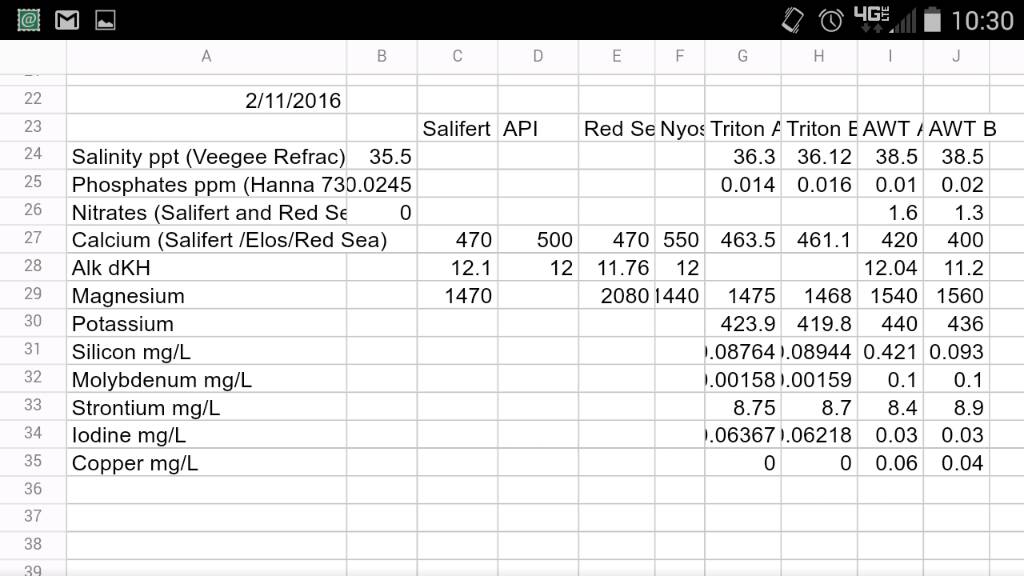
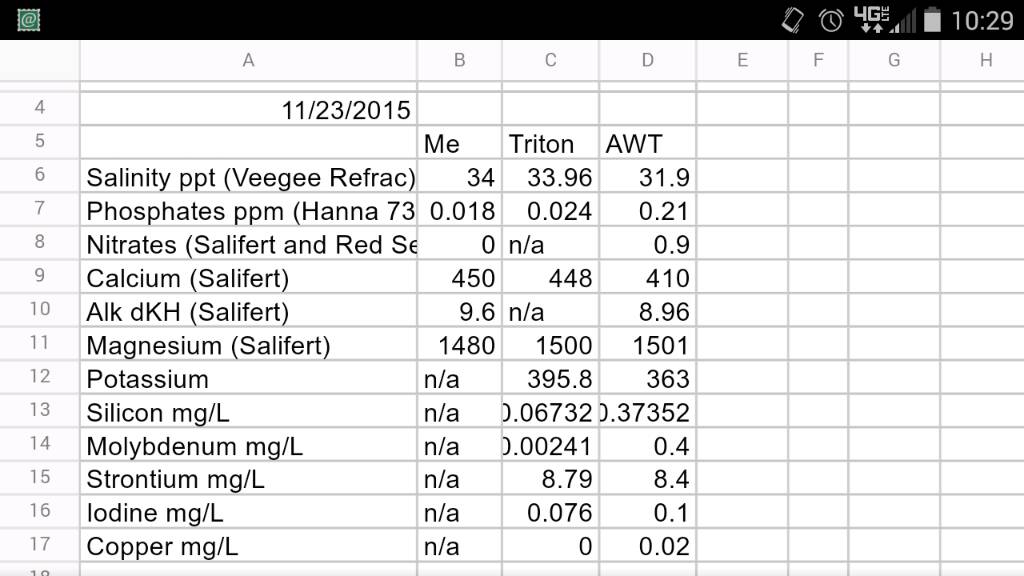
I would not rely on AWT's silica measurement. At least it has not lined up with Triton's number using the same sample water sent to both places on a couple different occasions nor has it been consistent between two tests from the same sample water sent in at the same time to AWT and Triton. Triton was consistent between the two samples with in reason.
From my big 3 shootout thread which you'll also see other discrepancies with AWT's results compared to mine and Triton's.
Kchapmanjr, your inline TDS meter is reading post RO or treated water on the IN probe and post DI water on the OUT probe. You need to know your tap water TDS to know how effective your system is and that is just one of the many limitations of the inline TDS meters.
You know, that is not something I thought to ask, but would be a question BRS could answer. My assumption would be that the IN probe is reading post RO water and the OUT probe is reading post DI.
I'm not sure where the silicate is coming from, or even whether Aquamedic measures it accurately, but if you do not have a diatom problem, there is no concern about silica. I dosed silicate for many years to support sponge growth. :)