


Moonlight Percent: 20% blues too much?

tutmatt3

Well-Known Member
View Badges
Joined
Dec 28, 2016
Messages
607
Reaction score
367
Rating - 0%
0   0   0
Hey Guys,

So I have these on my AQ: http://current-usa.com/loop/orbit-ic-led-aquarium-light/
Part Data of the IC's: http://current-usa.com/wp-content/uploads/2017/02/Orbit-PAR-Measurements-1.pdf

My question is: Is 20% blues too much moonlight?
My day runs 'peak' for 6.5 hours @ r-20, g-20, b-100, w-25

Then the system runs moonlight for 6x hours (duration of moonlight not programmable on this unit)
(6pm-midnight)

I had the moonlights @ 10%blue, but playing with it more tonight, really enjoying them @ 20%. All coral really seems to pop (for my visual pleasure)

I was reading up that some corals even continue to grow during moonlight, so thought 20% might not be as bad as I thought. Maybe it looks very bright to me since I'm used to viewing it @ 10%, but love to hear what you guys have to say!

The lights remain off for a total of 8.5h once midnight hits

Let me take some pics real quick of 10% vs 20% (of course hard to calibrate camera vs eyes)
20%:
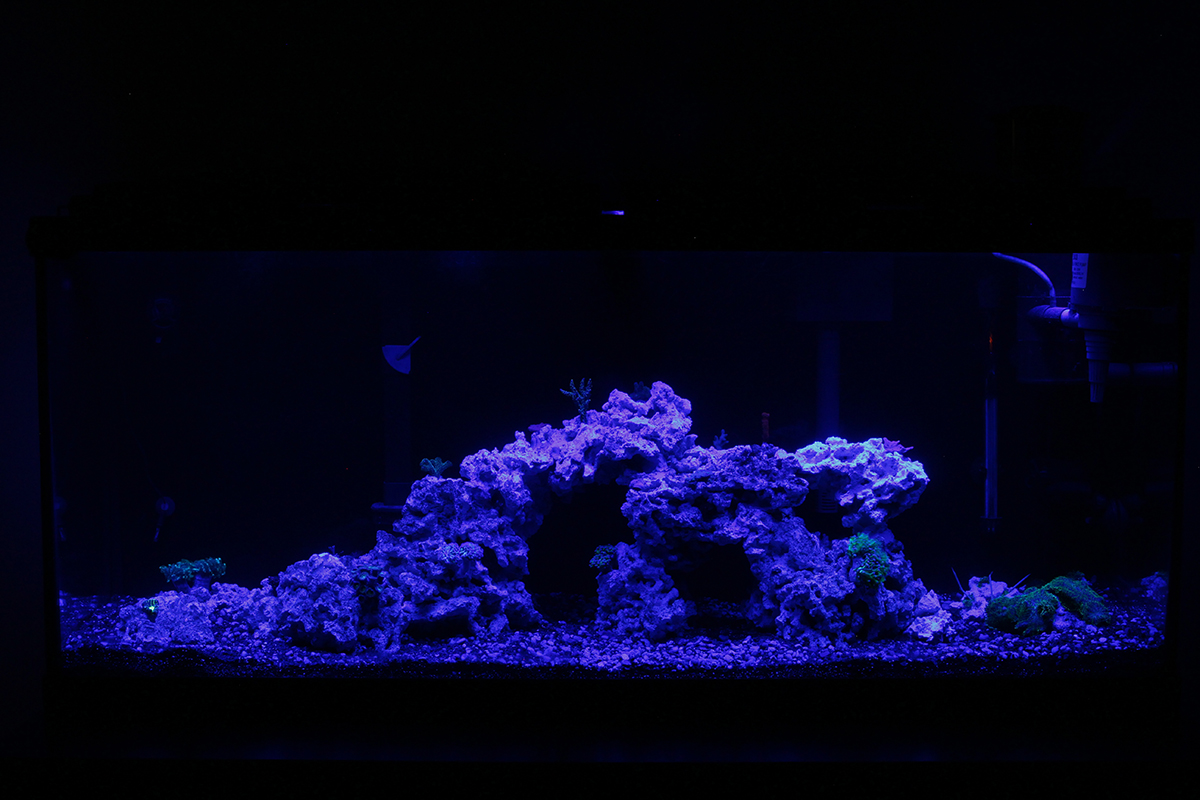
6OubyQdjaNF2unI5FGAYDA3ev4os5.jpg


10%
6OubSbG9r2r4CWWg8HKnpDlj5G0H5.jpg


Even in the pics you can tell certain greens & colors pop!
Love to hear your thoughts!

 

Jason mack

Monti madness
View Badges
Joined
Dec 3, 2016
Messages
5,479
Reaction score
15,002
Location
Holland
Rating - 0%
0   0   0
I think for the blues it's more what you like yourself , what is the most appealing to your eye .. but I could be wrong !
 
OP
OP
tutmatt3

tutmatt3

Well-Known Member
View Badges
Joined
Dec 28, 2016
Messages
607
Reaction score
367
Rating - 0%
0   0   0
I think for the blues it's more what you like yourself , what is the most appealing to your eye .. but I could be wrong !
Hmm ok. Maybe @ lower percentages, but correct me if im wrong (those who know), I think the blues is where most photosynthesis takes place, ya?
Thats why we run roughly a 3blue:1white ratio for peak?

I've know white is necessary of course, but too much would be algae issues.

Also don't currently have the fish in (in QT), so I'm sure I'll have to see how they react to the stronger moonlight, if it may be too strong for them.
 

bios

Well-Known Member
View Badges
Joined
Aug 16, 2016
Messages
750
Reaction score
458
Location
camerino italy
Rating - 0%
0   0   0
Clorophilla a,b,c,d have 2 peaks of work
One is 430-500 nm(actinic lights)
Other is 600-700 nm
This is only a short summary
But in my opinion in the night better 2/3 % of blue light max
 

mcarroll

10K Club member
View Badges
Joined
Jan 8, 2012
Messages
15,213
Reaction score
8,968
Location
Virginia
Rating - 0%
0   0   0
My question is: Is 20% blues too much moonlight?

Nerdy answer: moonlight isn't blue and is extremely weak. Most corals do not see moonlight....only the ones at the very surface.

Normal answer: copy the same intensity that Current uses on their pre-programmed mode that includes moonlight. :)

I watched a video on led where red cause photosynthesis to occur faster.

That's why a lot of the led grow lights are red !!

But.....corals don't need or want photosynthesis to happen any faster!

In bright light, corals already shut down photosynthesis for most of the day. And most corals – even stony corals – don't seem to require much photosynthesis to get the job done – so why should we want to rush it? :)
 
OP
OP
tutmatt3

tutmatt3

Well-Known Member
View Badges
Joined
Dec 28, 2016
Messages
607
Reaction score
367
Rating - 0%
0   0   0
I watched a video on led where red cause photosynthesis to occur faster.
That's why a lot of the led grow lights are red !!
Interesting! I've heard that red will also encourage nuisance algae, but then again it barley even penetrates the water!

Clorophilla a,b,c,d have 2 peaks of work
One is 430-500 nm(actinic lights)
Other is 600-700 nm
This is only a short summary
But in my opinion in the night better 2/3 % of blue light max
Got it, cheers!

Nerdy answer: moonlight isn't blue and is extremely weak. Most corals do not see moonlight....only the ones at the very surface.

Normal answer: copy the same intensity that Current uses on their pre-programmed mode that includes moonlight. :)

Hmm ok. current uses 10% on their pre-programmed. Thats what I was using for a while, but with my moonlight kicking on so early, it makes it difficult to enjoy the beautiful lighting during that time haha (6pm-midnight)
 

Hans-Werner

Valuable Member
View Badges
Joined
Aug 24, 2016
Messages
1,994
Reaction score
3,042
Rating - 0%
0   0   0
Most organisms are especially sensitive to blue light which is caused by a special highly sensitive pigment called cryptochrome. Cryptochrome regulates the diurnal activity, even in humans. Giving too much blue light turns the night into day for the tank´s livestock. So in my eyes it is not a good idea to use blue light for the night illumination. You´d better choose very dim white light. This also has the advantage that your optic vision is much more sensitive to white light than to blue light and you can watch your tank and its inhabitants better and with much less "light" (expressed for example in PAR or mW radiation).
 
Last edited:
OP
OP
tutmatt3

tutmatt3

Well-Known Member
View Badges
Joined
Dec 28, 2016
Messages
607
Reaction score
367
Rating - 0%
0   0   0
Most organisms are especially sensitive to blue light which is caused by a special highly sensitive pigment called cryptochrome. Cryptochrome regulates the diurnal activity, even in humans. Giving too much blue light turns the night into day for the tank´s livestock. So in my eyes it is not a good idea to use blue light for the night illumination. You´d better choose very dim white light. This also has the advantage that your optic vision is much more sensitive to white light than to blue light and you can watch your tank and its inhabitants better and with much less "light" (expressed for example in PAR or mW radiation).
Very interesting. I know humans have different reaction to blue light, causing us to remain in an 'awake' state, but I would have though fish to develop with that filtered light as their natural evolution. hmm
Of course this is all just pondering from my end, no proof / research
 

Hans-Werner

Valuable Member
View Badges
Joined
Aug 24, 2016
Messages
1,994
Reaction score
3,042
Rating - 0%
0   0   0
Also for the fish blue light signals daytime. Darkness or absence of light signals nighttime just as in humans. Blue light will cause them to remain in an 'awake' state. In an evolutionary sense you can imagine the blue light sensitivity of humans as a remnant from our times as fish or algae or bacteria when in the ancient ocean blue light already was the signal for daylight.;)
 

TOP 10 Trending Threads

WHAT AMOUNT OF LIVE ROCK AND SAND SHOULD BE PRIORITIZED FOR OPTIMAL BIODIVERSITY/FILTRATION?

  • 100% live rock + bagged sand

    Votes: 38 26.6%
  • 100% dry rock + 100% live sand

    Votes: 48 33.6%
  • 50/50 live/dry rock, 50/50 live/bagged sand

    Votes: 32 22.4%
  • 75% live rock, 25% live sand

    Votes: 15 10.5%
  • 25% live rock, 75% live sand

    Votes: 10 7.0%
Back
Top







