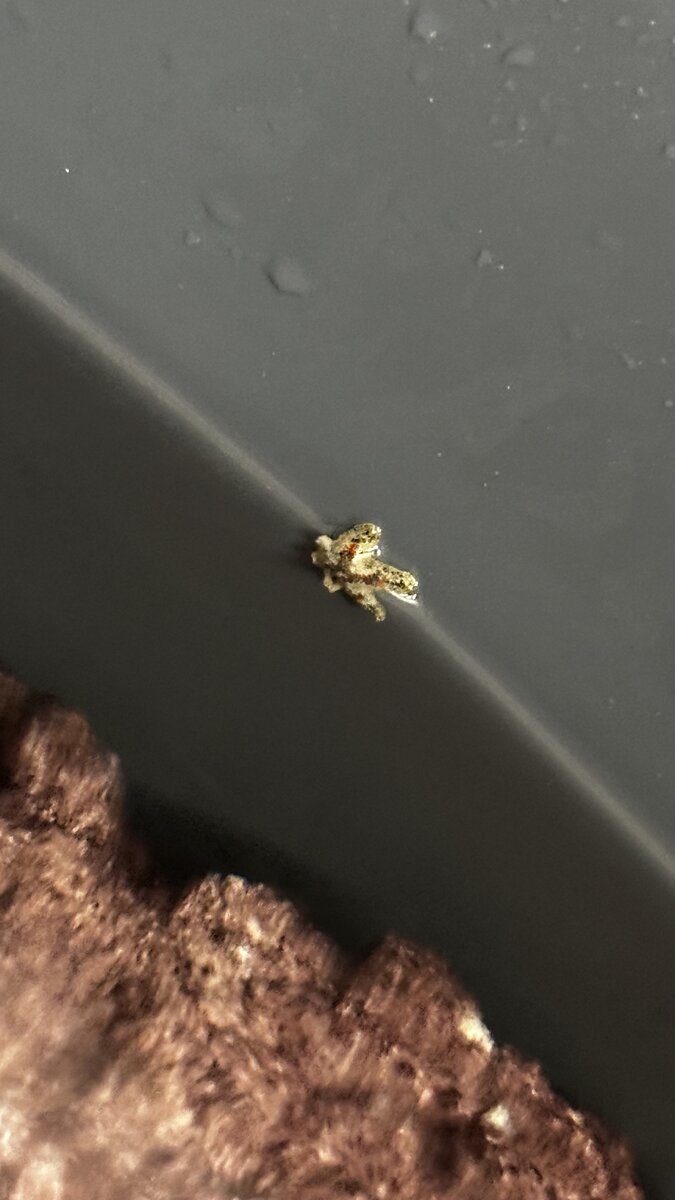
Mystery star

DmitryB

Active Member
View Badges
Joined
May 26, 2026
Messages
419
Reaction score
312
Location
Hunter, NY
Rating - 100%
1   0   0

So in my bucket that is keeping live rock from LFS cycling in preparation for a 170 in a couple of months, I just saw this little guy sitting on the wall. Is he good bad? If he's good, I'll probably grab him and put him in the 40 gallon tank because he'll get crushed by rocks in the bucket.
IMG_7595.jpg
 

Gumbies R Us

God, Bouldering, and Reefing
View Badges
Joined
Nov 10, 2022
Messages
29,691
Reaction score
52,499
Location
North Georgia
Rating - 0%
0   0   0

Tahoe61

10K Club member
View Badges
Joined
Mar 2, 2012
Messages
18,035
Reaction score
21,723
Location
AZ
Rating - 0%
0   0   0
There are different species of Asterina starfish commonly found in our systems.

Some do eat coral, it seems Zoanthids are on the menu. Whether the Asterina is an obligatory corallivore is up for debate.

The other issue is reproduction. Some varieties are prolific and become invasive. Again the particular types that have the potential to become invasive is also up for debate.

Personally I take a wait and watch approach. If the Asterina is hanging around Zoanthids or at the base of other coral types I watch even closer.
 

ISpeakForTheSeas

7500 Club Member
View Badges
Joined
Nov 22, 2021
Messages
9,425
Reaction score
10,846
Location
United States
Rating - 0%
0   0   0
There are different species of Asterina starfish commonly found in our systems.

Some do eat coral, it seems Zoanthids are on the menu. Whether the Asterina is an obligatory corallivore is up for debate.

The other issue is reproduction. Some varieties are prolific and become invasive. Again the particular types that have the potential to become invasive is also up for debate.

Personally I take a wait and watch approach. If the Asterina is hanging around Zoanthids or at the base of other coral types I watch even closer.
Basically what Tahoe61 said: Aquilonastra starfish (known in the hobby as Asterina, though that's actually a different genus in the same family); some species are likely good CUC but some are known to be coral-eaters (whether they eat coral in the wild or not is currently unknown); unfortunately, telling them apart is very difficult and requires a microscope:
Aquilonastra starfish (known in the hobby as "Asterina") - some species are fine/helpful, others have been known (at least when in large numbers) to go after corals (almost always zoas).

As a general rule, if the top of the starfish is primarily black, or if it has red/orangish spots on it (like the star in the link below), then it may be harmful:
Some have been studied in lab settings and found to be herbivorous - Aquilonastra corallicola, for example:

"A. corallicola feeds on diatoms and green algae growing on the rock and glass walls of the aquaria."*

Others are thought to be either similar in diet to A. corallicola or to be biofilm feeders. For what it's worth, though, even known herbivores like Chocolate Chip Starfish and Blue Linckia Starfish (both of which are currently thought - with good reason - by the scientific community to be biofilm-feeders) are known to exhibit opportunistic predation in aquaria, with Chocolate Chip Stars eating pretty much anything they can catch, and Blue Linckias being known to prey on Aquilonastra stars, sponges, tunicates, and even (very rarely) corals.

So, while these can be predatory, it would seem they either only go after specific corals for specific reasons (such as the coral having a specific biofilm/microbiome that attracts it), or that they use them as a last-resort famine food.

*Source:
 

TOP 10 Trending Threads

DO YOU THINK TECHNOLOGICAL ADVANCEMENTS ARE MORE HELPFUL OR HURTFUL TO REEFING?

  • More helpful.

    Votes: 11 39.3%
  • More hurtful.

    Votes: 2 7.1%
  • I think it depends mostly on the technology.

    Votes: 11 39.3%
  • I think it dependsmostly on the reefer behind the technology.

    Votes: 9 32.1%
Back
Top
Home
Post thread…
Market
What's new