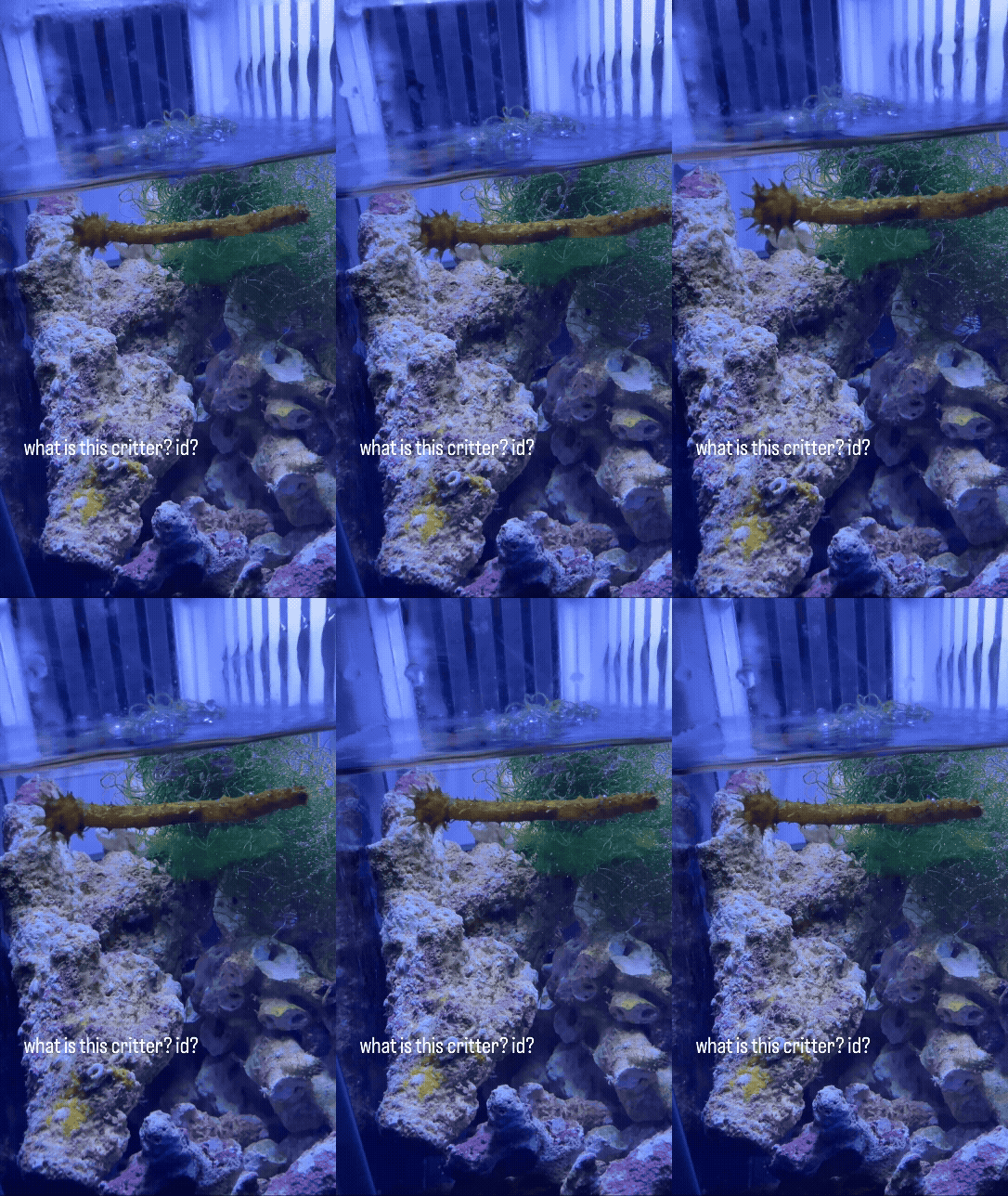
Hi so I recently bought some live australian rocks to seed my tank, saw this critter. Can anyone help ID this?
Thanks!
Thanks!
Follow along with the video below to see how to install our site as a web app on your home screen.
Note: This feature may not be available in some browsers.
Yes. It’s a new tank. So far it’s staying in the sump, with live rocks that’s covered with algae.Yep sea cucumber. Some can foul a tank if they die. Not sure what this one eats but in a new tank you may consider purchasing some algae pellets for it.
Generally good, but can crash a tank if something goes wrong:Thanks!
Good or Bad? It’s my first time adding live rocks to seed the tank.
I can't tell for sure what it is from the pics, but it looks like it could be a sea cucumber.
I'd recommend being aware that sea cucumbers can release a fish poison when extremely stressed, but as long as there's nothing harassing them in the tank, they should be totally fine (so just don't get a fish or invert known to eat or pester sea cucumbers and you should be fine; if you're concerned about it, my suggestion is to run carbon/keep carbon on hand to run, and keep mixed saltwater ready to be used for a water change just in case). I have more info on the toxin if you'd like.
I know they may sound scary, but sea cucumbers are usually totally harmless/beneficial.
Some general feeding info for sea cucumbers:
And some more feeding info specifically for sand-sifting cukes:there are basically two types of sea cucumbers: filter feeders and sand-sifters. The filter feeders need fed things like Isochrysis galbana (T-Iso), Tetraselmis sp., Thalassiosira sp., and Chaetoceros sp., while the sand-sifters should do find on pretty much any tiny/ground up food (pellets, frozen, etc.) with plenty of greens (phytoplankton/microalgae and/or macroalgae) added in - you just want to make sure the mix reaches the sand so that they could sift the sand to get the food; you could do this by using sinking feeds, or by mixing the feed in with some sand in a dish that you take out and put in to the tank at feeding time for the cuke:
With regards to the sediment feeding cucumbers, as mentioned, you can ghost feed the tank and they'll do just fine on that. For example, the Chocolate Chip Sea Cucumber (Isostichopus badionotus) has been bred in captivity on the following diets*:
"Two feeding protocols were tested: In the first year, the broodstock were fed with commercial tilapia and rabbit feed which was ground, supplemented with Spirulina powder, and blended with disinfected beach sand (30g food/kg sand). In the second year, the food was changed to a mixture of ground Ulva sp., Sargassum sp., and Macrocystis sp. meals (Baja Kelp, Ensenanada, B.C., Mexico) blended with disinfected beach sand (30g algae mixture/kg sand). The food was changed every third day to prevent fungus formation."
I don't remember the other species I've looked at at the moment, but, generally speaking, sand sifting sea cucumbers are not picky about what they eat (though the food likely needs to be relatively decently sized so as to fit in with the sediment they're sifting - for example, the food they fed to the juvenile sea cucumbers when they reached 3 cm in the study above was sieved 55 at microns). Some easy foods you could offer that should work even for smaller cucumber species would be things like TDO Chromaboost Type A and Spirulina powder like used in the study I referenced.I've seen a removable dish of sand mixed with food used successfully in sea cucumber aquaculture,Edit: The study referenced in the quote above:
https://onlinelibrary.wiley.com/doi/epdf/10.1111/jwas.12061I'd try to get the food in the ~100-500 micron range, preferably closer to 50-200 microns (especially if the cuke isn't full grown). I know foods in that size can be hard to come by - Otohime and TDO Chromaboost offer pellets in that general range, and they're amongst the best pellet feeds on the market (no pellets on the market for hobbyists are as good as fresh food or a high quality frozen food).
I don't know the Florida Sea Cucumber's (Holothuria floridana's) preferred food size, but most other species in the genus prefer feeds that range from ~60-200 microns, with a handful of exceptions that prefer either medium-small foods (~200-600 microns) or huge foods (~2,000-3,500 microns).*
Pretty much every pellet on the market will contain grains of some variety (almost always to act as a binding agent to hold the pellets together; sometimes also to provide enough calories/energy to make the food an efficient feed) - if used in small enough quantities, it's not really an issue, but when there's too much grain (too many carbohydrates) it can cause some nutrition issues.
For the spirulina, you can buy spirulina powder which will probably be closer to the right size for the cuke.
*Source:
Sophistication in a seemingly simple creature: a review of wild holothurian nutrition in marine ecosystems - PMC
Holothurians are marine invertebrates that are among the most widespread benthic megafauna communities by both biomass and abundance in shallow‐water and deep‐sea ecosystems, their functions supporting important ecological services worldwide. ...
www.ncbi.nlm.nih.gov![]()