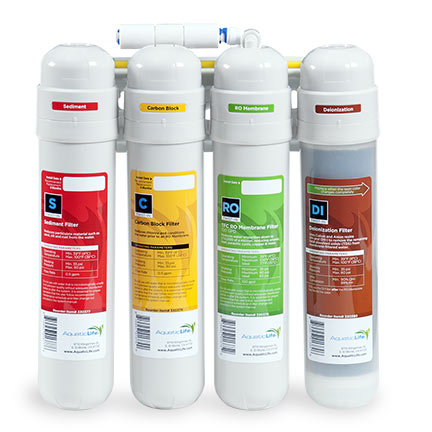
New RODI unit causing ammonia

Oceanwave45

Active Member
View Badges
Joined
May 7, 2017
Messages
482
Reaction score
454
What state or country do you live in
Colorado
Rating - 0%
0   0   0
okay so I have been have an ammonia spike since I started using a new RODI unit - has anyone heard of this?

I have checked every other possible cause and it seems to be my rodi water.

6FB0D8AF-3B99-476F-8C7B-9D9B6810D69B.jpeg
 
Did you run your RODI unit for a few minutes to flush the system before starting to use it for your tank? Depending on the system, some suggest you run the system for 15 to 30 minutes just flushing it into ready to use status.
 
I'd test some fresh water from the RODI unit and see if you get an ammonia reading. I believe the carbon block will remove chlorine but not chloramines and chloramines read as ammonia. Don't quote me on this though.
 
Did you run your RODI unit for a few minutes to flush the system before starting to use it for your tank? Depending on the system, some suggest you run the system for 15 to 30 minutes just flushing it into ready to use status.
I don't know, My boyfriend did it, I am not good with putting things together. So I will have to ask, but knowing him I bet he didn't. We have used it twice now, so wouldn't the ammonia be out already? Its been used for like four hours already if not more.
 
The output of RODI units is very small depending on the unit. 2-3 gallons per hour. May not have been enough to flush your particular unit. And if that was the problem, potentially lots of "stuff" could have come out initially when you started making RODI.
 
Depending on where you live, Chloramine is a very real possibility. You can check with your local water district to see if they do indeed use Chloramine instead of straight Chlorine.
As mentioned above, Chloramine will read as Ammonia on a test kit as Chloramine's are derivatives of ammonia by substitution of one, two or three hydrogen atoms with chlorine atom.
It takes a special carbon block to remove Chloramine 's from the RO water.
Your RO manufacturer should offer a carbon block specially designed for use in areas that utilize Chloramine in municipal water.
 
Adding to my above post, Chloramine can and often does ruin the RO membrane. I would check with your water district ASAP.
 
Usually 65psi is needed for water pressure.
 
but knowing him I bet he didn't.

Lol, yup, RTM...

Get a TDS meter as well, they are under $20 on amazon.

It may have been stated already (there have been several posts since I started typing, lol), but are you sure you are using the good water, not the waste water?

Usually 65psi is needed for water pressure.

65??? Your house water is regularly above 50? Even when I lived in the city, I never saw my gauge go above 55...

Anyway, mine works just fine above 35 psi... I aim for 40-45 (as that is what my houses average is)...
 
Here is what I found, not sure what I am looking for here

page3image40096

Chemical Compound

MCLG

MCL Action Level

90th Percentile

# of Samples

Sample Sites Above Action Level

AL or TT Viola- tion

Monitoring Period

Typical Sources

Lead(ppb) 0 AL=15 3 60 0

Copper(ppm) 0 AL=1.3 0.20

60 0
Parts per billion (ppb) or Micrograms per liter (ug/l):One part per billion corresponds to one minute in 2,000 years or

Note:*The 90th percentile is the 54th largest result out of the 60 samples taken.

No 01/01/2014

No
single penny in $10,000,000.

to 12/31/2016

Corrosion in household plumbing systems. Erosion of natural deposits.

Organic Compound

MCLG

MCL

# of Samples

Average of Individual Samples

Lowest to Highest

18.9-57.7 15.2-37.0

MCL Violation

Sample Date 2016

No Quarterly No Quarterly

Typical Sources

By-products of drinking water disinfection.

Organic Compound

MRDL G

MRDL

Annual Average

Lowest to Highest

MCL Violation

Typical Sources

Chlorine(ppm) 4 4 1.17 0.51-1.77

No Water additive used to control microbes.

 
Lol, yup, RTM...

Get a TDS meter as well, they are under $20 on amazon.

It may have been stated already (there have been several posts since I started typing, lol), but are you sure you are using the good water, not the waste water?


65??? Your house water is regularly above 50? Even when I lived in the city, I never saw my gauge go above 55...

Anyway, mine works just fine above 35 psi... I aim for 40-45 (as that is what my houses average is)...
Yes I was using the correct water, I made sure of that. And when we make water, of course there is more waste than pure RODI water. I just have never heard if ammonia in RODI water before.

Interesting
 
What does PSI have to do with ammonia? I am not sure I understand
Keeping the pressure high increases the amount of water passing through the membrane and DI cartridge. Imagine if a small stream flowing through 30% of a cartridge but only in that one area. Over time you exhaust that small area. Where as full volume of water passes through all of the membrane and cartridge prolonging the life and working more efficiently.
 
Keeping the pressure high increases the amount of water passing through the membrane and DI cartridge. Imagine if a small stream flowing through 30% of a cartridge but only in that one area. Over time you exhaust that small area. Where as full volume of water passes through all of the membrane and cartridge prolonging the life and working more efficiently.
Oh I understand so maybe the pressure in my house is too strong and it’s not be filtered correctly
 
Oh I understand so maybe the pressure in my house is too strong and it’s not be filtered correctly
Maybe more like less pressure. Like we talked about earlier, you are in an apartment and the water has to travel upward losing head pressure.
 
Depending on where you live, Chloramine is a very real possibility. You can check with your local water district to see if they do indeed use Chloramine instead of straight Chlorine.
As mentioned above, Chloramine will read as Ammonia on a test kit as Chloramine's are derivatives of ammonia by substitution of one, two or three hydrogen atoms with chlorine atom.
It takes a special carbon block to remove Chloramine 's from the RO water.
Your RO manufacturer should offer a carbon block specially designed for use in areas that utilize Chloramine in municipal water.
It’s chlorine
 
Maybe more like less pressure. Like we talked about earlier, you are in an apartment and the water has to travel upward losing head pressure.
****! How do I fix that?
 
The packageing in the box of the unit reads 80 psi
 

TOP 10 Trending Threads

WHAT DO YOU ALWAYS RUN OUT OF AT THE WORST TIME?

  • Salt mix

    Votes: 11 15.7%
  • Fish or coral food

    Votes: 4 5.7%
  • Test kits or reagents

    Votes: 6 8.6%
  • Filter media or replacement fleece

    Votes: 4 5.7%
  • RO/DI filters or supplies

    Votes: 11 15.7%
  • Fragging and repair supplies, like glue or epoxy

    Votes: 8 11.4%
  • I keep a backup of everything

    Votes: 20 28.6%
  • Other (Post in the comments)

    Votes: 6 8.6%
Back
Top
Home
Post thread…
Market
What's new