PARwise

TelegrahamTested LLC

Well-Known Member
View Badges
Joined
May 20, 2017
Messages
723
Reaction score
970
Rating - 0%
0   0   0
Have you done a direct comparison of the XHO on other spectrometers vs the PARwise? Can you provide a pic of the spectrum on the higher-end spectrometer you used? I have a PARwise and could use a good reference for comparison

I'm curious as to the accuracy of the PARwise measuring single-wavelength LEDs instead of multiple wavelengths. That would be of use to somebody building their own LED fixtures, knowing that Chinese-made LEDs rarely match the advertised wavelengths.

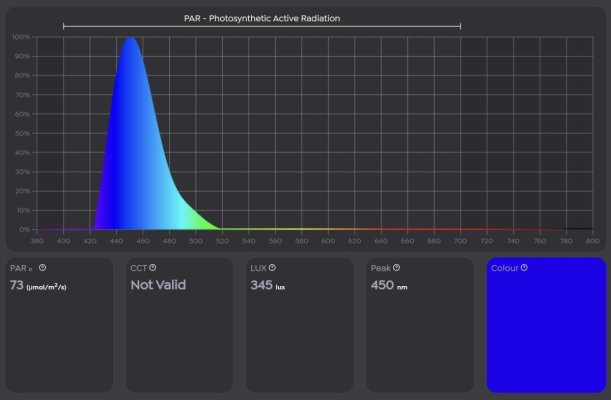
I have the PARwise, the UPRtek, and the Hopoocolor. This is the XHO as captured by the UPRtek MK350S. There is a significant difference. The peak is 450nm and the second bump is 470nm.
Reef Brite XHO IMG_2020_0510_112040 2.jpeg
 

Nonya

Valuable Member
View Badges
Joined
Mar 18, 2019
Messages
1,704
Reaction score
693
Location
Grand Rapids
Rating - 0%
0   0   0
This isn't accurate.
1. What measurements have you made to prove your point?
2. I should have said "In my experience, and based on actual measurements I've made of Chinese-made LEDs, because I literally have a box full of them."
 
Last edited:

CasperOe

In it to win it!
View Badges
Joined
Feb 14, 2022
Messages
3,258
Reaction score
5,511
Location
Glasgow, United Kingdom
Rating - 0%
0   0   0
Just used one today, good experience using an android phone for the software. Borrowed it from the LFS to try it, may just go ahead and invest in one :D
 

TelegrahamTested LLC

Well-Known Member
View Badges
Joined
May 20, 2017
Messages
723
Reaction score
970
Rating - 0%
0   0   0
1. What measurements have you made to prove your point?
2. I should have said "In my experience, and based on actual measurements I've made of Chinese-made LEDs, because I literally have a box full of them."
Ironically, a measurement is directly above your reply. The Reef Brite XHO uses cheap LEDs, and yet they measure 450nm and 470nm. Minimal ± if any. Literally. We, the hobby, like to perpetuate "cheap Chinese" as a thing to support the ridiculous pricing of some of our gear. My box-o-photons suggests that regardless of where diodes are made, so many will land within their specified range.

Let's see the other two.

Here's Jeff's XHO as seen by the PARWise.
here is what the xho looked like:
50871421-8A78-4668-B975-6E7C2512D195.jpeg
And as seen by the UPRtek.

1702638001027.png


I'll grab a Hopoocolor later. The spectrometer is at a friend's and the XHOs are in storage.

I find it fun that we're talking precision spectrum in a PARwise thread. Like diarrhea and being stuck in an elevator.
 

Nonya

Valuable Member
View Badges
Joined
Mar 18, 2019
Messages
1,704
Reaction score
693
Location
Grand Rapids
Rating - 0%
0   0   0
I find it fun that we're talking precision spectrum in a PARwise thread. Like diarrhea and being stuck in an elevator.
Not making the connection. You need to explain that humor/sarcasm vs. accuracy.

Anyway, I'd like to see the three spectrographs' readouts for the same double-peak LED, if possible. I've heard of the Hopoocolor. I wondered if it was accurate enough to justify the purchase.
 

Nonya

Valuable Member
View Badges
Joined
Mar 18, 2019
Messages
1,704
Reaction score
693
Location
Grand Rapids
Rating - 0%
0   0   0
We, the hobby, like to perpetuate "cheap Chinese"
I've been in the hobby for multiple decades, so I'm a charter member of "we".

The loose bulk chips from places like ALI Express and Amazon are, more often than not, differ from what's advertised. Most buyers aren't concerned about the accuracy and/or don't have the ability to measure the spectra.

I've built numerous DIY LED systems since sometime before 2010, and when it comes to the blues, violets, and LEDs labeled as UV, I've gone back to measure many of them to find that they're not all that close to what they were labeled. In use, it didn't seem to make the kind of difference that really mattered to the SPS.

The Crees are another story, and typically match the binning for which they were labeled. All of the popular name brands (whether made in the US or not), appear to be accurate, spectrum-wise, but they rarely list individual wavelengths; instead, they list the manufacturer and color (red, royal blue, etc.), and may show an image of the full spectrum.

I'm guessing your experience is different. I'm not calling your baby ugly--I'm speaking from my own experiences.
 
Last edited:

Nonya

Valuable Member
View Badges
Joined
Mar 18, 2019
Messages
1,704
Reaction score
693
Location
Grand Rapids
Rating - 0%
0   0   0
I'd like to see your data/analysis that led you to this statement.
Already covered. I'm not going to fill the thread with all of those images. I can post a few recent ones in a bit.

So are you just trolling, or do you have data/analysis to support your challenge to my statement?
 

Nonya

Valuable Member
View Badges
Joined
Mar 18, 2019
Messages
1,704
Reaction score
693
Location
Grand Rapids
Rating - 0%
0   0   0
So here's an LED advertised as 395nm. The spectrometer says the peak is 383nm. Chinese-made.
1702668560751.png
 

Nonya

Valuable Member
View Badges
Joined
Mar 18, 2019
Messages
1,704
Reaction score
693
Location
Grand Rapids
Rating - 0%
0   0   0
Here's a Chinese LED labeled as 430nm UV. Of course, 430nm isn't UV, but just demonstrates the mislabeling you can get. The spectrometer readings for the lot ranged from 438 to 443nm. Not even close. So these are examples of my experiences with Chinese LEDs.
1702668730894.png
 

Nonya

Valuable Member
View Badges
Joined
Mar 18, 2019
Messages
1,704
Reaction score
693
Location
Grand Rapids
Rating - 0%
0   0   0
Here's one more. Advertised as 430nm. All in the batch measured 423-424nm. I wouldn't call them garbage, because they all work in the LED arrays, but if I want a certain mix of peak wavelengths its good to know what I really have to work with.


1702669236487.png
 

Nonya

Valuable Member
View Badges
Joined
Mar 18, 2019
Messages
1,704
Reaction score
693
Location
Grand Rapids
Rating - 0%
0   0   0
I did a comparison of PAR readings using the PARwise, Biotek Marine BTM3000 and the Apogee SQ-520. All 3 sensors were put in the exact same place out of the water. The BTM3000 read 426μmol/s, the Apogee read 321μmol/s, and the PARwise read 310μmol/s.

From what I've found, the Apogee is supposed to have a better spectral response between 380 and 700nm, yet the BTM3000 (essentially the same sensor previously used by Apogee) reads 100μmol/s higher. Logic would suggest the BTM3000 would read a lower PAR, yet the opposite is true. Also interesting is that the PARwise reading is close to the Apogee.

I can't make any conclusions as to which is/are the most accurate. Only my corals will know.
 

LgTas

Well-Known Member
View Badges
Joined
Dec 10, 2020
Messages
547
Reaction score
512
Location
Tasmania
Rating - 0%
0   0   0
Already covered. I'm not going to fill the thread with all of those images. I can post a few recent ones in a bit.

So are you just trolling, or do you have data/analysis to support your challenge to my statement?

Not sure why asking for evidence to support a statement is trolling?

Anyway thank you for some examples, found it interesting
 

Nonya

Valuable Member
View Badges
Joined
Mar 18, 2019
Messages
1,704
Reaction score
693
Location
Grand Rapids
Rating - 0%
0   0   0
Here's one more. Advertised as 430nm. All in the batch measured 423-424nm. I wouldn't call them garbage, because they all work in the LED arrays, but if I want a certain mix of peak wavelengths its good to know what I really have to work with.
1702669236487.png
The irony here is that these are closer to the UV threshold than the LEDs labeled as UV.
 

TelegrahamTested LLC

Well-Known Member
View Badges
Joined
May 20, 2017
Messages
723
Reaction score
970
Rating - 0%
0   0   0
Here's one more. Advertised as 430nm. All in the batch measured 423-424nm. I wouldn't call them garbage, because they all work in the LED arrays, but if I want a certain mix of peak wavelengths its good to know what I really have to work with.
1702669236487.png
You are using a PARwise to show me that the peaks don't match the advertised spectrum? Suggest using an alternative spectrometer. You'll find that using the PARwise to defend your position is unwise, as its accuracy is greater than the diodes you're attempting to smear.
 

TelegrahamTested LLC

Well-Known Member
View Badges
Joined
May 20, 2017
Messages
723
Reaction score
970
Rating - 0%
0   0   0
Here's how far off the PARwise is from an actual spectrometer. This is my data, not something found online. Same light, same conditions, but different spectrometers. One is good, one is crap. What I don't understand is why the PARwise software hasn't been adjusted to eliminate the chopping of the peak spectrum and the left shift of its data. That should be an easy fix, but it has been that way since its release.

1702825557048.jpeg
 
Last edited:

TOP 10 Trending Threads

HOW DO YOU ADJUST YOUR CUC AS ALGAE DISAPPEARS?

  • Capture and re-home CUC

    Votes: 2 4.7%
  • Increase white light/hours in tank to spur algae growth to feed CUC

    Votes: 2 4.7%
  • Feed nori to support CUC

    Votes: 17 39.5%
  • Feed herbivore pellets to support CUC

    Votes: 11 25.6%
  • Allow attrition to balance CUC and algae

    Votes: 22 51.2%
  • Provide macro algae to feed CUC

    Votes: 5 11.6%
  • Introduce CUC predators

    Votes: 1 2.3%
  • Other (please explain)

    Votes: 4 9.3%
Back
Top