A completely open sump can be a problem. Too much water available to the return pump. If your overflow clogs, the return pump will overfill the display, and cause a mess.
I'm not sure but that sounds hypothetical. So just to add on...
Personally, I've run nothing but open sumps since around 1995.
Usually with plain U-tube overflows (almost 100%).
I've have never seen a clog or drain break happen on a correctly built system with no defects. (I've had to return some bad/broken products. Always always always do multiple power-off tests on any new system. Always.)
Even a basic old-school U-tube drain is no-clog by its design.
For what it's worth, I've got a pretty massive sump compared to average...a 30 Long on a 100 gallon system.
Running, it's about half-full....and carries about 11 gallons of water.
There are about 11 gallons of open space on top of the water/under the tank rim of the displays connected.
The meniscus will give me around another .5 gallons.
(Yes this matters :) ....the meniscus saved me from losing
any water on the one potential flood I've had....thanks to a precipitation event seizing all the pumps AND return siphon breaks in the tank. Sump+meniscus held 100% of the water even with the drains siphoning water down to the spray-bar outlets!!)
But if clogs are a real fear, then a pump shutoff seems more sensible.
And a leak detector would seem to be mandatory for when something besides the drain breaks.
There are high and low end options for all of this....
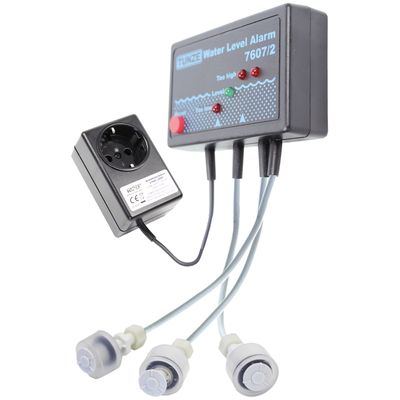
Water level alarm
comes with three sensors, a run-dry sensor and two overflow sensors. Each sensor comes with a holdin...
mehr
7607/2
207.96 USD
...among others.
You can integrate a leak detector with the ATO or return to shut off the pump, and/or have a plain notification system like the $60-70 Honeywell Wifi leak detectors that get high ratings.
Just some more thoughts...
Chopping up your sump up into arbitrary sections before your tank is even running is very common but
seems backward to me. Like putting three rows of seats in a vehicle before you even know whether it's gonna be an SUV or a sports car.
IMO, a refugium would be the only real reason to chop it up – one wall/section.
But an ATO is all it takes to make a skimmer be reliable and a refugium is hardly necessary for reefing.
A refugium is not even the only way to grow algae
if that's a goal.
In fact, a refugium is the
only way to grow algae
that can't easily be added later on if/when needed. (Though it's still not impossible to add on later...just not as easy as dropping something in and turning it on.)
It may even be
the least efficient way to grow algae when everything is considered.
An ATS as probably the most efficient based on the design and that there are
so many different ways to do it, inlcuding commercial and DIY options out the wazoo. ;)
(Check out
@SantaMonica's recent ATS article if you're not familiar with them....it's sort of a comparison of algae methods, but mostly it's there to point out what gives the ATS its advantages. Lots and lots has been written on other methods, so I suspect that's why not much focus is on them in his article. GOOD ARTICLE.
@Paul B's DIY algae trough might be the most famous ATS around....tho I'm not sure he's got it back up and running after the move. If you wanna see real-life examples, his is a good one to start with.)
2¢


















