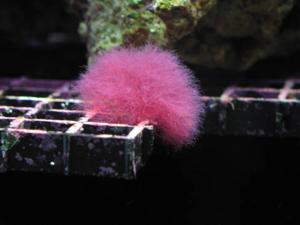
Thoughts on this purple macro from TBS?

William Sharkspeare

Community Member
View Badges
Joined
May 30, 2026
Messages
81
Reaction score
106
Location
a tropic sea
What state or country do you live in
Pennsylvania
Rating - 0%
0   0   0
This purple macro has really shot up over the last couple weeks. Scrolling through Mosaic, Halymenia floresia and "Blue Smoke" are close but don't seem quite right. More like a combination of the two. Although, the second "picture" (its a video) of blue smoke looks pretty close.

It is very thin, wispy and delicate. It looses its shape as soon as it is out of the water.

@LiverockRocks


PXL_20260908_215145230.jpg

PXL_20260908_214932802.PORTRAIT.jpg

PXL_20260908_215213166.jpg

PXL_20260908_215153574.jpg

PXL_20260905_213323412.jpg

PXL_20260905_213324704.jpg

PXL_20260905_213315279.jpg

PXL_20260905_213315745.jpg
 
The first three pictures look like Red Gracilaria. Florida has two species of Halymenia, both of which are very delicate.

What you have looks like Halymenia florsia. All Halymenia should feel gelatinous. I don’t know what Blue Smoke is. Latin names help.

Halymenia floresia
Species of Halymenia are a very unique and add an interesting aesthetic to a marine aquarium. It features striking flame shaped blades and pink or red coloration. It's gelatinous, smooth and delicate. This particular species grows offshore attached to rocks and hard bottom by a single holdfast to depths of about 65'. Single specimens can grow quite large and reach heights of about 12" or so. Halymeniarequires good water quality and moderate to high flow to maintain its slippery fleshy blades. In the aquarium they will seldom attach so they must be anchored or allowed to tumble as free floating specimens. Because the tissue is thin like ulva, it can fragment easily in the aquarium so tank overflows need to be protected. Halymenia is very palatable and is readily eaten by both Tangs and Angels.​

Halymenia floridana
An interesting species of Halymenia that is highly variable in color, ranging from bright yellow to red depending on the depth collected. Like all species of Halymenia it's gelatinous and smooth in texture and is easily torn. This particular species stays rather compact and its blades are rounded and irregular similar to species of Ulva. This species is found offshore to depths of about 65' attached to hard bottom by a single holdfast. Some specimens are found growing suspended in the water amongst algae mats. In the aquarium they will seldom attach so they must be anchored or allowed to tumble as free floating specimens. They can't be buried in the sand bed as the tissue will die off. It's very palatable and is readily eaten by both tangs and angelfish.

1788925248773.jpeg
 
Last edited:

I think Blue Smoke is this. And it is invasive.​


https://www.reefcleaners.org/nuisance-algae-id-guide

Cotton Candy Algae

cottoncandyalgae 300x225


Algae under this heading usually appear as a light pink fuzz. Closer examination will show it is made up of many branches with even more branchlets. The plants are very small, lose form out of the water and sway in the current. Each plant forms from a single holdfast. Callithamnion species and the sporophyte stage of Asparagopsis taxiformis are usual suspects. The pictured specimen is quite good looking, they usually don't have such an aesthetic appeal, and are a dull red or reddish brown.

Manual Removal: Easy if it hasn't taken hold in places your fingers won't fit. Scrape your thumb on the surface it is attached to, while holding the algae like a pencil as you remove it. This helps you get the small holdfast.

Clean Up Crew members include urchins, sea hares, large turbos, emerald crabs and most hermit crabs.

This algae isn't particularly common, but has the ability to grow rapidly from fragments.
 
Definitely not Ogo and I don't think it's Halymenia. This stuff is thin and threadlike.

Callithamnion looks pretty close. The description is pretty accurate - branches/branchlets, single holdfast. I'll shoot John an email and may end up removing it later today when I get home.
 
Feathery Red Macro - wrightiella blodgetti
Jeremy M.jpg

This is a feathery macro that we see in the spring and fall. Not invasive. Very cool that it grew in your tank, that is uncommon to hear. Maybe it will grow back.

Sorry @William Sharkspeare, we did not see your inquiry.
@revhtree we are not being notified when R2R folks @LiverockRocks us.
 
The red delicate seaweed is gorgeous as well! Species?
If your referring to post #7, then that is the subject of this thread.

The tunicates are awesome. I knew they had started to grow back there but the rock was in the back of the tank and they were facing the back wall; so I never really got a good look at them.
 
“If your referring to post #7, then that is the subject of this thread“

I think Post #5 seals the deal for me. However, I disagree that it is particularly invasive. Years ago, I read the same review at ReefCleaners that said it was invasive and I nuked Cotton Candy with toothbrush and peroxide. A few years ago Cotton Candy & Ulva intestinalis both sprouted.

“John agrees with being ones of the "cotton candy" species and recommends removing it. Shame. It's very pretty.”
 

TOP 10 Trending Threads

WHICH KIND OF INVERT HAS CAUSED THE MOST MISCHIEF IN YOUR TANK?

  • Sea urchins

    Votes: 23 28.0%
  • Hermit crabs

    Votes: 13 15.9%
  • Other crabs

    Votes: 5 6.1%
  • Shrimp

    Votes: 6 7.3%
  • Snails or conchs

    Votes: 3 3.7%
  • Sea stars

    Votes: 1 1.2%
  • Anemones

    Votes: 15 18.3%
  • None! My inverts are model citizens. :-)

    Votes: 12 14.6%
  • Something else (tell us in the comments)

    Votes: 4 4.9%
Back
Top
Home
Post thread…
Market
What's new