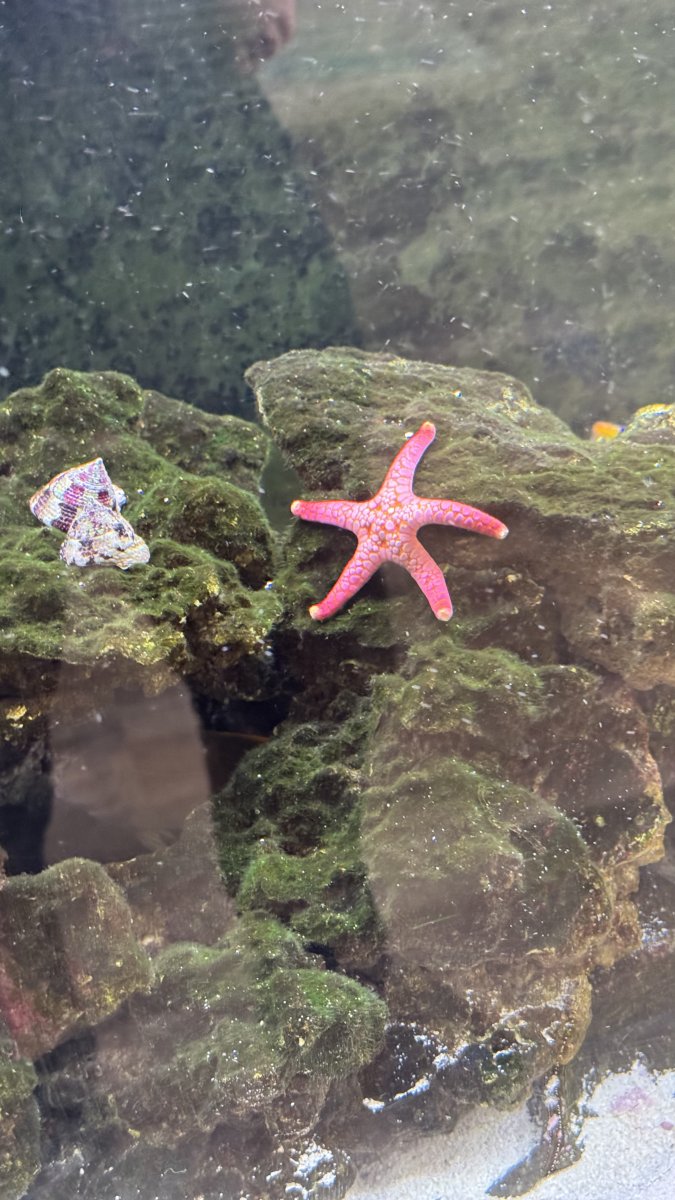
Tile starfish feeding

Aronsaquarium

Active Member
View Badges
Joined
Mar 5, 2022
Messages
334
Reaction score
77
Location
los Angeles
Rating - 0%
0   0   0
Hey!
Does anyone have experience with these tile starfish?
I’ve had it for a couple weeks now, he seems to walk around the tank a healthy amount, however I haven’t been able to feed it mysis directly like I did with my previous starfish (different types).

Is it normal for them to live off whatever they walk over throughout the day?
IMG_2314.jpeg
 

Timfish

Crusty Old Salt
View Badges
Joined
Jul 22, 2012
Messages
4,468
Reaction score
5,481
Location
Austin, TX
Rating - 0%
0   0   0
It's a Fromia species and they generally are relatively short lived. You might peruse @ISpeakForTheSeas thread here:


ISpeakForTheSeas

7500 Club Member
View Badges
Joined
Nov 22, 2021
Messages
9,368
Reaction score
10,759
Location
United States
Rating - 0%
0   0   0
Hey!
Does anyone have experience with these tile starfish?
I’ve had it for a couple weeks now, he seems to walk around the tank a healthy amount, however I haven’t been able to feed it mysis directly like I did with my previous starfish (different types).

Is it normal for them to live off whatever they walk over throughout the day?
IMG_2314.jpeg
Yeah, I talk quite a bit about them in the thread linked by Timfish - Fromia stars are thought to be biofilm-feeding starfish, so they're essentially thought to feed on biofilms:
Biofilms are typically a mix of bacteria, cyanobacteria, diatoms, microalgae, fungi, etc.; they can vary drastically in makeup dependent on a number of different factors (and figuring out what is in them requires lab-grade equipment).
Many biofilms may not be visible with the naked eye, so it may seem like the star isn't feeding even if they are. This is unfortunately problematic, though, as it also means it may seem like the star is feeding when they're not.

If they're not feeding, or if they're not getting the right nutrition from the food they do consume, then they will (as it seems most starfish in our tanks do) starve.

livinlifeinBKK (the member who started the thread linked above) had some early signs of success with their Fromias before they lost them (I believe they had a few unrelated tank crashes and eventually stopped trying with starfish for the moment) using masstick and fresh oysters - I do stress that these were very early, preliminary signs of success, and others have tried similar diets without success in getting the stars to feed (so they may only feed on masstick, oysters, or other things as "famine foods," and they may not derive adequate nutrition from them).


As a general recommendation at this point, aside from Aquilonastra stars (which are a mixed bag at this point on reef-safeness), I suggest people not get any true, tropical starfish to avoid them starving - brittle starfish do much better in our tanks, and I typically recommend them instead (except for the Green Serpent Star, Ophiarachna incrassata, which is not reef-safe).

Since you already have your star, though, the below may be helpful:
Some ways to potentially gauge the health of the starfish that may be useful:
1 - Visual: is anything visually wrong with the specimen? (From what I know of starfish, these cues are generally pretty obvious if they're there at all - if the starfish is disintegrating, there's something wrong).
2 - Weight: is the specimen putting on or maintaining weight (generally healthy), or is it losing weight (under most circumstances, this would be unhealthy)?
3 - Size/Length: if it's not already full size, is the specimen growing? Is it shrinking (either from weight loss, disease, limb loss, etc.)?
4 - Reproduction: is the specimen engaging in reproductive behaviors/activities (i.e. courting, nesting, spawning, etc.)? (I recognize this one is not as common of an indicator in captive starfish at this point, but there are a few instances of starfish attempting to spawn in captivity).
5 - Longevity: is the specimen relatively close to meeting, actually meeting, or exceeding their expected wild lifespan (or at least surviving for a few years - healthy), or is the specimen dead/dying prior to doing so (unhealthy)?
6 - Speed: how quickly can the specimen right itself when it's flipped over?
7 - Level of activity: how much is the specimen moving around? (Generally speaking, low activity indicates poor health; moderate activity indicates good health; and high activity indicates good health but probable stress - it could be searching for food, oxygen, etc., but it's probably not in terrible health when moving a lot).
8 - Grip strength: does the specimen have a strong hold/grip with its tube feet? (A strong grip indicates good health, a weak grip indicates poor health).
9 - Willingness to eat: is the specimen eating? (Seems obvious, but can be really hard to tell with some stars - some stars leave little trails called feeding scars through the things they're eating; sometimes you can see their everted stomachs; other times, like if they're feeding on biofilm, you may not be able to tell at all - them crawling onto visible food is a good sign they're willing to eat, but - as mentioned above - the food may or may not meet their nutritional needs).

And a final note on starfish keeping (rehashing some of my comments above):
One important thing to keep in mind with foods for these guys - just because they eat it, doesn't mean it's meeting their nutritional needs; it might be, but it might not be. With how long it seems to take these guys to starve, unless you're monitoring their health closely, you might not notice if it's not meeting their needs until it's too late.
 

TOP 10 Trending Threads

HOW DO YOU ADJUST YOUR CUC AS ALGAE DISAPPEARS?

  • Capture and re-home CUC

    Votes: 7 6.7%
  • Increase white light/hours in tank to spur algae growth to feed CUC

    Votes: 6 5.8%
  • Feed nori to support CUC

    Votes: 35 33.7%
  • Feed herbivore pellets to support CUC

    Votes: 36 34.6%
  • Allow attrition to balance CUC and algae

    Votes: 45 43.3%
  • Provide macro algae to feed CUC

    Votes: 6 5.8%
  • Introduce CUC predators

    Votes: 1 1.0%
  • Other (please explain)

    Votes: 11 10.6%
Back
Top