Water Pressure Physics

  • Thread starter Thread starter sundog101
  • Start date Start date
  • Tagged users Tagged users None

sundog101

Well-Known Member
View Badges
Joined
Sep 7, 2014
Messages
994
Reaction score
651
Rating - 0%
0   0   0
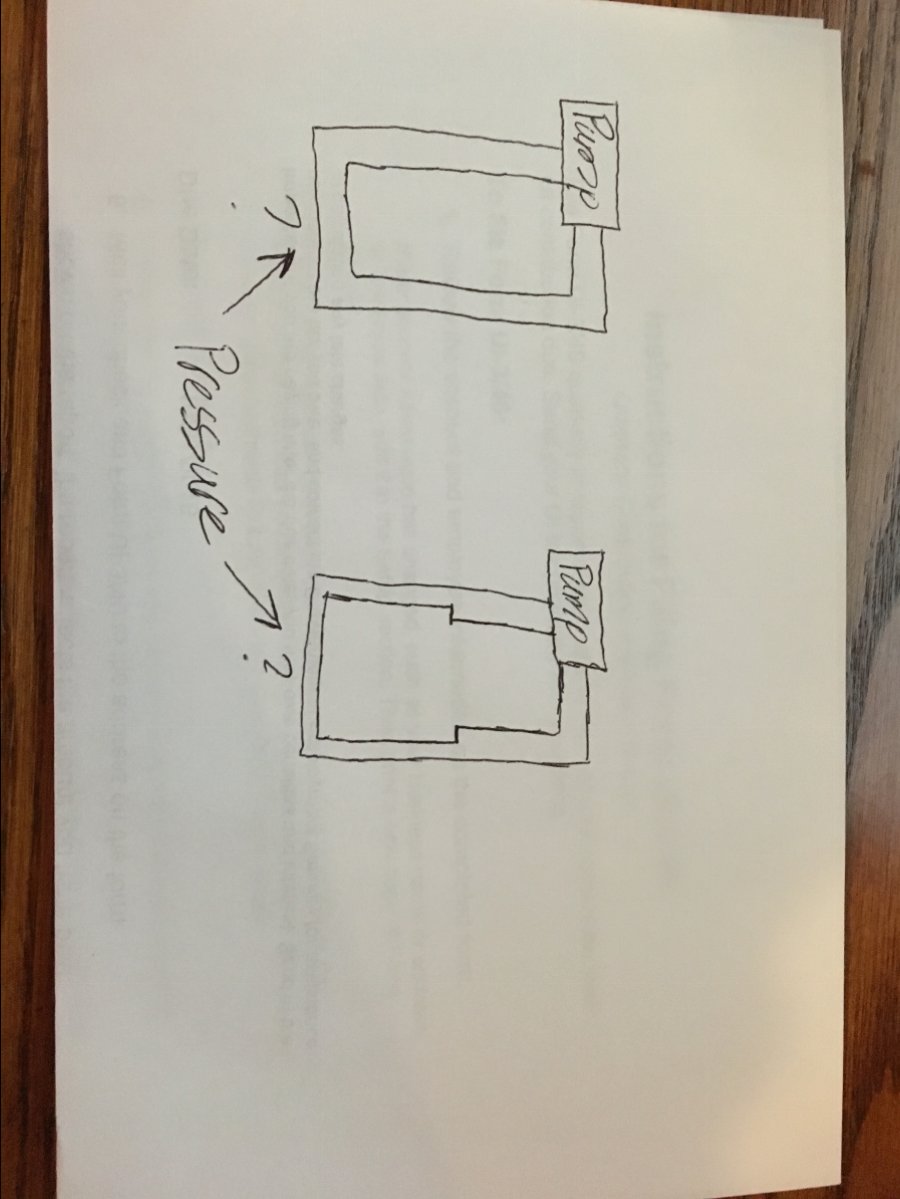
Let's say I set up a hypothetical pump that pumps water down and then back up. One loop has a reduced pipe diameter at the bottom of the loop.

Here's a diagram I drew:
IMG_0170.JPG


Here's the question- Would the pressure be the same at the bottom, or will the reduced pipe have a lower pressure?

 
FLOW RATE in the narrow tube would be increased. Water doesn't compress, so PRESSURE would be the same... even if you turned the pump off :)
 
There will be pressure loss due to the 90 degree bent. However, with the reduced piping on the bottom, it will actually increase the pressure by the difference of area I believe. The volume flow rate from the pump is the same. So it's pumping the same amount of water down the pipe. With the reduced area, the same amount of water will induce a higher pressure than the one with the same piping diameter.
 
There will be pressure loss due to the 90 degree bent. However, with the reduced piping on the bottom, it will actually increase the pressure by the difference of area I believe. The volume flow rate from the pump is the same. So it's pumping the same amount of water down the pipe. With the reduced area, the same amount of water will induce a higher pressure than the one with the same piping diameter.

I believe this answer is correct except for the reduced area part. Water can't be compressed so it wouldn't be more pressurized, at least from what I know
 
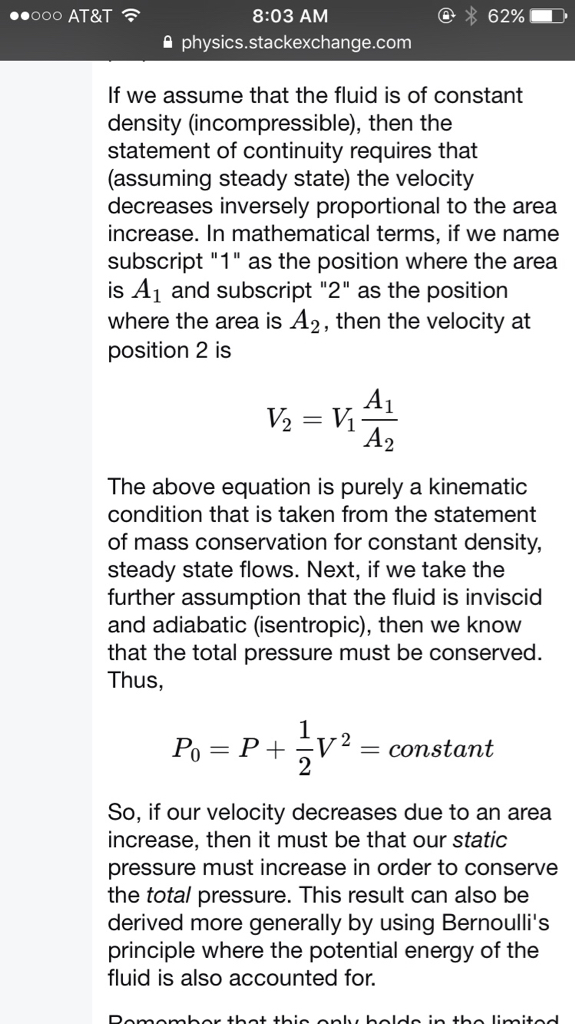
Found the following online. It's been decades since I touch this stuff. The following seems to make sense.
46e11cf53cd4f54b663f35d48e221afe.jpg
 
Are you making the assumption that the flow is exactly the same? It wouldn't be, and that greatly complicates an analysis.

With no flow, the pressure is exactly the same, and depends only on the 'depth" of water. That is, the pressure depends critically on where you measure it in terms of "altitude".

With flow, and hence friction against the pipe, the pressure depends on where you measure in relation to the pump and the height. Assuming the pump is at the top, then the higher pressure is just after the pump, and the lower is just before the pump. But it still depends on height.

The thin pipe has more friction, so will have higher pressure (back pressure) that the water has to push against (assuming similar flow, which won't be true).
 
Also, when pumping water vertically, you lose half a PSI per foot, or 1 PSI per 2 feet.
 
Aside from the interesting theoretical question, what's the purpose in asking the question?

Well I realized I know a lot less about pressure than I thought I did :confused:. Just a theoretical question that's been bugging me.
It seems whatever I think, is really reversed.
 
9332ec5e79a90070caac06a2ad8a183c5db9d748

(A)
where:
v is the fluid flow speed at a point on a streamline,
g is the acceleration due to gravity,
z is the elevation of the point above a reference plane, with the positive z-direction pointing upward – so in the direction opposite to the gravitational acceleration,
p is the pressure at the chosen point, and
ρ is the density of the fluid at all points in the fluid.
 

TOP 10 Trending Threads

WHAT DO YOU ALWAYS RUN OUT OF AT THE WORST TIME?

  • Salt mix

    Votes: 10 15.6%
  • Fish or coral food

    Votes: 4 6.3%
  • Test kits or reagents

    Votes: 5 7.8%
  • Filter media or replacement fleece

    Votes: 4 6.3%
  • RO/DI filters or supplies

    Votes: 11 17.2%
  • Fragging and repair supplies, like glue or epoxy

    Votes: 7 10.9%
  • I keep a backup of everything

    Votes: 18 28.1%
  • Other (Post in the comments)

    Votes: 5 7.8%
Back
Top
Home
Post thread…
Market
What's new