I'm considering doing just this from now on. I'm not sure quarantining the corals has offered any further benefit after dipping them when they arrived.Why not just dip your corals and place them in the tank ?
Follow along with the video below to see how to install our site as a web app on your home screen.
Note: This feature may not be available in some browsers.
I'm considering doing just this from now on. I'm not sure quarantining the corals has offered any further benefit after dipping them when they arrived.Why not just dip your corals and place them in the tank ?
I don’t understand what’s with torches lately. I just had a shipment of 46 colonies come in, all DOA with brown jelly.Really struggling with my torches in quarantine. I have slowly been losing them over the past couple of weeks 1 at a time every few days. The first loss was a torch that came in retracted and by the following day had bailed out and there were signs of brown jelly. I immediately removed it and began dosing cipro daily. I continue to dose cipro daily.
Daily I am also doing approximately 2 gallon water change in my 20 gallon quarantine tank. I also continually monitor temp and daily check salinity, alkalinity, nitrates, and phos (about 15-30 mins after the water change) and dose back up my nitrates to keep them at 8 and phosphates at 0.1. When I check daily the nitrates typically are at about 5 and phos of 0.06.
I am now in the process of losing my 4th of 10 torches. It's first head showed signs of brown jelly disease so i excised it. The remaining head is beginning to lose its flesh band and the polyps appear to be bailing out. I have removed it from my QT as well. I'm not really sure where to go from here. I fear quarantining is doing more harm the good but worry about putting my corals into my main tank and then seeing them spread something into it. My hammers and frogspawn in the QT continue to look healthy and unphased.
dang, that sucks! I was so confused at the slow decline on mine. Each happened days apart from each other despite stable water parameters and also dosing cipro to boot. I don't think I'll be quarantining, just dipping from here on.I don’t understand what’s with torches lately. I just had a shipment of 46 colonies come in, all DOA with brown jelly.
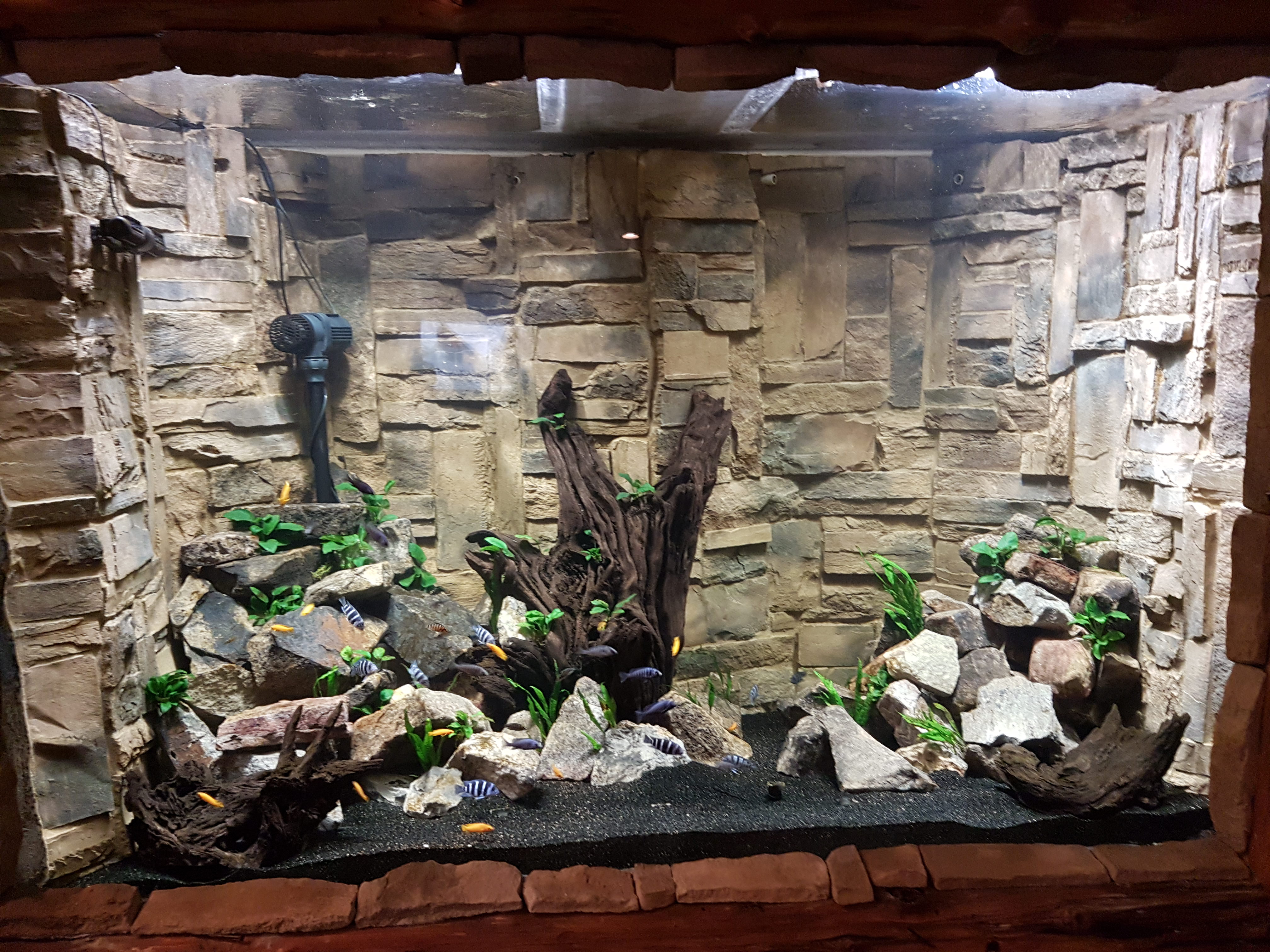
The part I was dreading the most is now complete: the clean up. All water, sand, rocks, and wood have been removed from the old freshwater scape and I have deep cleaned the tank. It is now a clean slate.
![]()
Next up is breaking down and cleaning the maintenance room.
If necessary though I try to limit that. Don't want to freak out the fish.Do you still get in the tank?
Seems like you have a nutrient imbalance if you're going a ton of bubble algae. what are your levels? nuissance algae only grows with certain conditions. In the mean time, try popping the bubbles, your foxface might be more interested in them then.Quick update: Copperband is doing great! She coexists peacefully with everyone now. No one picks on her. I had a bunch of tiny aiptasia everywhere but no longer see them anywhere. She has cleaned the tank nicely. She also loves to eat shrimp and bloodworms though she can often be slow and less aggressive during feeding time. Still, she seems to be getting adequate nutrition.
Unfortunately, the tank seems to be going through one of those changes. I lost several coral beginning with my toadstool. I went on vacation one week and came back to a dead toadstool flopped over and decaying. I tried trimming back to healthy tissue but it continued to decay all the way down to its rock. I ultimately had to remove it. It had been thriving and growing so well too.
A couple of weeks after that I lost my first hammer from what appeared to be BJD. I pulled it out of the tank and into quarantine but it was too late for it. A week or so after that I lost the next one. After that, I was on the lookout for any changes so when the third and fourth hammers lost a head they got pulled out early. I trimmed the dying heads and put them in quarantine. The QT and main tank both got dosed cipro, and I was thankfully able to save the remaining two. No other corals have show any more signs of distress since. The two saved have been successfully back in the tank. Thankfully, one of the hammers I saved was a 10 head specimen (now down to about 5 or 6 heads).
Finally, the tank has had a horrible outbreak of bubble algae. It is literally all over every rock and beginning to do the same to my back and side walls. The foxface wants nothing to do with it. I purchased a handful of pitho crabs and they have made no dent in it either. It literally is going to take over the tank, so I have finally purchased a bottle of vibrant to dose the tank with. Obviously, I'm worried about what it may do to the tank but I don't think I have much choice anymore.
I test weekly. My phos, if left alone, runs high. I dose lanthanum chloride throughout the week to keep it steady at around 1.5-1.7. Nitrates get dosed once weekly up to 15 and usually is around 10 at the end of the week, ready for redosing.Seems like you have a nutrient imbalance if you're going a ton of bubble algae. what are your levels? nuissance algae only grows with certain conditions. In the mean time, try popping the bubbles, your foxface might be more interested in them then.
I live in fort meyers and would like to help!! Maybe one day, I'll bring my wife with me i can look at you r equipment and see what you can use or not it's not as hard as you think I have a pretty big rodi and salt mix station and could help w that also let me knowI am the lucky owner of a 1000 gallon in-wall aquarium through the purchase of its house and for the past 6 years have been running a large frontosa freshwater tank. Unfortunately during a recent and significant winter snap in the south I lost all of my fish (and learned that I need more automation to prevent such an incident again). I am currently in the process of completely breaking down everything for a deep clean, and it seemed an appropriate time to consider transitioning to a saltwater tank.
About me: I have only ever cared for 1 aquarium in my lifetime, this 1000 gallon one. No prior experience before jumping headfirst into it. It was an empty eyesore that I turned into something I was quite proud of. When I first began I, rightfully so, deemed a saltwater tank too complicated for an absolute beginner to jump into at such a large scale. But with plenty of time and research my first tank was a success. In some ways the large tank may have made things easier as there were no quick swings in water parameters at such a large volume. I understand that changing to saltwater is much more complex compared to the tank I have been running.
I am hoping that with plenty of time and planning I can create another successful tank. I expect the planning stage to take months to gather the appropriate materials and gear and to spread out the cost of doing so over time. By posting here I am hoping to receive advice that will help move this in the proper direction. I also have a lot of material and gear that cannot be reused but I am hoping some may be.
The tank:
![]()
![]()
The acrylic is 1.25 inches thick and measures 8 feet long x 4 feet deep x 5 feet high. Three overflow weirs empty down the back of tank with three returns drilled into the bottom of each (one 2-inch and two ¾ inch pipes). Two 2-inch return pipes feed water back to the tank which empties into the top of the aquarium.
The tank is accessible through an aquarium maintenance room behind it. Unfortunately space is pretty tight in there. I have about 26.5" x 25.5" of room to the side of the tank. I have looked at adding a sump below the main tank but the supporting beams would prevent placing anything of significant size under it and there is very little room to crawl under there to service it anyways. There is hot and cold water plumbed to the maintenance room in the form of a laundry washer hook up and there is a drain on the floor as well.
![]()
![]()
For filtration, I currently have a 50-gallon drum acting as a DIY sump. It normally sits half-full with the remainder of the space available for overflow should I lose power or need to turn off the pumps. It is plumbed to empty into the floor drain in a controlled manner. For mechanical filtration the water passes through a 5-gallon bucket-sized pain strainer mesh disposable bags and then into quilt batting. The water is then pumped through an Ultima 1000 filter for biological filtration and then back to the tank. I’m not sure that the stand-alone ultima filter is even compatible with salt water and may have to go.
![]()
Is there anything with my freshwater filtration system that can remain or does it need a complete overhaul? The relatively tight space here makes it a little tough to design around.
I have space along the backwall of my maintenance room where I typically house two small quarantine tanks. I suppose I could take that space and place your typical sump there instead and plumb it back to the main tank from there. I would just lose my quarantine tanks.
I currently have the incoming water passing through a 2-stage filter and know I will have to add on or convert to RO/DI.
![]()
Thanks for reading. As I said above, I am currently in the process of breaking down the aquarium to clean it up. The current sand and rockwork has to go in place for salt-water appropriate replacements. I know a lot of planning will be required to convert such a large tank to the more complex salt water but I am excited at the prospect of doing so. I look forward to some good advice. Thank you.