


75 Gal With Artificial Rock Background

MoReefSafe

New Member
View Badges
Joined
Jul 12, 2019
Messages
13
Reaction score
5
Rating - 0%
0   0   0
With my second ever reef tank, it seemed like an opportunity to do something a bit unique. Although I love the trend to negative space reefscapes, I actually also enjoy reef walls where the fish have places to hide. Tanks where you can go days/months without seeing a certain critter, and when they pop out it really feels like a special occasion. The only problem is that the amount of rock needed to accomplish that was expensive for me at the time, as I was a college student. So I searched the forums for ideas and found a 2019 build thread where someone built a reef wall using waterfall foam! Taking some of their experience and really making something different, the build turned out very realistic (in my opinion). My guiding motivations for this build were:
1. Build a scape with a realistic looking artificial background with lots of hidey holes that does not take up much tank volume.
2. Save money.
I’m not sure the build was as successful at either goal as it could have been, but it was a LOT of fun. And I learned a lot. In retrospect, THOSE should have been my guiding motivations.
The tank was a super cheap marineland 75 gallon from Petsmart which was on sale for $199 with the stand. I drilled the tank for an overflow and did my own plumbing. I’ve never posted a build thread before. So I figure I’ll just lead with the finished product and then talk about the process afterward.
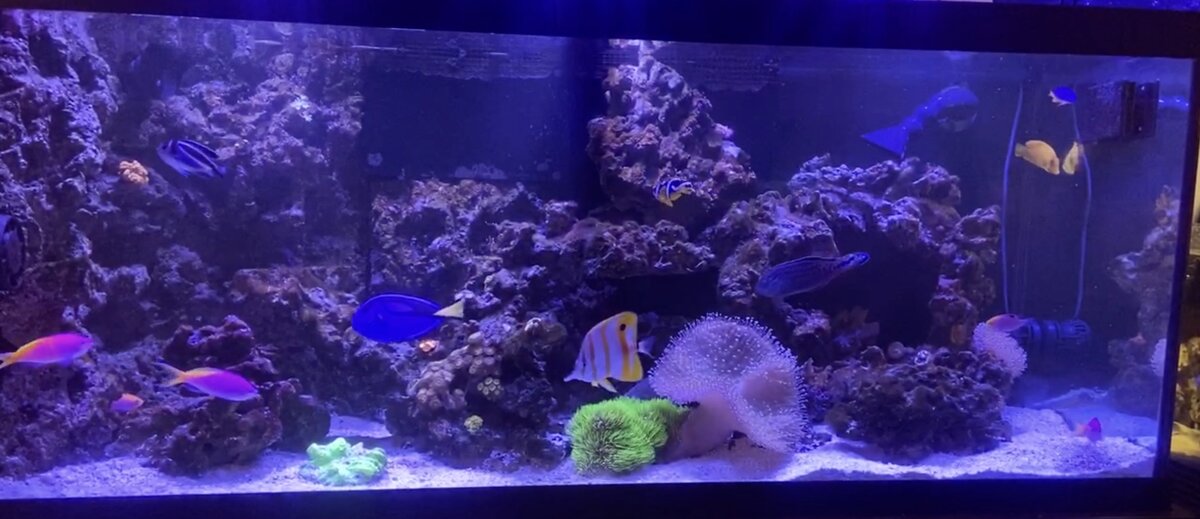
IMG_3909.jpeg

There was an extra piece that covered the overflow, but unfortunately there are no photos of the tank with it installed.

 

lizardal7

New Member
View Badges
Joined
Sep 19, 2024
Messages
14
Reaction score
12
Location
RI
Rating - 0%
0   0   0
get creative! I used shelf rock to add to the back wall. Only down side is that there's little or no flow behind those rocks. so just be careful when water changes come.
 
OP
OP
MoReefSafe

MoReefSafe

New Member
View Badges
Joined
Jul 12, 2019
Messages
13
Reaction score
5
Rating - 0%
0   0   0
For the background, I measured and cut pieces of light diffuser grid and zip tied them together. I also zip tied some flat reef rock I won at a raffle (saving $!). This is necessary because the waterfall foam is so light that a bit of real rock is needed to help keep the background down when submerged. Once that step was done, the pieces were test fit inside tank.

IMG_3914.jpeg

IMG_3912.jpeg
 

mikee002

Active Member
View Badges
Joined
Nov 25, 2016
Messages
297
Reaction score
130
Rating - 0%
0   0   0
For the background, I measured and cut pieces of light diffuser grid and zip tied them together. I also zip tied some flat reef rock I won at a raffle (saving $!). This is necessary because the waterfall foam is so light that a bit of real rock is needed to help keep the background down when submerged. Once that step was done, the pieces were test fit inside tank.

IMG_3914.jpeg

IMG_3912.jpeg
Looking forward to seeing more of the process in this. Thinking of something similar for a build.
 
OP
OP
MoReefSafe

MoReefSafe

New Member
View Badges
Joined
Jul 12, 2019
Messages
13
Reaction score
5
Rating - 0%
0   0   0
I realized after a bit that it would be very difficult to match the look of those rocks when I carved the foam. So those rocks were removed and I zip tied some new rocks which would be easier to match. This was a bit of a challenge because the new rock was more dense and did not have any holes to stick the zip ties through. I had to drill the holes with a masonry bit. There are no pictures of the drilling, unfortunately. A few rocks split into pieces, but most of them held up. Only one or two holes per rock is needed because the waterfall foam is very strong and helps hold the rocks in place very well.
IMG_3921.jpeg
 
OP
OP
MoReefSafe

MoReefSafe

New Member
View Badges
Joined
Jul 12, 2019
Messages
13
Reaction score
5
Rating - 0%
0   0   0
I believe the rock was caribsea flat bottomed rock. It comes painted purple. So that was the color which would eventually be matched. If I was smart, I would have test fitted the grid again and cut the hole where the return line would come through. Turned out it was not much of an hassle to address after the fact, however. Also, if the left side covered the entire side of the tank, I would have had to cut a hole for my AI power head. But that was not necessary for this build.

So it was time to start with the water fall foam. I wish I could remember how many cans it took. At least 4, but maybe more. Also, a couple cans were wasted because that cheap plastic tube that shoots out the foam would break at the trigger. I highly recommend getting one of the metal tubes that they sell separately. It will save you some cans of foam and a few curse words as well. Trust.

Just inject a little bit in each square. The foam expand quite a bit and becomes quite voluminous, and allows a lot of material for carving. I would only inject a little extra foam on areas which I really wanted to build up for extra caves or tunnels.
IMG_3926.jpeg

IMG_3923.jpeg

IMG_3929.jpeg


In this last photo, you can see that the hole for the return line is being cleared before the foam fully cured. In retrospect, I should have allowed the foam to fully cure first. Before carving out that part of the foam, I used a wire snip tool to cut the plastic light grid in the general shape of a circle so that it would fit around the bulkhead where the return line fed back into the tank. The thickness of the foam conceals the bulkhead entirely and you never even see the bulkhead once the background is installed.

 

TOP 10 Trending Threads

WHAT AMOUNT OF LIVE ROCK AND SAND SHOULD BE PRIORITIZED FOR OPTIMAL BIODIVERSITY/FILTRATION?

  • 100% live rock + bagged sand

    Votes: 34 27.0%
  • 100% dry rock + 100% live sand

    Votes: 45 35.7%
  • 50/50 live/dry rock, 50/50 live/bagged sand

    Votes: 27 21.4%
  • 75% live rock, 25% live sand

    Votes: 11 8.7%
  • 25% live rock, 75% live sand

    Votes: 9 7.1%
Back
Top


