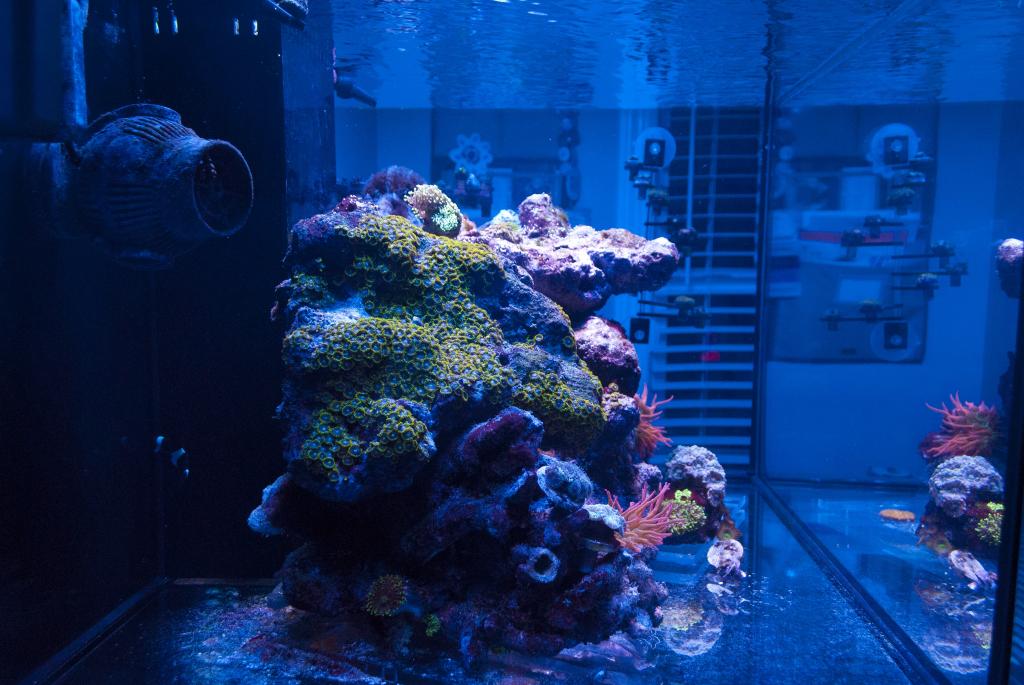
adjusting leds with a meter ???

Waters

"...in perfect isolation, here behind my wall."
View Badges
Joined
Nov 5, 2013
Messages
9,346
Reaction score
20,852
Location
Mentor, OH
Rating - 0%
0   0   0
How did you assess intensity levels? What were the levels?

How did you assess PAR levels? What were the PAR levels? (In case these are different answers.)
Intensity levels were based on Radion intensity settings. I left them at the same percentage when switching spectrums....which was only 57% total intensity. All I did was slightly increase the whites/greens/and reds. The blues remained at 100%. The PAR levels were both using a PAR meter and also Ecotech's PAR calculator. The PAR levels were incredibly low based on what I have read that SPS "require". I was only reading around 600 at the surface yet I still bleached two acros? Once I lowered the whites back down and moved the acros lower in the tank, they quickly began to recover. I am still trying to figure out how people are running their Radion Pros near 100% in the 14-16K spectrum....I would cook my whole tank in a week.
 

pickupman66

5000 Club Member
View Badges
Joined
Aug 10, 2010
Messages
6,032
Reaction score
1,165
Location
Winchester, TN
Rating - 0%
0   0   0
IIRC.. I know somewhere sometime I read something that stated the par meters we use do not fully or properly report the PAR we see from the LEds. 10%-15% less than what is actually emitted? maybe that has changed.

to the OP, I feel that SPS want that 450-500 par which is what I strive to achieve. that said, even my LPS love to drink in the sun. this Torch is set up high in my tank. it has grown at least 6x the original size in 2 years under my LED array. I run a Lumentek pro 240 with the blues at 75% and the whites at 50%. It went form a 5 heard frag (lime size) to this massive 12 head colony that is almost cantelope sized.

May 2016
DSC_8498.jpg


August 2014
DSC_7320.jpg
 

ksc

Well-Known Member
View Badges
Joined
Jul 21, 2008
Messages
576
Reaction score
362
Rating - 0%
0   0   0
It's all about acclimation. The same coral growing nicely at 300par will probably do great at 600 par if it is slowly acclimated. I just received a few bleached frags a month ago. I put them on the side frag rack which gets very low light (@150par). I started to see some color and moved them to a different rack that gets 300par. Eventually they will be moved so they get 500par. Then I'll decide where to place them based on their color (sps).

The height your light is above the water will also affect your intensity as well as spread. Those little led beams burn things, so I'd install the light as high as possible so you can turn it up and get better spread.
 

mcarroll

10K Club member
View Badges
Joined
Jan 8, 2012
Messages
15,213
Reaction score
8,968
Location
Virginia
Rating - 0%
0   0   0
All stress factors combine to precipitate a bleaching event, so I would stop focusing solely on the lighting scenario - there is definitely more going on for them to bleach so easily.

Corals growing out and blocking flow to others can be a biggie, even if you didn't make any changes.

Carbon dosing seems stressful if you're doing that.

@Waters, I know this probably is all in the past and you're just bringing it up for example, so this is just hypothetical analysis.

Intensity levels were based on Radion intensity settings. I left them at the same percentage when switching spectrums....which was only 57% total intensity.

I wouldn't have any faith that the numbers on the fixture could be used like that.

Like you ended up doing, I would only use either a PAR or lux meter (even a cheapie $15 lux meter is better than eyeballs!) to assess intensity vs any calculator or built-in settings - and it sounds like your levels were very moderate.

Having before and after PAR readings would have been another set of data points though.

The PAR levels were incredibly low based on what I have read that SPS "require".

There's a lot of bs info and hyperbole floating around IMO.

30,000 lux (600 PAR) is not incredibly low.

Consider these points:
  • Stony corals are known to survive down to 1,000 lux.
  • 5,000-10,000 lux is where a lot of corals seem to reach their "compensation point" and is incredibly low intensity
  • I run a stony coral tank that gets around 14,000 lux. :) It grows mostly the same corals as the 50,000 lux display next to it. (Tho probably slower.)
  • 30,000 lux is moderate. In fact, right in the sweet spot, I'd say.
Also, lighting intensity is not the end-all....folks using more light than you are not doing anything "better" than you are. More is not better. :)

Once I lowered the whites back down and moved the acros lower in the tank, they quickly began to recover.

If you move your corals around at the drop of a hat, that's an additional stress factor to consider. Had they been moved recently before this?

Restoring the lights to their previous settings (undoing the change you made) should have been all you needed to do.

Now you have to move them again if you want them back at their original light (and flow, etc) position.....or the coral has to adapt to the new-new flow and lighting conditions. Might be fine in the long run, but in the short term it's another stressor in the mix.

I am still trying to figure out how people are running their Radion Pros near 100% in the 14-16K spectrum....I would cook my whole tank in a week.

It goes back to the more is not better thing. It's simply a matter of what their corals were acclimated to vs what yours were acclimated to. Neither is better....it's mostly a question of what is normal to the coral.

To that point....if the folks running 100% switched down to match your light settings, their results would be just as bad as you switching up to their settings.

I put them on the side frag rack which gets very low light (@150par). I started to see some color and moved them to a different rack that gets 300par. Eventually[...]

Instead of constantly moving them, which would seem to preclude them acclimating to any light level (how could they if they get moved as soon as there is some apparent recovery?), it would be interesting to simply place one of these bleached frags in a good spot where they can expect excellent flow as well as a steady flow of nutrients.

In studies on wild corals, better flow and food ameliorated many stressors that contribute to bleaching.

So near a return outlet is usually a good place due to the flow of particulates from the sump (most sumps, on average, have some detritus issues).

I haven't done any comprehensive studies, but I have had good luck with dying frags without using any elaborate movement routine. They seem to do the acclimation on their own - you just have to remove the stress(es) that caused it. Often (maybe all the time?) that's as simple as bringing the coral home to a nice, well-kept tank. :) :)

 

ksc

Well-Known Member
View Badges
Joined
Jul 21, 2008
Messages
576
Reaction score
362
Rating - 0%
0   0   0
I like moving stuff around, many sps can look different at different light intensities.

These were healthy frags that had been bleached by a lighting mistake. The only reason I knew they were alive was that there polyps came out at night.

Quote____

Instead of constantly moving them, which would seem to preclude them acclimating to any light level (how could they if they get moved as soon as there is some apparent recovery?), it would be interesting to simply place one of these bleached frags in a good spot where they can expect excellent flow as well as a steady flow of nutrients.

In studies on wild corals, better flow and food ameliorated many stressors that contribute to bleaching.

So near a return outlet is usually a good place due to the flow of particulates from the sump (most sumps, on average, have some detritus issues).

I haven't done any comprehensive studies, but I have had good luck with dying frags without using any elaborate movement routine. They seem to do the acclimation on their own - you just have to remove the stress(es) that caused it. Often (maybe all the time?) that's as simple as bringing the coral home to a nice, well-kept tank. :) :)[/QUOTE]
 

Waters

"...in perfect isolation, here behind my wall."
View Badges
Joined
Nov 5, 2013
Messages
9,346
Reaction score
20,852
Location
Mentor, OH
Rating - 0%
0   0   0
All stress factors combine to precipitate a bleaching event, so I would stop focusing solely on the lighting scenario - there is definitely more going on for them to bleach so easily.

Corals growing out and blocking flow to others can be a biggie, even if you didn't make any changes.

Carbon dosing seems stressful if you're doing that.

@Waters, I know this probably is all in the past and you're just bringing it up for example, so this is just hypothetical analysis.


I wouldn't have any faith that the numbers on the fixture could be used like that.

Like you ended up doing, I would only use either a PAR or lux meter (even a cheapie $15 lux meter is better than eyeballs!) to assess intensity vs any calculator or built-in settings - and it sounds like your levels were very moderate.

Having before and after PAR readings would have been another set of data points though.


There's a lot of bs info and hyperbole floating around IMO.

30,000 lux (600 PAR) is not incredibly low.

Consider these points:
  • Stony corals are known to survive down to 1,000 lux.
  • 5,000-10,000 lux is where a lot of corals seem to reach their "compensation point" and is incredibly low intensity
  • I run a stony coral tank that gets around 14,000 lux. :) It grows mostly the same corals as the 50,000 lux display next to it. (Tho probably slower.)
  • 30,000 lux is moderate. In fact, right in the sweet spot, I'd say.
Also, lighting intensity is not the end-all....folks using more light than you are not doing anything "better" than you are. More is not better. :)


If you move your corals around at the drop of a hat, that's an additional stress factor to consider. Had they been moved recently before this?

Restoring the lights to their previous settings (undoing the change you made) should have been all you needed to do.

Now you have to move them again if you want them back at their original light (and flow, etc) position.....or the coral has to adapt to the new-new flow and lighting conditions. Might be fine in the long run, but in the short term it's another stressor in the mix.


It goes back to the more is not better thing. It's simply a matter of what their corals were acclimated to vs what yours were acclimated to. Neither is better....it's mostly a question of what is normal to the coral.

To that point....if the folks running 100% switched down to match your light settings, their results would be just as bad as you switching up to their settings.

I haven't done any comprehensive studies, but I have had good luck with dying frags without using any elaborate movement routine. They seem to do the acclimation on their own - you just have to remove the stress(es) that caused it. Often (maybe all the time?) that's as simple as bringing the coral home to a nice, well-kept tank. :) :)


Thanks for taking the time to respond. To answer your questions....I am not dosing anything except 2 part plug magnesium. The only faith I had in the numbers provided by the Radions is that the intensity stayed at 57%...I never changed it when I changed the spectrum....so the intensity should not have changed (although based on what I am reading, whites offer more Par than blues?) The acros that were bleaching were never moved until I moved them down. Rather than just return my lights to their original settings, I wanted to try moving them down to keep the lights at the new settings since the other coral didn't seem to mind. The bleaching continued which is why I then turned the lights back down. Those acros have only been moved once, and they still sit there today :-) Based on our informative response, I am going to not worry about forcing my intensity up higher and focus more on the responses of the coral. I still want to try to move into a whiter spectrum though so I will slowly add whites/greens/reds and watch the Acros.

 

mcarroll

10K Club member
View Badges
Joined
Jan 8, 2012
Messages
15,213
Reaction score
8,968
Location
Virginia
Rating - 0%
0   0   0
Sounds like a good plan!

As things progress, maybe consider how easy those corals seemed to bleach.

Since your lighting seems moderate and the change you made seems to have been relatively small - I'd think of those pieces as your "canaries in your coal mine".

Seems to me there had to be one/more contributing factors. I mentioned some, but could even be lack of food...or just those corals being particularly sensitive...too many possibilities to guess at from across the internet. But the bleaching is a clue I wouldn't let go lightly - all you know really is what triggered it. It seems a stretch to say that your minute color change trigger a bleaching event all by itself.

One other thought: Corals use red light mostly to let them know how close to the surface they are (self preservation). Is there a chance these acros are deep water types that may have little/no adaptation for dealing with red light/surface light conditions? Any idea as to their species or collection location?
 

Waters

"...in perfect isolation, here behind my wall."
View Badges
Joined
Nov 5, 2013
Messages
9,346
Reaction score
20,852
Location
Mentor, OH
Rating - 0%
0   0   0
Sounds like a good plan!

As things progress, maybe consider how easy those corals seemed to bleach.

Since your lighting seems moderate and the change you made seems to have been relatively small - I'd think of those pieces as your "canaries in your coal mine".

Seems to me there had to be one/more contributing factors. I mentioned some, but could even be lack of food...or just those corals being particularly sensitive...too many possibilities to guess at from across the internet. But the bleaching is a clue I wouldn't let go lightly - all you know really is what triggered it. It seems a stretch to say that your minute color change trigger a bleaching event all by itself.

One other thought: Corals use red light mostly to let them know how close to the surface they are (self preservation). Is there a chance these acros are deep water types that may have little/no adaptation for dealing with red light/surface light conditions? Any idea as to their species or collection location?
I would definitely say that lack of food might be an issue....I have always had almost undetectable levels of nitrate and phosphates. I am trying to feed the tank more to combat that......algae just scares the crap out of me lol. The two that bleached were a fast growing red Millepora and an unidentified green acro. The green one has almost 100% recovered and the Millepora has recovered about 60%, coming back as green rather than red. Neither coral was at the surface but both appeared to be directly underneath the Radion pucks.
 

TOP 10 Trending Threads

WHAT AMOUNT OF LIVE ROCK AND SAND SHOULD BE PRIORITIZED FOR OPTIMAL BIODIVERSITY/FILTRATION?

  • 100% live rock + bagged sand

    Votes: 34 27.0%
  • 100% dry rock + 100% live sand

    Votes: 45 35.7%
  • 50/50 live/dry rock, 50/50 live/bagged sand

    Votes: 27 21.4%
  • 75% live rock, 25% live sand

    Votes: 11 8.7%
  • 25% live rock, 75% live sand

    Votes: 9 7.1%
Back
Top