Algae diatom identification few weeks into dino battle

  • Thread starter Thread starter RAFoster
  • Start date Start date
  • Tagged users Tagged users None

RAFoster

New Member
View Badges
Joined
Jul 23, 2026
Messages
3
Reaction score
13
What state or country do you live in
Wisconsin
Rating - 0%
0   0   0
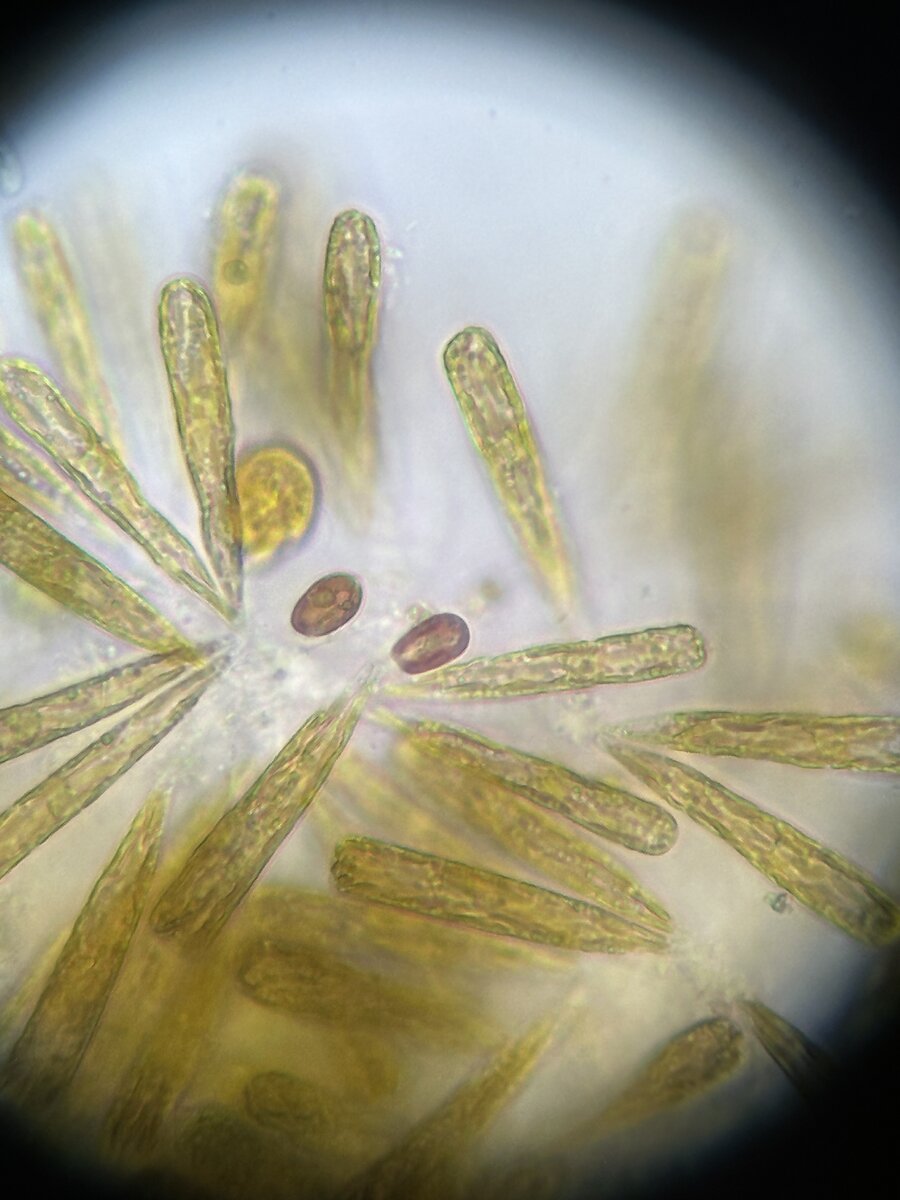
I've been battling dinos for a few weeks with a UV sweep, raised phosphates and nitrates from zero, and bottled bacteria. I'm seeing way less dinos now but not sure what is replacing them. I'm guessing the long things are diatoms. Can see an LCA dino but not sure what the purplish things are. Any help is appreciated thanks.
IMG_8281.JPG

 
Bumping this in hopes someone with more experience identifying these under a microscope can help. It definitely sounds like you’re making progress against the dinos. Good luck getting the rest of it sorted out!
 
In the video you can see that the apparent color of the purple cell changes if it moves/turns. I think it's some other flagellate which would also explain the movement.

I took a screenshot from the video
e7cd4523-3cdd-4b0d-965f-c28733801081.png

I think that's a central pyrenoid (the circle in the middle of the cell)

I have a similar specimen in post #136 of my microscopy thread (page 7, the app won't jump to the correct post if you click on the link but to see the video you will have to use a webbrowser anyway): https://www.reef2reef.com/threads/microscopy-thread.1138845/post-14468506
Note that I'm not using simple bright-field microscopy so my specimens will always look a bit more detailed and "3D".

I'm currently adding new dry sand to the system which causes elevated silicate levels. From the rather large diatoms (at least I assume those are diatoms) in your image you might have elevated silicate levels as well. Maybe these guys appear together with diatoms.

I could also imagine it being some Rhodomonas species which would explain the darker red/purple color.

If they are not taking over the entire tank I don't think they are something to worry about. They don't look like Euglenids which can cause issues and also not like Chrysophytes which would probably disappear together with the diatoms once silicate levels come down.
 
Last edited:
Awesome thanks. My tank is only about 6 months old so I think it's just working its way through these things. I had diatoms then dinos and now I hope I'm getting back to diatoms. I imagine the silicate levels are high from the dry sand I used to start things. I enjoy looking what's in there but I'm ready for the dinos to leave.

 
Awesome thanks. My tank is only about 6 months old so I think it's just working its way through these things. I had diatoms then dinos and now I hope I'm getting back to diatoms. I imagine the silicate levels are high from the dry sand I used to start things. I enjoy looking what's in there but I'm ready for the dinos to leave.

New dry sand can cause diatoms even in well established tanks. If you take a look at page 1, post #16 "Diatoms (Nitzschia sp.?)" you can see an image of new dry sand in a 6 year old system: https://www.reef2reef.com/threads/microscopy-thread.1138845/post-14060262

It takes quite a while to go away, which is annoying, but diatoms don't really cause any harm. A few dino cells between diatoms is also common. Your tank will get there, it just takes time 😊
 

TOP 10 Trending Threads

HOW IMPORTANT ARE FISH TO MAKING A REEF TANK FEEL COMPLETE?

  • Essential! A reef needs fish movement and personality

    Votes: 28 63.6%
  • Very important, but one or two fish may be enough

    Votes: 5 11.4%
  • Optional... a coral-only reef can feel completely finished

    Votes: 2 4.5%
  • I actually prefer a coral-and-invertebrate-only system

    Votes: 0 0.0%
  • It depends on the tank’s size, style, or purpose

    Votes: 7 15.9%
  • I’ve kept a fishless reef (details in the comments)

    Votes: 1 2.3%
  • Well...it's complicated... (answer in the comments)

    Votes: 1 2.3%
Back
Top
Home
Post thread…
Market
What's new