1. Introduction
Sea anemones of the genus Stichodactyla, especially Stichodactyla gigantea and Stichodactyla haddoni, are fascinating and complex organisms that combine striking beauty with surprisingly sophisticated biology. In reef aquariums, their coexistence raises a recurring question among hobbyists: can these anemones interfere with each other through chemicals released into the water, even without physical contact?
This phenomenon is known as chemical allelopathy, and although it is well documented in soft corals and other cnidarians, its specific existence between these two anemone species is more difficult to demonstrate conclusively. Nevertheless, there is a solid scientific foundation that helps explain how such interactions could occur, which compounds might be involved, and how to distinguish this potential phenomenon from other causes of decline, such as pathogens, mechanical aggression, or poor environmental conditions.
In an aquarium, organisms do not compete only for physical space. They also compete and cooperate for light, water flow, food, microbiome balance, and potentially interact and resolve problems within the chemical space of the water: signals and compounds released by one organism that affect another. In corals and other sessile cnidarians, chemical competition (allelopathy) is well recognized as a general ecological mechanism: many cnidarians produce allelochemicals that mediate competitive interactions.
However, the existence of allelopathy in cnidarians does not automatically prove that it exists, or that it is important, between host anemones such as S. gigantea and S. haddoni. This distinction is essential to avoid confusing a plausible hypothesis with direct evidence. Scientific evidence specifically demonstrating allelopathy between these two species remains limited, but their known biology makes such interactions plausible.
2. Anemones are Chemically Active Systems
To understand the possibility of allelopathy, one must first recognize that anemones are not chemically passive organisms. On the contrary, they possess one of the most sophisticated biochemical arsenals in the animal kingdom.
Modern research has shown that anemones produce a wide variety of bioactive compounds, including peptide toxins, hydrolytic enzymes, and membrane-altering proteins.
These toxins originally evolved for prey capture and defense, but once released into the surrounding environment, they may also affect neighboring organisms, especially in closed systems such as aquariums. Chemical interaction between anemones would not depend on a single compound, but on a combination of molecules with different physiological effects.
https://www.mdpi.com/1422-0067/26/13/6109
One important group is the actinoporins, proteins capable of forming pores in cellular membranes. These proteins insert themselves into the membrane and disrupt its integrity. At high concentrations they cause cell death; at lower concentrations they induce physiological stress and functional disruption. These toxins do not require direct contact. If present in sufficient concentrations in the water, they may affect the epithelial cells of another anemone, impairing its ability to maintain structure.
https://en.wikipedia.org/wiki/Actinoporin
https://pubmed.ncbi.nlm.nih.gov/35880756/
Another important group consists of peptide neurotoxins, which affect ion channels. Anemone muscle cells depend on these channels to maintain tone and expansion. Interference with ion channels may result in persistent contraction, inability to fully expand, or loss of adhesion to the substrate.
https://en.wikipedia.org/wiki/RTX-III
In addition, anemones produce hydrolytic enzymes, such as proteases and phospholipases, which alter cellular proteins and lipids. At low concentrations, these enzymes may not immediately destroy tissue, but can cause chronic cellular irritation. Researchers have also identified biogenic amines, such as tyramine and serotonin, which can act as signaling molecules and alter the physiological activity of nearby cells.
In the ocean, the enormous water volume rapidly dilutes released compounds. In an aquarium, water volume is limited and continuously recirculated, prolonging exposure. However, it is important to emphasize that many effects attributed to allelopathy may actually result from environmental deficiencies such as inadequate lighting, improper water flow or poor water quality
3. Mechanisms of Chemical Release
Several natural mechanisms allow these compounds to enter the surrounding water:
-Continuous mucus secretion This is the most important mechanism. Anemones produce a protective mucus layer containing proteins, lipids, and bioactive compounds. This mucus is constantly shed and dispersed into the water. In a closed aquarium, relative accumulation may be much greater than in the open reef.
-Stress-related release. When a cnidarian is stressed, due to transport, sudden environmental changes, handling, or competition, it may release increased amounts of mucus and cellular components. This is not necessarily an “attack,” but neighboring organisms may still be affected. Physiological stress may also increase the release of intracellular compounds.
-Normal cellular turnover. Epithelial cells are continuously replaced, releasing intracellular content into the surrounding water as part of normal biological processes.
4. Observable Effects
Many aquarists have repeatedly reported a consistent “no contact, but observable effect” pattern: a previously stable anemone begins to decline after another anemone is introduced, even when the two are physically separated. In many cases, improvement occurs when the animals are isolated in separate systems or when chemical filtration such as activated carbon, enhanced filtration, or ozone is used. Notably, there are no visible sting marks or burn lesions, and the deterioration is gradual, consistent with chronic stress rather than acute injury.
So, based on aquarists observations, if bioactive allelopathic compounds affect nearby anemones, the effects tend to be gradual rather than sudden or dramatic. Instead of rapid tissue damage, the impact typically appears as chronic physiological stress, including incomplete expansion, persistent contraction, migration, reduced feeding response, and a gradual loss of vitality. These changes suggest functional disruption rather than immediate tissue destruction. Importantly, in many cases these effects are at least partially reversible if the source of chemical stress is removed or sufficiently diluted, further supporting a chemical rather than mechanical or contact-based cause.
However, there are also many documented cases of peaceful coexistence lasting years. This suggests that the phenomenon is not universal, or may be mitigated by maintenance techniques such as ozone, activated carbon, or polymer filtration media like Purigen. It is also possible that anemones adapt to each other over time, reducing hostile chemical signaling, or becoming less sensitive to it.
5. Distinguishing Allelopathy from Nematocyst Damage and Pathogens
It is essential to distinguish chemical allelopathy from damage caused by nematocysts, the stinging cells of cnidarians. Nematocysts require direct physical contact. Typical signs include localized bleaching, tissue necrosis and clearly defined lesions. This is very different from the systemic stress caused by dissolved compounds in the water.
Another phenomenon that may be confused with allelopathy is infection. Anemones host complex microbiomes, and introducing a new specimen may introduce new bacteria, including species of the genus Vibrio, capable of causing tissue necrosis and structural collapse. The key difference is that pathogens actively reproduce, whereas allelopathic compounds do not. Infections typically cause progressive and irreversible deterioration unless treated, while chemically induced stress may be reversible if exposure is eliminated. It is also possible that an infection may manifest as a consequence of an injury or a situation of continuous stress.
In some cases, the “weapon” may not be a direct toxin, but a shift in the microbiome. Associated bacteria may produce metabolites that affect neighboring organisms. This is not necessarily an infection, but a chemically mediated microbial interaction. Introducing a new anemone may effectively introduce a new microbial consortium. In unstable systems, the resulting imbalance may resemble allelopathy.
6. My Personal Experiences
I must admit that my favorite animals to keep in reef aquariums are sea anemones. I am fascinated by their dynamism: the hypnotic motion of their tentacles swaying in the current, and the way clownfish nestle among them, finding refuge from external threats. It is a scene of serene beauty that conceals complex and still poorly understood biological mechanisms. Below is a photo of one of my Amphiprion perideraion.
My first attempt to keep Stichodactyla gigantea and Stichodactyla haddoni together dates back to 2010. At that time, I introduced a gigantea into a tank where a haddoni was already established. The new anemone failed to adapt, and I documented the process in a Reef Central thread.
https://reefcentral.com/forums/showthread.php?t=1942967
Although the original photographs have been lost (anyway I share them hereby), the thread still preserves the record of an intense experience. In it, I described the beginning of a chloramphenicol treatment, following the recommendations of Julian Sprung in The Reef Aquarium, Volume 2. , a practice that wasn’t very common among hobbyists at the time.
@Randy Holmes-Farley and
@OrionN took part in the discussion. I send them a warm greeting from here. The initial hypothesis was an opportunistic bacterial infection, possibly caused by Vibrio, favored by transport stress and environmental changes.
The thread eventually became a collective diary of hobbyists attempting to save severely affected specimens after transport. The clinical pattern repeated itself: cycles of inflation and deflation, gaping mouth, mucus expulsion, cloudy water, and frequently progressive necrosis. Limitations in ammonia measurement and the potentially misleading effects of chemical neutralizers were also discussed. We discussed things like the anemone expelling material from its mouth, metabolic waste, zooxanthellae, gametes?; and I carried out antibiotic baths in a hospital tank
Although the anemone showed temporary improvement, it relapsed systematically when reintroduced into the main tank. This suggested the presence of a persistent factor within the system: reinfection, environmental stress, or perhaps the influence of compounds released by other anemones. Variables such as lighting, flow, and oxygenation were evaluated, but no explanation proved conclusive. Ultimately, despite all efforts, the Stichodactyla gigantea perished, confirming its reputation as one of the most difficult species to acclimate in captivity.

Although antibiotic treatment with chloramphenicol produced temporary improvement, the anemone consistently relapsed when reintroduced into the main tank. This suggested the presence of a persistent factor within the system: reinfection, environmental stress, or possibly chemical compounds released by other anemones. Ultimately, despite all efforts, the gigantea died, reinforcing its reputation as one of the most difficult anemones to acclimate in captivity.
In a later experiment, in the same tank I placed a Heteractis magnifica in an auxiliary tank initially filled with freshly prepared saltwater and a stablished biological filter. The anemone remained fully expanded and stable for days. When I connected the tank to the main system, even with germicidal filtration, the reaction was immediate: the magnifica began to deflate. The contrast was unmistakable, the same animal, stable in new water, reacted negatively to water from the established system. It was as if the water carried something more than microorganisms, an invisible chemical signal. This observation does not prove allelopathy, but it demonstrates that aquarium water contains complex biological and chemical factors capable of immediately influencing anemone physiology.
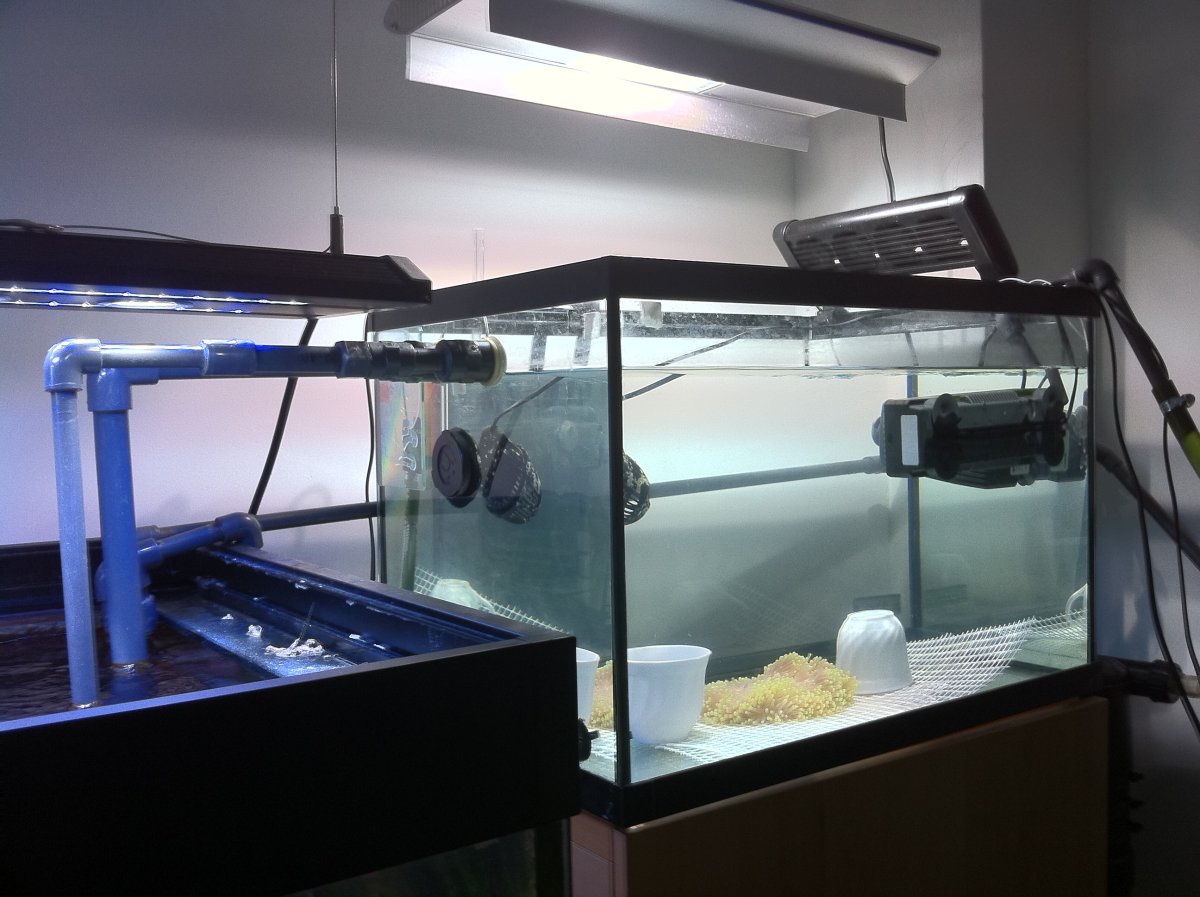
In one of my previous tanks, I successfully maintained a blue Stichodactyla gigantea together with a Heteractis magnifica, positioned at opposite ends of the tank, as if each occupied its own chemical territory. That system was dismantled in 2017 due to relocation.
My current tank is a 250-gallon system structured around two large atolls, and I’m now reactivating it after a long because of my continuous work travel. Fortunately, from now on I will travel less and will be able to dedicate to the aquarium the time it deserves. The aquascape design centers on creating an anemone garden in the left atoll, while the right atoll will host a mixed coral reef. At present, the system includes a purple Stichodactyla gigantea, a red-foot Heteractis magnifica, and a blue Stichodactyla haddoni.
A black snowflake
Amphiprion ocellaris clownfish lives in the
gigantea, together with a
Neopetrolisthes crab, and a pair of Picasso
percula clownfish lives in the
magnifica. They are the star protagonists because they appear on the covers of my two books in my series
The Marine Reef Aquarium.

The blue haddoni at the right botton of the left atoll was introduced three weeks ago, and so far has produced no observable negative effects. However, past experience encourages caution. About a year ago, I introduced a green
Stichodactyla haddoni into this tank, and it did cause a clear adverse effect on the purple
gigantea. Within a few hours of its introduction, the
gigantea began to deflate at night, something that had never happened before. The new
haddoni also failed to settle properly into the substrate, as if it too were somehow compromised. After several days of observing an increased frequency in the
gigantea’s inflation and deflation cycles, I decided to remove the
haddoni. The recovery was immediate: the
gigantea regained its stability, as if an invisible source of stress had been removed.
I am introducing a new green gigantea this week. The anemone is currently traveling from the Red Sea to Seville, in southern Spain. Please see below the spot I have planned for it.
All of this will be included in the next volume of my book series, where I share my most valuable experiences and hard-earned lessons. I love writing these books. They are not built to impose answers, but to listen to evidences for them. As an attentive hobbyist, I observe, compare, doubt, and record. I understand that every conclusion is provisional, supported not by the desire for it to be true, but by the accumulated weight of the evidence behind it. Yet evidence, by itself, remains silent if it is not preserved. That is why books, and forums like this one, play an essential role: they are instruments through which individual experience is transformed into shared knowledge. My goal is to help fellow hobbyists learn faster, avoid the mistakes I made along the way.
Thanks for reading!