


Best sump return pumps?

  • Thread starter Thread starter cdemoss01
  • Start date Start date
  • Tagged users Tagged users None
Should I buy this to add onto my pump?
Amazon product ASIN B0FN7GXHZQ
1773417867930.png

Its a UV sterilizer.
 
1773417867930.png

Its a UV sterilizer.
It isn’t going to be killing parasites at 9W of power, and 400+gph flow… it would help with water clarity, though!

For context, my 15W Lifegard UV sterilizer has a minimum flow rate of 250GPH, this would be a great flow rate for (some) waterborne parasite control!

— basically, you’d want a larger UV sterilizer (wattage), or a smaller pump moving water through that particular sterilizer!
 
It isn’t going to be killing parasites at 9W of power, and 400+gph flow… it would help with water clarity, though!

For context, my 15W Lifegard UV sterilizer has a minimum flow rate of 250GPH, this would be a great flow rate for (some) waterborne parasite control!

— basically, you’d want a larger UV sterilizer (wattage), or a smaller pump moving water through that particular sterilizer!
Alright thank you.
 
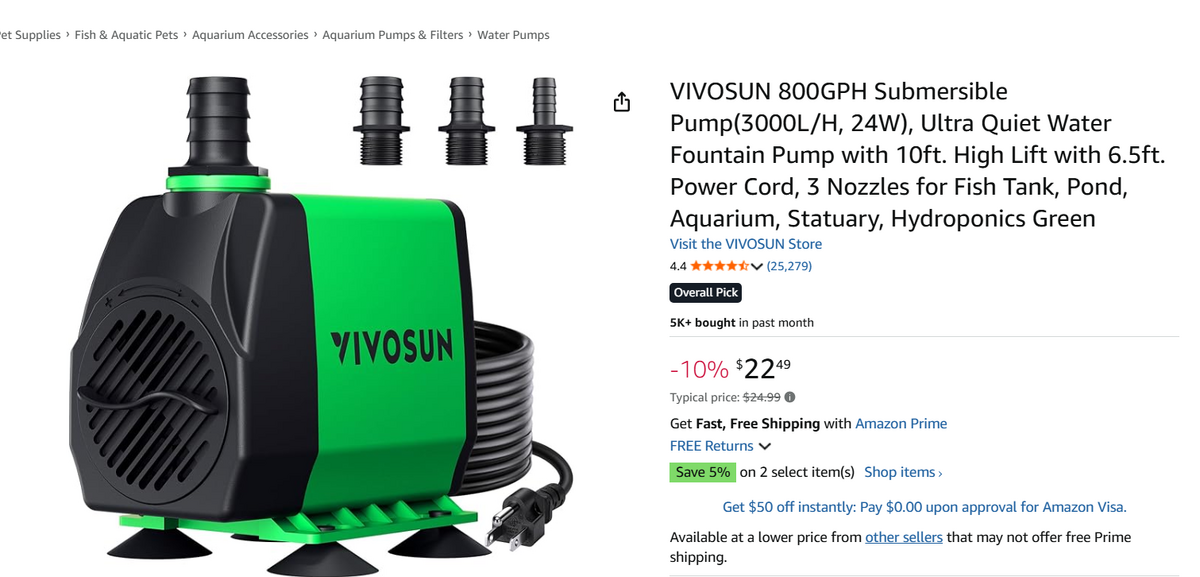
1772824540544.png

I lied 22.49$

This pump is NOT RECOMMENDED for salt water.

I had this exact pump installed in a small 15 gallon setup. Over time, the cord going into the back of the pump became brittle until I saw arcing from the back of the pump.

I reached out to the seller, and he replaced it no questions asked because the listing doesn't say "not suitable for salt water".

The replacement pump has a much better cord (like the one in the picture). But when I asked if this cord was better suited for salt water, the seller said "no".


Here is the pump after being submerged:

1773419825279.jpeg


1773419909852.png


1773419953466.png
 
Over time, the cord going into the back of the pump became brittle until I saw arcing from the back of the pump.
Yikes!!

— I’m not actually familiar with any cord insulation material which does this… I’ve never seen or experienced it before, and I used to throw pumps in all sorts of questionable fluids!

"not suitable for salt water".
if I had to guess, the cord is due to mystery plastic being used for insulation; the seller likely didn’t know this would happen to it either!

The impeller’s shaft, however, was almost certainly stainless steel, vs. ceramic! — the former will definitely slowly corrode and leech metals into your water column in a saltwater tank…
 
This pump is NOT RECOMMENDED for salt water.

I had this exact pump installed in a small 15 gallon setup. Over time, the cord going into the back of the pump became brittle until I saw arcing from the back of the pump.

I reached out to the seller, and he replaced it no questions asked because the listing doesn't say "not suitable for salt water".

The replacement pump has a much better cord (like the one in the picture). But when I asked if this cord was better suited for salt water, the seller said "no".


Here is the pump after being submerged:

1773419825279.jpeg


1773419909852.png


1773419953466.png
Dear God.
 
@UncommonSense
Does my return HAVE to be on the other side of the tank? I am trying to keep pipes away from my electrical. I am going to use PVC instead of flexible to lower leak risk.
 
@UncommonSense
Does my return HAVE to be on the other side of the tank? I am trying to keep pipes away from my electrical. I am going to use PVC instead of flexible to lower leak risk.
It definitely does not have to be opposite the overflow! In fact, many reef ready tanks plumb the return through the overflow box!

I usually just try to place the return so the tank water has to mix with return water before going back to the sump again!
 
It definitely does not have to be opposite the overflow! In fact, many reef ready tanks plumb the return through the overflow box!

I usually just try to place the return so the tank water has to mix with return water before going back to the sump again!
I didn't know you could do that.. through the overflow?
 
I didn't know you could do that.. through the overflow?
Yup, it’s remarkably common with internal overflows! — you just add an extra bulkhead through the tank bottom, and add a hole or two to the weir teeth to pass the return plumbing through! — it comes out really clean!

Here’s an extreme example, from my hexagon tank’s custom island overflow, 6x return lines through the weir teeth:
image.jpg


(The spare clear piping sticking out of the overflow box is actually a wire conduit for my lighting; the wiring will be literally plumbed through a dry conduit in the overflow box, and out the bottom of the tank via bulkhead… this is necessary to achieve the goal of six viewing panes with zero equipment or wiring obstructions!)
 
Last edited:

TOP 10 Trending Threads

ARE YOU READY TO CONFESS TO CRAZIEST, DUMBEST, FUNNIEST THING YOU’VE EVER DONE IN REEFING?

  • Yeah, I'll confess! (Share your story in the comments!)

    Votes: 34 54.0%
  • Nah, I'll keep mine a secret...(Don't be like that, share with the class!)

    Votes: 29 46.0%
Back
Top
Home
Post thread…
Market
What's new





