


cdemoss01
5000 Club Member
View BadgesPartner Member 2026
Excellence Award
R2R App User
Hospitality Award
R2R Research
ThreadAward
My Tank Thread
My Aquarium Showcase
Follow along with the video below to see how to install our site as a web app on your home screen.
Note: This feature may not be available in some browsers.
It isn’t going to be killing parasites at 9W of power, and 400+gph flow… it would help with water clarity, though!![]()
Its a UV sterilizer.
Alright thank you.It isn’t going to be killing parasites at 9W of power, and 400+gph flow… it would help with water clarity, though!
For context, my 15W Lifegard UV sterilizer has a minimum flow rate of 250GPH, this would be a great flow rate for (some) waterborne parasite control!
— basically, you’d want a larger UV sterilizer (wattage), or a smaller pump moving water through that particular sterilizer!
![]()
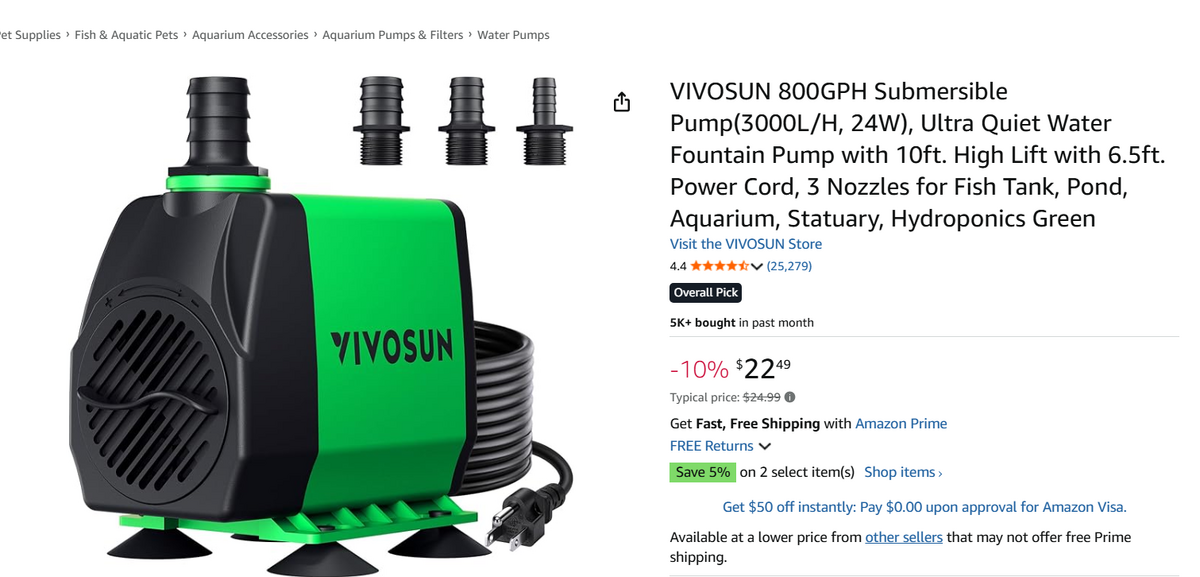
I lied 22.49$
Yikes!!Over time, the cord going into the back of the pump became brittle until I saw arcing from the back of the pump.
if I had to guess, the cord is due to mystery plastic being used for insulation; the seller likely didn’t know this would happen to it either!"not suitable for salt water".
Dear God.This pump is NOT RECOMMENDED for salt water.
I had this exact pump installed in a small 15 gallon setup. Over time, the cord going into the back of the pump became brittle until I saw arcing from the back of the pump.
I reached out to the seller, and he replaced it no questions asked because the listing doesn't say "not suitable for salt water".
The replacement pump has a much better cord (like the one in the picture). But when I asked if this cord was better suited for salt water, the seller said "no".
Here is the pump after being submerged:

![]()
![]()
![]()
It definitely does not have to be opposite the overflow! In fact, many reef ready tanks plumb the return through the overflow box!@UncommonSense
Does my return HAVE to be on the other side of the tank? I am trying to keep pipes away from my electrical. I am going to use PVC instead of flexible to lower leak risk.
I didn't know you could do that.. through the overflow?It definitely does not have to be opposite the overflow! In fact, many reef ready tanks plumb the return through the overflow box!
I usually just try to place the return so the tank water has to mix with return water before going back to the sump again!
Yup, it’s remarkably common with internal overflows! — you just add an extra bulkhead through the tank bottom, and add a hole or two to the weir teeth to pass the return plumbing through! — it comes out really clean!I didn't know you could do that.. through the overflow?







