Confused about lighting

jaws789832

Active Member
View Badges
Joined
Oct 2, 2014
Messages
466
Reaction score
414
Location
New Mexico
Rating - 0%
0   0   0
So I am having a hard time understanding lighting and and what is best for corals in both growth and color. Kelvin, par, pur, intensities, lumens, blue spectrum (400-470nm) red spectrum (700nm) all seem to contradict one another. Some say a lower kelvin (6500-10,000) is better for coral growth and more matches the sunlight, but then other charts say corals need more blue (the 400-470nm range) which would be a higher kelvin (the 18,000-20,000 range).

I am using 2 ecotech radions G3 pro's with 2 4' T-5 ATI coral plus bulbs. Ecotech coral lab programs are all calling for the light to be in the 20k+ kelvin range for optimal color and growth, but doesn't that get far away from normal sunlight, and does that mean all the other studies that say a lower kelvin is better for growth in corals are wrong? Right now I run a program that click on at 10am in the 20k range, ramps up to the 14 range to peak from 2pm-6pm then ramps back down to the 20k range and ends at 10pm. I like the color scheme of my lights (they are visually appealing with the blues and the pop in the morning and the more natural daylight during the day) but I am trying to figure out if this is whats best for my corals. My corals seem to be doing fine, some definatly better than others, the growth is there but not what I was hoping for and the colors are a little washed out (sort of brownish).

My Par seems good using the apex par meter. Tank is 27 inches deep by 5' long and I record 100 par at the bottom in the corners, 500+par at the top of the rockwork and 200-250 in the middle on the sandbed. All other parameters are very stable. The only thing I am not sure about is phosphate as I think my hanna checker is wrong so I am going to look into getting a new one (Its been reading 0 for a while, and I checked it on a tank that I Heavily feed with no phosphate removal and it still read 0). My tank is a mixed reef but it is slowly changing to predominantly sps. I run the triton core 7 base elements with a flourishing fuge. About 1/4 cup gfo and 1.5 cup carbon in a reactor. Skim pretty heavy and feed pretty heavy. I feed LRS, pellets, blackworms,brine shrimp, phyto and am loaded with Pods. Fish stock is 2 mating clowns, 6 line wrasse, yellow tang, powder brown tang and a reef chromis. Soon to add 2 Mandarins (which I got from algae barn and are in QT now and doing great). The only thing I don't like about my tank is a small aptaisia outbreak (which I bought berghias a few weeks ago and haven't seen them since adding them so still waiting on the outcome of those).

I am just looking to open up a discussion on whether I should change my lighting to the higher kelvins which is recommended by ecotech or a lower kelvin (which some say more mimics sunlight and is better for the corals).

 

mcarroll

10K Club member
View Badges
Joined
Jan 8, 2012
Messages
15,213
Reaction score
8,968
Location
Virginia
Rating - 0%
0   0   0
Corals don't grow directly in sunlight, so you can leave aside the idea of growing under 6500K lighting. :)

If you can take my word for it, the simplest way to do your setup is to make the light color so that it looks good to you. Typically this is around 14,000-20,000K for most folks. Then use your PAR meter to make the intensity correct. (Your levels are currently on the high side, but fine.)

Then you can stop worrying about light and focus on water flow, chemistry and nutrition!

Light is easy, and only one of several components that need to add up to have a healthy, awesome-looking coral. :)
 
OP
OP
jaws789832

jaws789832

Active Member
View Badges
Joined
Oct 2, 2014
Messages
466
Reaction score
414
Location
New Mexico
Rating - 0%
0   0   0
I think every reef in the world would probably disagree that they don't grow in sunlight. In my quest for knowledge I have found a lot of beautiful reef tanks that are actually grown in natural sunlight (in a window or under a skylight) then lights are added to bring out colors for viewing times. As I stated my chemistry is really in check And my feeding regimen seems to cover all the bases with lots of live food and supplements for a healthy system. The triton elements that I dose should keep all my trace elements in good shape. I know there are other things like amino acids and such that I don't really know about but with the fuge, that is supposed to keep those in correct proportions (I think). Lighting is the one thing I am trying to get a better grasp on.
I do understand as lighting gets deeper in the water certain colors get filtered out at certain depths with the blues going deeper than most. But most reefs are in relatively shallow water so a lot of the light from the sun does make it to them hence a lower kelvin. Light can be as easy or as hard as you want to make it. I can change a few colors or intensities, say that looks good and go from there or I can try to get a better understanding of what makes the coral thrive, whats its needs truly are, and gain a better understanding on how to maintain a long term successful reef both in my tank and in the oceans
 

mcarroll

10K Club member
View Badges
Joined
Jan 8, 2012
Messages
15,213
Reaction score
8,968
Location
Virginia
Rating - 0%
0   0   0
I do understand as lighting gets deeper in the water certain colors get filtered out at certain depths with the blues going deeper than most. But most reefs are in relatively shallow water so a lot of the light from the sun does make it to them hence a lower kelvin. Light can be as easy or as hard as you want to make it. I can change a few colors or intensities, say that looks good and go from there or I can try to get a better understanding of what makes the coral thrive, whats its needs truly are, and gain a better understanding on how to maintain a long term successful reef both in my tank and in the oceans

You can look down at my suggestion if you want just because it seems simplistic, but it was made earnestly. I would consider it with the same regard.

Regardless, try this:
Fig5.jpg


Yes, there are surface corals, but that's a minority of what we get in the hobby and none require levels like that. (But clams do....usually being found in 30' of water or often much less. As far as I know they're never found any deeper than around 70', and that's in an ideal feeding situation.) Most corals are very stressed at surface light levels.

Most corals we deal with get at most a little orange and at most a smattering of red, along with a big fat greasy ton of blue and blue-green.

In terms of what corals need, it helps to understand what makes them go.

Easier said than done (keep reading!!), but I can tell you there's no magic combination of colors. :D (There are intensity levels that matter quite a bit though, so using a light meter is a very very good idea.)

If you're really curious to look deeper, check out my blog (linked in my sig) section on Light. Lots of good entries there, including:
 
Last edited:
OP
OP
jaws789832

jaws789832

Active Member
View Badges
Joined
Oct 2, 2014
Messages
466
Reaction score
414
Location
New Mexico
Rating - 0%
0   0   0
I wasn't looking down or disregarding you and I am sorry if it seemed that way. I am just trying to get a better understanding of what my corals need to thrive lighting wise and those links you provided were very informative and helpful and I thank you. I value the expertise and experience of every member here on R2R. I spend a lot of time googling and searching for information on all aspects of reefing and it seems there are 2 types of information. Some overly simplistic (don't chase numbers, set it and forget it, just do it this way.....) and others that are too scientific that us uneducated people (such as myself) who don't have degrees in biology and chemistry can't really understand. There is a lack of information for people who want to learn more but don't know where to start or what information to trust (because as we know there is a lot of false or just downright wrong information out there as well).

I recently added 2 tubes of T5-ho to supplement my ecotech radions because I noticed I was getting a lot of shadowing and the underside of my corals were dieng off . Does this mean that the LEDS don't put out light that reflects as well as the T-5's? I also switched to a more of a ecotech coral labs SPS AB+ schedule on my LED's (did it sort of slowly over a 3 week period), I was running at 65% at 14k, and now I am running at 100% on the SPS AB+ and My par went way down (like cut in half). My corals don't seem to mind much (really no difference yet but its early) but my clam (derasa) is not happy at all (his mouth gapes open pretty much all night long when the lights are off).

It sort of makes me question as to what my PAR meter is measuring. If I turn the white, red and green off on my leds and just run the Blue, Royal blue and UV at 100% I get a Par of zero. This makes sense as to why my par on the SPS-AB+ got cut in half because I basically cut the power to the whites red and green in half in the switch. So I guess the question is, Is par really what I should be looking at or would lumens be a better indicator. I never really looked into lumens (because I have a par meter) but I wonder if the lumens go up and down with the different spectrums of light like the PAR did? I would think they would though because in some of the other threads they talk of a direct mathematical correlation from lumens to PAR. One of these days I just might run a little experiment and check my PAR numbers on each color of light on my LEDS just to see which color puts out the most PAR. I know the Blues RB and UV put out zero, but as far as the greens reds and whites I don't know which one causes the biggest jump.
 

saltyfilmfolks

Lights! Camera! Reef!
View Badges
Joined
Feb 25, 2014
Messages
28,739
Reaction score
40,625
Location
California
Rating - 0%
0   0   0
Ok, heres an "Anarchists" view. Skeptic is a more polite term.
I talk to old timers, manufacturers, and look at really old threads and research and hers what Ive found.
The same coral will grow under a 6.5 kelvin metal halide, a 20k radium halide, a t12 fluoro actinic 55k combo, a t5 combo of any color, cheap chinese black boxes, expensive black boxes, stupid expensive leds that let the user guess completely wrong on color combos.
What this tells me is, if the light contains parts of the visible spectrum the coral can use, it will take it and use it. Intensity is the only question.

White. what color is white? technically is all colors evenly distributed across the spectrum, 6500k. Some whites we buy are 8000k some 12000k some 4000k. all are generally green limited .

Does this mean that the LEDS don't put out light that reflects as well as the T-5's?
Shadowing. An easy experiment. One flash light over an apple at 12 over the apple. make it one 48in tube over the apple. Its the size of the source. You can now take 3 flash lights over the apple. it fills in from the single source. the more small sources creates one larger source.
I was running at 65% at 14k, and now I am running at 100% on the SPS AB+ and My par went way down (like cut in half).
I dunno, but its possible the mix was more blue(blue has less par) but not necessarily less pur(what the croal uses).

It sort of makes me question as to what my PAR meter is measuring.
I recommend to Par meter uses a Lux meter. You can measure overall intensity. You can get 500 par on just a blue channel, prob wont grow coral but its PAR....

I just might run a little experiment and check my PAR numbers on each color of light on my LEDS just to see which color puts out the most PAR.
I highly encourage this. I would add a lux meter to the mix, as it measures only intensity. And intensity is VERY important. More important IMO that the silly knobs the manufacturers give us to control color so we feel smart(or dumb).

Its a lot of these reasons that lead me to continually advise, set the color to YOUR eye, and make the tank look great. Then set the intensity. Minor chances in ratios are likely only aesthetic esp green red etc and even though it may read on the PAR meter the coral likely doesn't care at all. Esp when we keep in mind Par meters are used to grow green terrestrial crops.

Sound crazy yet? Look at DR Sanjay's tank. all levels at 100%. And some of the famous high end coral sellers have given us their secret color combos for radions recently. White channel only.;)
 

mcarroll

10K Club member
View Badges
Joined
Jan 8, 2012
Messages
15,213
Reaction score
8,968
Location
Virginia
Rating - 0%
0   0   0
+1 to everything salty said. :)

If I turn the white, red and green off on my leds and just run the Blue, Royal blue and UV at 100% I get a Par of zero.

Definitely an artifact of the measuring device. No light measurement is perfect – you always have to know the limits of your tool. :)

What PAR meter are you using?

Just for fun, try one of the downloadable lux meters for your smartphone.
(I really would spend the $10-$15 to have a handheld lux meter alongside your PAR meter.)

Measuring light using the Luminosity function is more useful outside of growing things....like in room lighting and other human habitats. ;)

@saltyfilmfolks check out this chart I just found by clicking the spectral sensitivity link on the luminosity page:
287px-Cones_SMJ2_E.svg.png

"Spectral sensitivities (normalized responsivity spectra) of human cone cells, S, M, and L types."
I've never heard of S cones with a 450nm sensitivity!!! I wonder if any of the lux meters have the same sensitivity?

(Those curves are normalized to each other....blue is definitely not equally weighted like that in real life.)
 

mcarroll

10K Club member
View Badges
Joined
Jan 8, 2012
Messages
15,213
Reaction score
8,968
Location
Virginia
Rating - 0%
0   0   0
Hm....if you can find out what sensor that uses, or what the sensitivity curve is like for whatever is in there, you can probably find a conversion factor to apply to your meter.

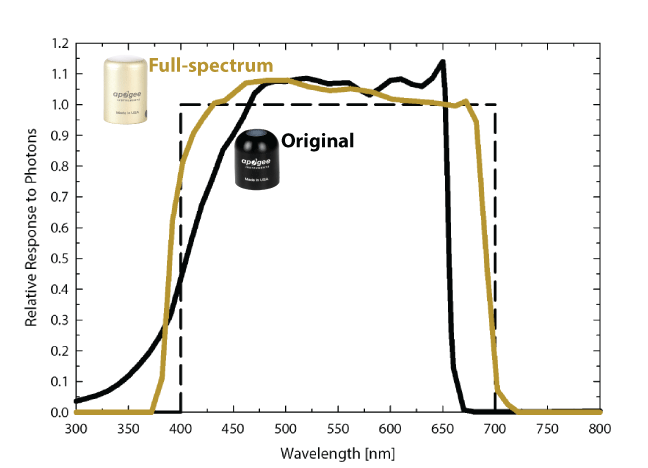
There's a good chance you have the "original" Apogee sensor from this curve:
quantum-spectral-response.gif


Even the new one isn't great at detecting UV, but it's much better on blue.

Apogee has conversion/correction factors you can use for this sensor,...trying to find that link...
 

Centerline

Valuable Member
View Badges
Joined
Sep 22, 2016
Messages
1,474
Reaction score
1,565
Location
St. Augustine, Florida
Rating - 0%
0   0   0
If you ever find you have a metal halide rig sitting around try this - score a 10-12 k bulb and raise or lower the light so that you have the same basic par as you are seeing now. What you will find is that pretty much every coral you put under it will grow much faster than 20k LED, MH, T5- whatever. I used to run 3 XMs over a 180 - absolutely amazing growth (coloration? well that's why I switched to Radiums :).
 

mcarroll

10K Club member
View Badges
Joined
Jan 8, 2012
Messages
15,213
Reaction score
8,968
Location
Virginia
Rating - 0%
0   0   0
I swear I'm not just being contrary, but in halide vs halide tests lower K lights always grew faster than higher K lights.

Here's the thing....nobody should be doubting the tanks that grow kick-elbow corals all day long. There are unmerous examples under T5, halide, LED and every permutation.

Folks that have trouble growing corals under one of them don't indicate a problem with the light source. :)
 

Centerline

Valuable Member
View Badges
Joined
Sep 22, 2016
Messages
1,474
Reaction score
1,565
Location
St. Augustine, Florida
Rating - 0%
0   0   0
I swear I'm not just being contrary, but in halide vs halide tests lower K lights always grew faster than higher K lights.

Here's the thing....nobody should be doubting the tanks that grow kick-elbow corals all day long. There are unmerous examples under T5, halide, LED and every permutation.

Folks that have trouble growing corals under one of them don't indicate a problem with the light source. :)
Not contrary at all man. I have more to learn about this hobby than most people with goldfish bowls - BUT with respect to lower K T5s are you saying that its a T5 thing? I really don't understand that and my subjective experience is that a 67k T5 tossed in the mix does seem to help with growth.
 

GoVols

Cobb / Webb - 1989
View Badges
Joined
Nov 29, 2016
Messages
13,076
Reaction score
35,080
Location
In-The-Boro, TN
Rating - 0%
0   0   0
If you ever find you have a metal halide rig sitting around try this - score a 10-12 k bulb and raise or lower the light so that you have the same basic par as you are seeing now. What you will find is that pretty much every coral you put under it will grow much faster than 20k LED, MH, T5- whatever.
+1
But lol, I'll always be a 20k Radium Junkie :)
 

kevlow

Active Member
View Badges
Joined
Feb 18, 2011
Messages
394
Reaction score
586
Location
clearwater, fl.
Rating - 0%
0   0   0
I am glad I came across this thread. Some really good info here.
When I used Radions, I had almost everything at 100%. Overall power was at 100%. My problem was that my shallow tank [8"] is 4'x2'. To get coverage I had to raise the lights up to 16" above the water. I lost a lot of par and had severe shading.

I maintain that lighting is not near as important as water quality and now I am learning more about flow.

I believe reef keepers think that lighting is an easy, magical fix; and that if we can just buy a new light it will fix all of our coral's problem.
I also think that the light manufactures know that all the buzzers and bells are what keeps people upgrading and switching brands, which equals sales.
Tanks with great coral have great water. The biggest trick is to balance the amount of nutrients in your tank with the amount of light that you are hitting it with.
I want to write more but I must get off computer now, sorry.
 

kevlow

Active Member
View Badges
Joined
Feb 18, 2011
Messages
394
Reaction score
586
Location
clearwater, fl.
Rating - 0%
0   0   0
I agree with the advice above from Mcarroll and Salty. Set your lights and adapt the par and nutrient level to match. The lights are the easiest part and getting the right water for your tank to thrive will always be the hard part.
 

TOP 10 Trending Threads

WHAT AMOUNT OF LIVE ROCK AND SAND SHOULD BE PRIORITIZED FOR OPTIMAL BIODIVERSITY/FILTRATION?

  • 100% live rock + bagged sand

    Votes: 34 28.1%
  • 100% dry rock + 100% live sand

    Votes: 41 33.9%
  • 50/50 live/dry rock, 50/50 live/bagged sand

    Votes: 27 22.3%
  • 75% live rock, 25% live sand

    Votes: 11 9.1%
  • 25% live rock, 75% live sand

    Votes: 8 6.6%
Back
Top