



- Joined
- Sep 21, 2018
- Messages
- 10,199
- Reaction score
- 10,137
Summary
With the results from Aquabiomics’ tankDNA test, a DNA survey of eukaryote organisms, the identified organisms in the aquarium and attached “algae pond” (refugium) were compared. Visual inspection of DNA abundances for more than 100 organisms indicated a high level of similarity, a conclusion supported by a near zero Bray-Curtis Dissimilarity. Differences in low abundance DNA organisms (<0.1-0.5% DNA abundance) were likely caused by the different number of DNA reads in each test. Surveying the largest twenty DNA abundance differences (low method variation present) in each sample revealed that half of these organisms could be grouped in just three taxa representing diatoms, dinoflagellates and ciliates. The population shifts in these taxa between the aquarium and algae mat covered algae pond surfaces were consistent with those observed in experimental aquaria that developed heavy mats of mixed algae.
Exploring Aquarium Eukaryotes With Aquabiomics tankDNA
What lives in our aquarium besides the stocked animals is generally not known with certainty, and usually, this doesn’t matter. There are times when knowing might be useful, such as investigating coral and fish health issues or keeping tabs on diatom and dinoflagellate populations. Aquabiomics offers the test tankDNA that identifies the DNA in aquarium water for the detection of parasites that cause fish and coral disease and the identification of diatoms and dinoflagellates. The test also identifies DNA from the entire aquarium community. I thought this last capability offered a nice alternative to surveying aquarium organisms with a microscope. Also, it would be interesting to determine if the organisms that lurked in my aquarium were the same ones in the attached algae pond (‘refugium”). Earlier this summer I sent DNA samples from my Aquarium and Algae Pond to Aquabiomics.
How tankDNA Works
Aquabiomics tankDNA provides all the equipment required to sample the aquarium water. The procedure involves passing 60 mL of aquarium water through a special filter that captures DNA bearing material. After a preservative is passed through the filter, it is bagged and mailed back to Aquabiomics where the DNA is extracted from the sample. After having the DNA fragments amplified and sequenced, the DNA sequences identified. Results are typically made available in your online account in 2-4 weeks.
What tankDNA Is Detecting
The DNA being detected in tankDNA is referred to as environmental DNA. This DNA can be inside a living or dead cell, or outside the cell attached to organic or inorganic matter. The amount of DNA an organism sheds varies and does not necessarily correlate with biomass. Shed DNA can also be eaten, decomposed, and adsorbed to surfaces, further confusing the relation between measured DNA abundance and organism population size. Another confounding factor is that not all DNA fragments are amplified equally well. With all this potential for variation, the results from a single test may only be good enough to identify the presence of an organism but not provide a quantitative description of the population. Comparing DNA abundances of two samples increases the odds of discovering population trends. How method variation affects DNA detection and organism identification can be observed by comparing data from replicate measurements. The Aquarium DNA sample was tested twice, one test had lower number of DNA reads, and the other had a higher number (Eli Meyer owner of Aquabiomics generously volunteered to rerun the sample at a higher read to support this study).
Observing Method Variation
The two Aquarium test results are plotted together to obtain a visual feel for the differences. The DNA abundance for each organism identified in the high read test was sorted in ascending order before plotting the data (“+” in the plot). The organisms identified in the low read test were also plotted (filled circles). Those in common with the high read test are plotted on top of the high read data, and those not detected in the high read test are plotted after organism 193 in descending order of DNA abundance. A second rescaled plot shows the trend for the very low DNA abundance organisms.


There are three regions of note in the plot: the long tail of low abundance organisms in the high read test with few organisms in common with the low read test (1-163), a larger number of organisms in common in the region of 164-193, and low read organisms not detected in the high read test (194-205). The long tail of low abundance organisms illustrates the strong dependence of detection of low abundance DNA organism on the number of DNA sequences read. Also, as the DNA abundance increases, the detection of organisms becomes much less dependent on the number of reads and the number of organisms in common between low and high read test increases (second region, 164-193). The third region, consisting of organisms detected in the low read test but not in the higher read, higher sensitivity test seems like it should not exist. While eight of the twelve of these undetected organisms represent the lowest DNA abundance in the low read test and might be dismissed as noise, the other four organism DNA abundances range from 0.12 to 0.52%, and cannot be so easily dismissed. Are these examples of false positives? The bar chart summarizes how the fraction of organisms common to both tests increases with increasing DNA abundance.

To put low abundance DNA identification in perspective, suppose 10,000 DNA fragments are read and an organism is identified with a DNA abundance of 0.01%. That corresponds to the organism being declared present with the detection of only one DNA fragment. Even with a 99% accuracy per nucleotide, multiple reads might be necessary to be confident about the identification. Taken together, these observations suggest care in using low abundance DNA for comparisons. Discarding abundances less than 0.1-0.5% might be appropriate for studies without replicated measurements.
Results. Are The Aquarium And Algae Pond Samples Identical?
The plotted Aquarium (“+”) and Algae Pond (filled circle) DNA abundances are, unsurprisingly, very similar and exhibit the same three regions of interest seen in the replicate Aquarium tests.


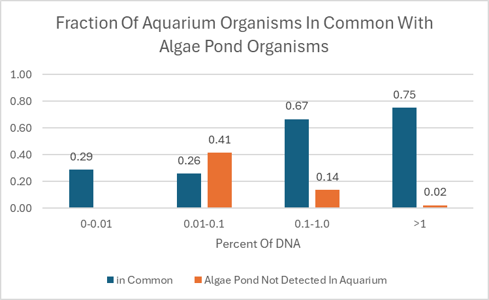
The bar chart shows that the fraction of Algae Pond organisms in common with Aquarium organisms (blue bars) rises with increasing DNA abundance but not as sharply as in the low and high read Aquarium samples. This larger number of organisms in common at lower DNA abundance likely reflects similar, high DNA reads.
The Bray-Curtis Dissimilarity, a metric used in ecology to compare two populations, ranges from 0 (populations are the same) to 1 (populations are completely different) was 0.16 for the Aquarium and Algae Pond populations. As a baseline, the Bray-Curtis Dissimilarity for the low and high read Aquarium results was 0.10. Relative to this baseline, this metric indicates that samples are nearly identical. Additional comparisons are presented in the tables.
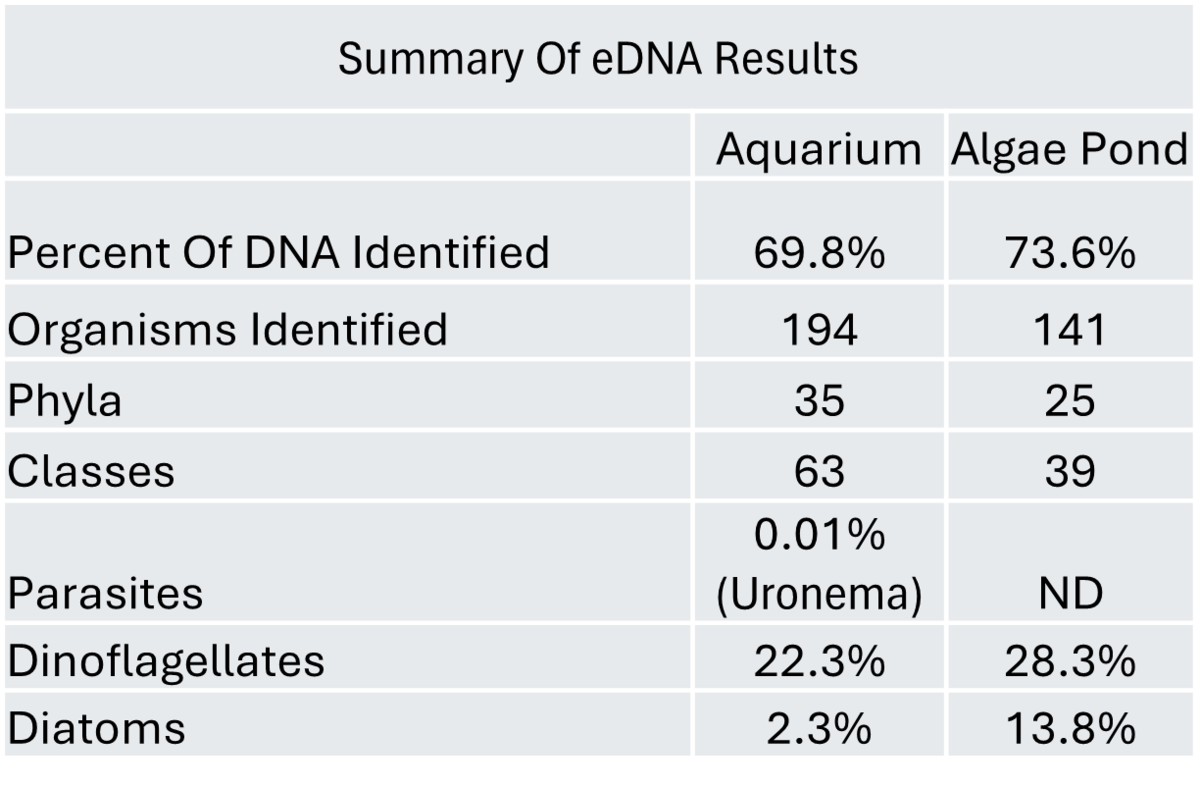
Percent of DNA is the fraction of the total DNA sequenced that was identified, being about the same for both samples. The number of identified organisms in the Aquarium test is substantially larger, likely due to differences in read numbers and not differences caused by biology. Similarly, the number of phyla and classes identified are larger in the Aquarium test. Only the higher sensitivity Aquarium test (higher reads) detected a low abundance fish parasite Uronema marinum. A surprisingly high level of dinoflagellate DNA was detected in both samples. A high abundance of diatom DNA was detected only in the Algae Pond sample, the first strong indication of a real difference. The next table compares the DNA abundances of stocked organisms.

Fish and soft coral DNA as expected was found in both samples. The lower amount of coral DNA in the Algae Pond sample is consistent with the coral residing in the aquarium. Appearance of similar amounts of fish DNA in both tests is suggestive of the water from both compartments being well mixed. Why hard coral Scleractinia DNA was found in my system is unknown. Snail DNA looks like it might be the same in both samples, even though like fish and soft coral, snails only resides in the aquarium. One anomaly in this group of results is the high level of Ulva rigida in the aquarium. Since the algae is present only in the algae pond, this identification might be incorrect? The next comparison involves the DNA abundance of all organisms.
The search for dissimilarity starts with the subtraction of each Algae Pond organism DNA abundance from that found in the Aquarium sample. The organisms were then sorted by this difference, from highest (greater percent of DNA for the organism in the Aquarium sample) to lowest (greater percent of DNA in the Algae Pond sample). The U-shaped plot of the absolute value of DNA abundance differences exhibits two maxima, the left most representing higher organism DNA abundance in the Aquarium sample, the right most maxima representing higher DNA abundance in the Algae Pond.
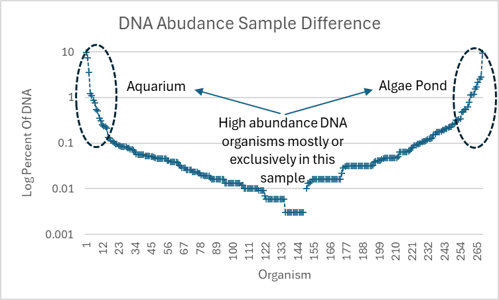
The circled organisms, the top twenty differences, were then sorted by a higher taxon, class or subphylum. Half of the forty organisms fell within just three taxa.
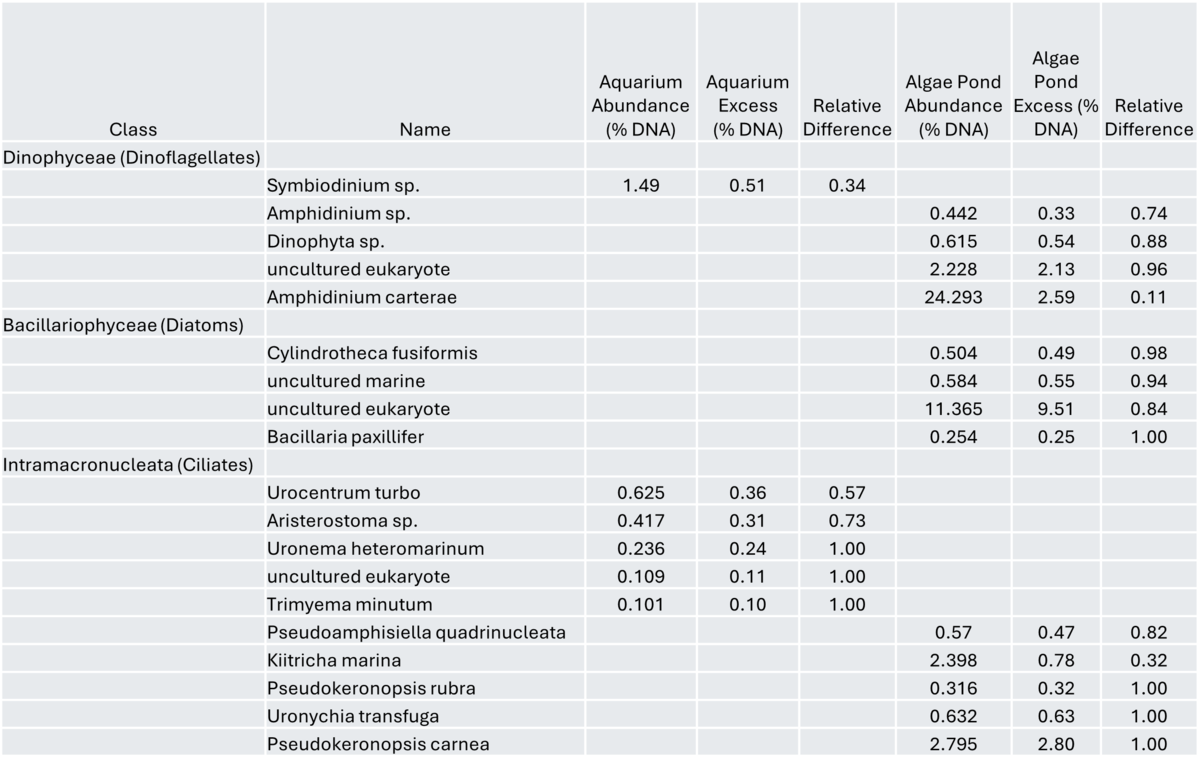
Two taxa Dinophyceae (dinoflagellates) and Bacillariophyceae (diatoms) show a larger or exclusive abundance (relative difference of 1) of several organisms each in the Algae Pond sample. This population trend might not be unusual. In experimental aquaria with strong lighting and mixed macro algae growth, diatom and dinoflagellate populations can become large when the algae form dense mats. Mat formation on the surfaces of the Algae Pond is a common occurrence that requires periodic removal. This difference data also raises several questions. Why is dinoflagellate but not diatom DNA abundance high in both samples? If the Algae Pond was the source of both and water mixing was sufficient (it is for fish DNA), wouldn’t both DNA abundances be high in the Aquarium? If dinoflagellate growth is high in both Aquarium and Algae Pond, why isn’t it visible in the Aquarium? How is the high diatom DNA not findings its way into the Aquarium like fish DNA is entering the algae pond.
The third taxa Intramacronucleata, the ciliates, exist as two different populations, one in the Aquarium and one, possibly larger, in the Algae Pond. A greater abundance of bacteria and organic particulates associated with the thick algae mat in the Algae Pond could explain the population difference.
These taxon-wide differences seem to be the clearest indication of how the two aquarium compartments differ. Moreover, observing taxon-wide changes is likely stronger support for there being a difference then single organism changes which can be subject to method variation.
Conclusion
Visual inspection of DNA abundances in water samples from the aquarium and attached algae pond indicated similar populations of organisms, a conclusion supported by a near zero Bray-Curtis Dissimilarity. Differences in low abundance DNA organisms (<0.1-0.5%) for these samples were likely caused by a different number of DNA reads. Surveying the largest twenty DNA abundance differences in each sample revealed that half the organisms could be grouped within just three taxa representing diatoms, dinoflagellates and ciliates. The population trends were consistent with those observed in experimental aquaria growing dense mats of mixed algae.
With the results from Aquabiomics’ tankDNA test, a DNA survey of eukaryote organisms, the identified organisms in the aquarium and attached “algae pond” (refugium) were compared. Visual inspection of DNA abundances for more than 100 organisms indicated a high level of similarity, a conclusion supported by a near zero Bray-Curtis Dissimilarity. Differences in low abundance DNA organisms (<0.1-0.5% DNA abundance) were likely caused by the different number of DNA reads in each test. Surveying the largest twenty DNA abundance differences (low method variation present) in each sample revealed that half of these organisms could be grouped in just three taxa representing diatoms, dinoflagellates and ciliates. The population shifts in these taxa between the aquarium and algae mat covered algae pond surfaces were consistent with those observed in experimental aquaria that developed heavy mats of mixed algae.
Exploring Aquarium Eukaryotes With Aquabiomics tankDNA
What lives in our aquarium besides the stocked animals is generally not known with certainty, and usually, this doesn’t matter. There are times when knowing might be useful, such as investigating coral and fish health issues or keeping tabs on diatom and dinoflagellate populations. Aquabiomics offers the test tankDNA that identifies the DNA in aquarium water for the detection of parasites that cause fish and coral disease and the identification of diatoms and dinoflagellates. The test also identifies DNA from the entire aquarium community. I thought this last capability offered a nice alternative to surveying aquarium organisms with a microscope. Also, it would be interesting to determine if the organisms that lurked in my aquarium were the same ones in the attached algae pond (‘refugium”). Earlier this summer I sent DNA samples from my Aquarium and Algae Pond to Aquabiomics.
How tankDNA Works
Aquabiomics tankDNA provides all the equipment required to sample the aquarium water. The procedure involves passing 60 mL of aquarium water through a special filter that captures DNA bearing material. After a preservative is passed through the filter, it is bagged and mailed back to Aquabiomics where the DNA is extracted from the sample. After having the DNA fragments amplified and sequenced, the DNA sequences identified. Results are typically made available in your online account in 2-4 weeks.
What tankDNA Is Detecting
The DNA being detected in tankDNA is referred to as environmental DNA. This DNA can be inside a living or dead cell, or outside the cell attached to organic or inorganic matter. The amount of DNA an organism sheds varies and does not necessarily correlate with biomass. Shed DNA can also be eaten, decomposed, and adsorbed to surfaces, further confusing the relation between measured DNA abundance and organism population size. Another confounding factor is that not all DNA fragments are amplified equally well. With all this potential for variation, the results from a single test may only be good enough to identify the presence of an organism but not provide a quantitative description of the population. Comparing DNA abundances of two samples increases the odds of discovering population trends. How method variation affects DNA detection and organism identification can be observed by comparing data from replicate measurements. The Aquarium DNA sample was tested twice, one test had lower number of DNA reads, and the other had a higher number (Eli Meyer owner of Aquabiomics generously volunteered to rerun the sample at a higher read to support this study).
Observing Method Variation
The two Aquarium test results are plotted together to obtain a visual feel for the differences. The DNA abundance for each organism identified in the high read test was sorted in ascending order before plotting the data (“+” in the plot). The organisms identified in the low read test were also plotted (filled circles). Those in common with the high read test are plotted on top of the high read data, and those not detected in the high read test are plotted after organism 193 in descending order of DNA abundance. A second rescaled plot shows the trend for the very low DNA abundance organisms.
There are three regions of note in the plot: the long tail of low abundance organisms in the high read test with few organisms in common with the low read test (1-163), a larger number of organisms in common in the region of 164-193, and low read organisms not detected in the high read test (194-205). The long tail of low abundance organisms illustrates the strong dependence of detection of low abundance DNA organism on the number of DNA sequences read. Also, as the DNA abundance increases, the detection of organisms becomes much less dependent on the number of reads and the number of organisms in common between low and high read test increases (second region, 164-193). The third region, consisting of organisms detected in the low read test but not in the higher read, higher sensitivity test seems like it should not exist. While eight of the twelve of these undetected organisms represent the lowest DNA abundance in the low read test and might be dismissed as noise, the other four organism DNA abundances range from 0.12 to 0.52%, and cannot be so easily dismissed. Are these examples of false positives? The bar chart summarizes how the fraction of organisms common to both tests increases with increasing DNA abundance.
To put low abundance DNA identification in perspective, suppose 10,000 DNA fragments are read and an organism is identified with a DNA abundance of 0.01%. That corresponds to the organism being declared present with the detection of only one DNA fragment. Even with a 99% accuracy per nucleotide, multiple reads might be necessary to be confident about the identification. Taken together, these observations suggest care in using low abundance DNA for comparisons. Discarding abundances less than 0.1-0.5% might be appropriate for studies without replicated measurements.
Results. Are The Aquarium And Algae Pond Samples Identical?
The plotted Aquarium (“+”) and Algae Pond (filled circle) DNA abundances are, unsurprisingly, very similar and exhibit the same three regions of interest seen in the replicate Aquarium tests.
The bar chart shows that the fraction of Algae Pond organisms in common with Aquarium organisms (blue bars) rises with increasing DNA abundance but not as sharply as in the low and high read Aquarium samples. This larger number of organisms in common at lower DNA abundance likely reflects similar, high DNA reads.
The Bray-Curtis Dissimilarity, a metric used in ecology to compare two populations, ranges from 0 (populations are the same) to 1 (populations are completely different) was 0.16 for the Aquarium and Algae Pond populations. As a baseline, the Bray-Curtis Dissimilarity for the low and high read Aquarium results was 0.10. Relative to this baseline, this metric indicates that samples are nearly identical. Additional comparisons are presented in the tables.
Percent of DNA is the fraction of the total DNA sequenced that was identified, being about the same for both samples. The number of identified organisms in the Aquarium test is substantially larger, likely due to differences in read numbers and not differences caused by biology. Similarly, the number of phyla and classes identified are larger in the Aquarium test. Only the higher sensitivity Aquarium test (higher reads) detected a low abundance fish parasite Uronema marinum. A surprisingly high level of dinoflagellate DNA was detected in both samples. A high abundance of diatom DNA was detected only in the Algae Pond sample, the first strong indication of a real difference. The next table compares the DNA abundances of stocked organisms.
Fish and soft coral DNA as expected was found in both samples. The lower amount of coral DNA in the Algae Pond sample is consistent with the coral residing in the aquarium. Appearance of similar amounts of fish DNA in both tests is suggestive of the water from both compartments being well mixed. Why hard coral Scleractinia DNA was found in my system is unknown. Snail DNA looks like it might be the same in both samples, even though like fish and soft coral, snails only resides in the aquarium. One anomaly in this group of results is the high level of Ulva rigida in the aquarium. Since the algae is present only in the algae pond, this identification might be incorrect? The next comparison involves the DNA abundance of all organisms.
The search for dissimilarity starts with the subtraction of each Algae Pond organism DNA abundance from that found in the Aquarium sample. The organisms were then sorted by this difference, from highest (greater percent of DNA for the organism in the Aquarium sample) to lowest (greater percent of DNA in the Algae Pond sample). The U-shaped plot of the absolute value of DNA abundance differences exhibits two maxima, the left most representing higher organism DNA abundance in the Aquarium sample, the right most maxima representing higher DNA abundance in the Algae Pond.
The circled organisms, the top twenty differences, were then sorted by a higher taxon, class or subphylum. Half of the forty organisms fell within just three taxa.
Two taxa Dinophyceae (dinoflagellates) and Bacillariophyceae (diatoms) show a larger or exclusive abundance (relative difference of 1) of several organisms each in the Algae Pond sample. This population trend might not be unusual. In experimental aquaria with strong lighting and mixed macro algae growth, diatom and dinoflagellate populations can become large when the algae form dense mats. Mat formation on the surfaces of the Algae Pond is a common occurrence that requires periodic removal. This difference data also raises several questions. Why is dinoflagellate but not diatom DNA abundance high in both samples? If the Algae Pond was the source of both and water mixing was sufficient (it is for fish DNA), wouldn’t both DNA abundances be high in the Aquarium? If dinoflagellate growth is high in both Aquarium and Algae Pond, why isn’t it visible in the Aquarium? How is the high diatom DNA not findings its way into the Aquarium like fish DNA is entering the algae pond.
The third taxa Intramacronucleata, the ciliates, exist as two different populations, one in the Aquarium and one, possibly larger, in the Algae Pond. A greater abundance of bacteria and organic particulates associated with the thick algae mat in the Algae Pond could explain the population difference.
These taxon-wide differences seem to be the clearest indication of how the two aquarium compartments differ. Moreover, observing taxon-wide changes is likely stronger support for there being a difference then single organism changes which can be subject to method variation.
Conclusion
Visual inspection of DNA abundances in water samples from the aquarium and attached algae pond indicated similar populations of organisms, a conclusion supported by a near zero Bray-Curtis Dissimilarity. Differences in low abundance DNA organisms (<0.1-0.5%) for these samples were likely caused by a different number of DNA reads. Surveying the largest twenty DNA abundance differences in each sample revealed that half the organisms could be grouped within just three taxa representing diatoms, dinoflagellates and ciliates. The population trends were consistent with those observed in experimental aquaria growing dense mats of mixed algae.















