


General Fish Information
- Scientific Fish Name
- Centropyge loricula
- Care Level
- Moderate - The species in this category demand a bit more attention than those that are considered "Easy" to care for. Some of these species may have special feeding, lighting, or water movement requirements and may require water conditions closer to those found in nature.
- Temperament
- Semi Aggressive - Species within this category are normally active fishes, and may occasionally chase or show aggression towards one another or similar shaped tankmates. When placing Semi-Aggressive species in your aquarium, be sure to introduce them after the smaller, more passive fishes have been established.
- Diet
- Omnivore - Species consumes both algae and meaty foods.
- Reef Safe
- With Caution - This species of fish may be prone to consuming or harassing corals or invertebrates such as shrimp, anemones or feather dusters, but are otherwise wonderful reef fish cohabitating well with soft and stony corals.
- Maximum Size
- 4"
- Family
- Pomacanthidae
- Minimum Tank Size
- 70 Gallons
- Compatibility
- View Chart
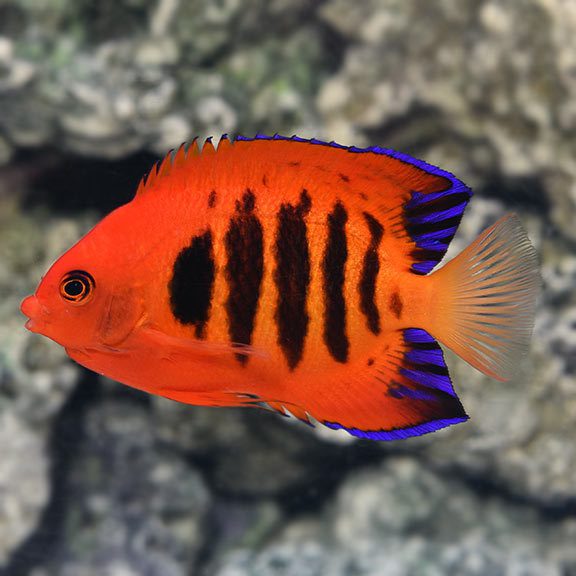
The Flame Angelfish is one of the most eye-catching and sought-after dwarf angelfish in the hobby. Its vibrant red-orange body is accented by bold vertical black bars, while the dorsal and anal fins feature blue edging with horizontal black striping—giving this fish its unmistakable “flame” appearance.
A minimum of a 70-gallon aquarium is recommended, with plenty of rockwork for grazing and hiding. Although stunning, the Flame Angelfish is known to nip at stony corals, soft corals, sessile invertebrates, and clam mantles. If added to a peaceful community, it should be introduced last. This species adapts well to aquarium life but does best in an established system and when housed with fish from dissimilar genera. Flame Angels are also highly sensitive to elevated copper levels and should never be exposed to concentrations near or above 0.15 ppm.
Flame Angelfish are hermaphroditic and extremely challenging to breed in captivity, with no visible color differences between males and females.
Their diet should include Spirulina, marine algae, high-quality angelfish-specific preparations, mysis shrimp, frozen shrimp, and other quality meaty foods.
Coloration and pattern vary depending on their collection location:
A minimum of a 70-gallon aquarium is recommended, with plenty of rockwork for grazing and hiding. Although stunning, the Flame Angelfish is known to nip at stony corals, soft corals, sessile invertebrates, and clam mantles. If added to a peaceful community, it should be introduced last. This species adapts well to aquarium life but does best in an established system and when housed with fish from dissimilar genera. Flame Angels are also highly sensitive to elevated copper levels and should never be exposed to concentrations near or above 0.15 ppm.
Flame Angelfish are hermaphroditic and extremely challenging to breed in captivity, with no visible color differences between males and females.
Their diet should include Spirulina, marine algae, high-quality angelfish-specific preparations, mysis shrimp, frozen shrimp, and other quality meaty foods.
Coloration and pattern vary depending on their collection location:
- Marshall Islands specimens are typically deeper red with thicker vertical black bars.
- Christmas Island fish are red to red-orange with thinner vertical bars.
- Cebu fish are red-orange with softer, less-defined bars and sometimes show a yellowish tint between them.
- Tahiti Flame Angels are rarely collected; they display a striking blood-red coloration with little to no yellow.
- Fish Video
















