Hair Algae, a Symptom Rather Than the Problem?

I purchased three sea hares to try and abolish my hair algae. Not all at the same time. I kept trying out of frustration. They all three died and never touched the hair algae IMO, so your mileage may vary.

Time (just under 9 months) and management of nutrients (phosphate) is the only thing that worked for me. I was surprised when I got overwhelmed by hair algae as tank was going on two years old before I experienced the ugly phase. I thought I had it made.

 
I purchased three sea hares to try and abolish my hair algae. Not all at the same time. I kept trying out of frustration. They all three died and never touched the hair algae IMO, so your mileage may vary.

Time (just under 9 months) and management of nutrients (phosphate) is the only thing that worked for me. I was surprised when I got overwhelmed by hair algae as tank was going on two years old before I experienced the ugly phase. I thought I had it made.

Thanks. I have 2 coming next week. We will see what happens., :)
 
A recent post by @Hans-Werner in Randy’s Tank and Learn thread inspired this thread.

Could hair algae or cyano be showing up because something else in the tank is dying or breaking down, rather than being the cause of the problem in the first place?
I believe that it can be both a symptom and a cause. We may see it localized when something dies or new rock or substrate added to the system. We also may see it become prolific and outcompete other organisms, taking their place. I think that Han's post has merit.

I am in the midst of a severe hair algae issue. It's depressing and gives me a new found empathy for those struggling with it.

I am not sure how I beat the last bout years ago. The only thing that I did was add a pile of turbo and astrea snails and an urchin with a lot of manual removal. It took a month or two to fully eradicate, but you could actually see the areas that the snails and urchins were working on, like mowed strips of lawn. I am not sure if they, the manual removal or time or a combination of all is what tipped the scale.

I am curious to see how your sea hares work out.

The lettuce sea slugs also sound promising if the sea hares don't do the trick.
 
Last edited:
Algae, cyanos and dinos often grow only in specific spots in a tank. For example, I never get algae on rocks or substrate, even though my snails prefer the glass, while a 3D-printed stand for a Homophyllia grows Ulva(ria) all the time. The frag plug that is sitting on it, however, stays clean.
My powerheads grow Ulva(ria) too, and if I clean them with bleach or HCl, they get covered in diatoms until the sea lettuce comes back. I can only assume the harsh flow doesn't allow the right biofilm to establish, so I would have to get them covered in coralline before they stay free of other algae.

@Dan_P pointed me to this "periphyton theory", and so far it's the only explanation I've found for why algae skips certain spots that get exactly the same light and flow. The organisms living mostly unnoticed on our rocks, like coralline algae, diatoms, and biofilms, must have evolved ways to keep themselves free of algae. Otherwise they would eventually starve or get shielded from light and flow.

It also more or less explains the ugly phase and why sometimes "resetting" the periphyton with something like the UV sweeper or by bleaching rocks can help. The only thing I have not figured out yet is how to get the "good periphyton" to grow everywhere 😁

Obviously, this is all just theory, but it can be backed to some extend by the scientific literature.

Do you have access to any scientific literature demonstrating that established periphyton can actively prevent nuisance algae from colonising surfaces? I’d be very interested in reading it, particularly how they distinguish that effect from competition, grazing or just normal ecological succession. 🤔
 
Do you have access to any scientific literature demonstrating that established periphyton can actively prevent nuisance algae from colonising surfaces?
You obviously won't find a paper saying "periphyton in general" does this. Generalizing over that many organisms would be ridiculous. But chemical warfare (allelopathy) between algae species is well documented, and there are also bacteria that inhibit dinoflagellate growth. An interaction between these organisms is relatively obvious, but nobody (to my knowledge) has measured how it impacts our reef tanks yet, so I call it theory for now.

[...], particularly how they distinguish that effect from [...] normal ecological succession. 🤔
Ecological succession isn't an alternative explanation that has to be ruled out. It's just the description of what is happening, but not why it is happening.

That why has been studied for decades. The classic paper from 1977 is literally called "Mechanisms of succession in natural communities" written by Connell & Slatyer and they proposed three models: facilitation, tolerance and inhibition. In the inhibition model, early occupants keep later colonists out until something removes them.

That is literally what I described: established periphyton keeping algae off a surface, until something like bleach or a UV sweeper resets it. This is the inhibition model. So asking me to distinguish it from "normal ecological succession" is like asking whether a wound closed because of clotting or because of "normal healing". 😅

[...], particularly how they distinguish that effect from competition, grazing [...]
The obvious way is grazer-free axenic cultures. Additionally, allelopathy can leave target cells present but impaired, while grazing removes them, so you have a lower cell count and will find cells in food vacuoles of protist grazers. There are also some general indicators for allelopathy found by Allen et al. & Leflaive et al. (2008) which helps to distinguish its effect from grazing.
 
You obviously won't find a paper saying "periphyton in general" does this. Generalizing over that many organisms would be ridiculous. But chemical warfare (allelopathy) between algae species is well documented, and there are also bacteria that inhibit dinoflagellate growth. An interaction between these organisms is relatively obvious, but nobody (to my knowledge) has measured how it impacts our reef tanks yet, so I call it theory for now.


Ecological succession isn't an alternative explanation that has to be ruled out. It's just the description of what is happening, but not why it is happening.

That why has been studied for decades. The classic paper from 1977 is literally called "Mechanisms of succession in natural communities" written by Connell & Slatyer and they proposed three models: facilitation, tolerance and inhibition. In the inhibition model, early occupants keep later colonists out until something removes them.

That is literally what I described: established periphyton keeping algae off a surface, until something like bleach or a UV sweeper resets it. This is the inhibition model. So asking me to distinguish it from "normal ecological succession" is like asking whether a wound closed because of clotting or because of "normal healing". 😅


The obvious way is grazer-free axenic cultures. Additionally, allelopathy can leave target cells present but impaired, while grazing removes them, so you have a lower cell count and will find cells in food vacuoles of protist grazers. There are also some general indicators for allelopathy found by Allen et al. & Leflaive et al. (2008) which helps to distinguish its effect from grazing.

Sooo, no evidence for your claim. Got it. 😅
 
Sooo, no evidence for your claim. Got it. 😅
Theory, not claim. I specifically pointed this out (see the last sentence you quoted in your initial question). I also gave you 3 articles for a start. If you look for "Allelopathy" you will find many more just for algae alone. That part isn't a theory, it's a well established fact. How far it applies to periphyton in our tanks is the theory.

One of the mentioned articles is part of the fundamental works behind the "ecological succession" you like to talk about, so I'm not sure you actually "got it". We have been here before... I can try to explain things to you, but I can't understand them for you. I don't want this to end up in another thread being locked up, so let's leave it at that.
 
I don't want this to end up in another thread being locked up, so let's leave it at that.

Is that a warning or just another hypothesis?
 
Sooo, no evidence for your claim. Got it. 😅

Is that a warning or just another hypothesis?
He called it a theory in his first post and again in his second. You asked for literature and got it. Including a paper that defines the mechanisms of the ecological succession you brought up. Direct answers with sources.

Your reply didn’t address any of it. The question was a predictable setup and the answer never mattered. Demanding support from others and mocking them while routinely failing to support your own countless claims on this forum would be ironic if it weren’t a consistent pattern.

“Let’s leave it at that” isn’t a warning. It’s someone ending a conversation with a poster who has a long public record of making unsupported claims and burning threads to the ground with serial deflections and the same nonsense on display here when asked to support them.
 
Last edited:
I've been fighting the same thing and it's driving me crazy.
I just added a bunch of mexican turbos to see if they would do anything.
I suppose like any addition for the purpose, the results may he hit or miss. I have had great luck with them over the years. Other people have not.
 
I do not believe that high nutrients causes undesirable algae outbreaks like is commonly discussed. In my fowlr the nutrients are literally off the scale of Hanna checkers but I have no GHA. I don't have any CUC either for that matter.

Earlier in the tank's life it did go through a bout of GHA, and through aggressive daily manual removal with a toothbrush in a bucket of tank water I finally got it under control. What was left of it was finished off with 2 doses of Reef Flux over a month or so and the GHA has never returned. The pukani rocks have now been colonized with various forms of turf algae that is actually very difficult to dislodge and siphon out and I'm ok with that, just about anything is better than GHA lol.

I have 5 or 6 giant zebra turbos in my sps tank, I've been meaning to try putting one of them into the fowlr to see if it would clean the rocks.

The latest dry pukani that is back on the market even comes with a disclaimer that it is full of phosphate. That is the reason I think GHA will grow on some rocks and not others, it's pulling nutrients right out of the substrate it's growing on. It sounds good but I just don't know.
 
He called it a theory in his first post and again in his second. You asked for literature and got it. Including a paper that defines the mechanisms of the ecological succession you brought up. Direct answers with sources.

Your reply didn’t address any of it. The question was a predictable setup and the answer never mattered. Demanding support from others and mocking them while routinely failing to support your own countless claims on this forum would be ironic if it weren’t a consistent pattern.

“Let’s leave it at that” isn’t a warning. It’s someone ending a conversation with a poster who has a long public record of making unsupported claims and burning threads to the ground with serial deflections and the same nonsense on display here when asked to support them.

Thanks for your unsolicited contribution, quite a lecture on unsupported claims from someone making a few of his own.
 
Last edited:
I am in the midst of a severe hair algae issue. It's depressing and gives me a new found empathy for those struggling with it.
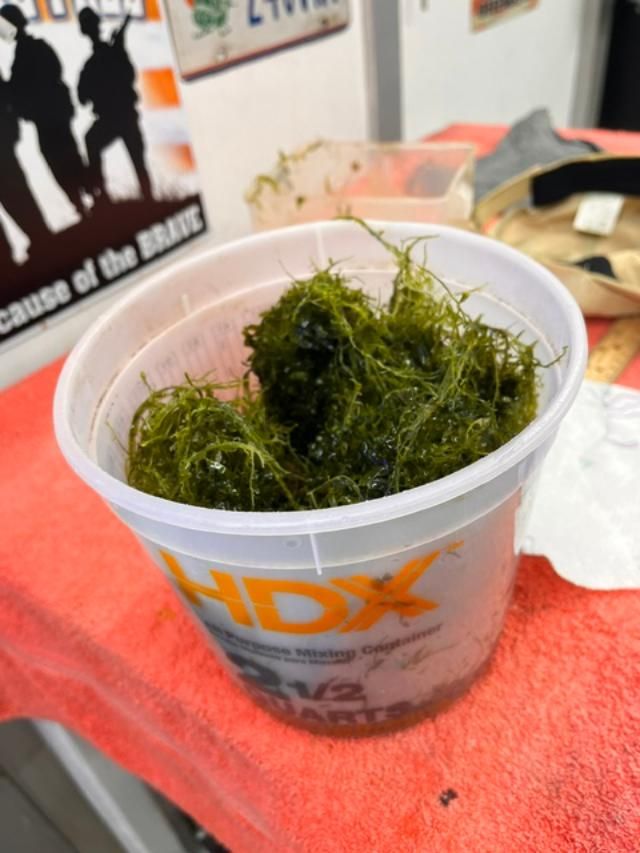
I am in the midst of a severe plague of this stuff which may be a type of caulerpa, I don't know but it covered my tank and may cause me to get out of the hobby due to my time being spent on other, more important things.

This is a pound of it which I remove every two weeks. (thats a 2 1/2 quart container)


It started like this and may have come from the local waters here, but I am guessing


Hair algae I can deal with because I feel it comes in cycles and doesn't matter what you do, how much light you have, what nutrients you have, or what kind of music you listen to (but Rap music will kill it) 😎

Those cycles can last a few months to over a year but they always clear up on their own. Most people don't keep a tank running long enough to experience this. Just my opinion of course. 😀

This severe outbreak happened a few times in my tank and without me doing anything, it left and the tank was pristine.

 
Thanks for your unsolicited contribution, quite a lecture on unsupported claims from someone making a few of his own.
That’s a pure fabricated projection. A deflection contrary to the searchable public record. You used nearly the same line on me two weeks ago in a different thread where you also attempted to deflect from getting caught in another drive-by troll. Smug deflection, never accountability.

IMG_0071.jpeg


As for “unsolicited,” your contribution to this public thread was to set bait, ignore the answer and post a mocking reply, which was also baiting further response. That’s the very definition of soliciting a response. You were playing to the room, and I’m part of the room.

This is what you do, thread after thread. deflect, reframe, ignore answers, bait and mock whoever responds, and keep doing it until people either exhaust and let your nonsense stand or staff has to step in and lock the thread.

Go ahead, keep being unaccountable for your words and deflecting, all over a pretextual troll aimed at EnterName. It’s Rev’s thread you’re doing it in this time. Or shall we go back to Randy’s thread where you smugly co-opted my apology to Randy as an apology to you instead of being accountable there too? Anywhere you’re engaged it’s the same deflective nonsense.
 
Last edited:
I am in the midst of a severe plague of this stuff which may be a type of caulerpa, I don't know but it covered my tank and may cause me to get out of the hobby due to my time being spent on other, more important things.
Are you going to try any chemical treatments?
 
Bean I have used flucolazole for 2 weeks in a test vat with corals and algae covered rocks. and it didn't do anything. The manufacturer told me to try a second dose for 2 more weeks which I am doing and am only in the 3rd day of that.
 
Thanks. I have 2 coming next week. We will see what happens., :)
OMG a couple of months ago I added a tiny sea hare about 3/4" long. I couldn't find it and figured it croaked. I found it and I know why I couldn't find it before. I thought it was a large rock. The thing is about 9" long and 6" wide. It looks like a Manatee.

It's the big blob in the center of the picture below that plastic float. That container is about 8" deep.

I guess he does eat this stuff.
Sea Hare.jpeg
 
Doing some digging it may be a type of cladophoropsis. If it is, it has deep roots and I’m also reading that the uptake pathway is different and fluconazole may not touch it.

What about peroxide dip? That may do it.
 

WHEN YOU SEE A REEF2REEF POLL, WHAT’S YOUR USUAL MOVE?

  • Vote right away, then head to the comments

    Votes: 15 42.9%
  • Read the comments first...then decide what I think

    Votes: 2 5.7%
  • Vote and explain my choice in the comments

    Votes: 3 8.6%
  • Dude, I just vote...I don't care about the comments

    Votes: 14 40.0%
  • Vote, then come back later to see how it turned out

    Votes: 3 8.6%
  • Pick “Other” because my opinion is too nuanced to fit any of your simpleton boxes

    Votes: 1 2.9%
  • I usually read the comments but exercise my right not to vote

    Votes: 0 0.0%
  • I always get excited about Daniel’s daily polls, obviously 😎

    Votes: 3 8.6%
  • Other (Post in the comments)

    Votes: 3 8.6%
Back
Top
Home
Post thread…
Market
What's new